







The Italian agricultural sector continues to grow. According to data published by Istat, in 2025 the agriculture, forestry, and fishing sector generated €80.1 billion in production value, up 3.9% from €77.1 billion in 2024. This growth was driven by a significant increase in prices (+3.6%) alongside a slight rise in volumes (+0.3%). The sector value added reached 46.6 billion euros, up from 44.2 billion the previous year. The increase stems primarily from rising prices (+5.6%), against a slight decline in volumes (-0.1%). This result fits within a national macroeconomic context of moderate growth in value added by volume (+0.4%). Production in the agricultural sector in the strict sense increased by 4.2% in value, reaching 75.2 billion euros (up from 72.2 billion euros in 2024), with growth driven almost entirely by prices (+3.8%), while volumes saw only slight growth (+0.3%).
According to Istat, in 2025, intermediate consumption in the agricultural sector increased by 0.9% in volume (with a 1% rise in the prices of goods and services used). Value added at current prices grew by 5.9%, reaching €43.1 billion (up from €40.7 billion in 2024), despite a slight decline in volume (-0.2%). Italy remains the European Union country with the highest agricultural value added.
Among the non-agricultural sectors, forestry maintained a virtually unchanged production value in 2025, with prices falling slightly (-0.2%) and volumes rising modestly (+0.1%). Fishing, on the other hand, recorded the sharpest decline in volumes (-0.6%), which, following the increase in prices (+2.5%), resulted in an overall growth in production value of 1.9%. The agri-food sector, which includes agriculture, forestry, fishing, and the food industry, generated an added value of 89 billion euros in 2025, up from 83.4 billion in 2024.
In 2025, volume growth (+0.7%) was driven by the food, beverage, and tobacco industry (+1.4%). The share of the agri-food sector value added in the national total rose to 4.4% from 4.2% in 2024. The sector composition confirmed the primary sector contribution as stable at 2.3% and strengthened the food industry share, which rose to 2.1% from 1.9% the previous year.
In 2025, employment in the agriculture, forestry, and fishing sector, measured in full-time equivalents (FTEs), decreased by 0.5%. The decline in self-employed workers (-2.2%) was not offset by the increase in employees (+2.3%). In the agri-food sector, labor input remained essentially stable (-0.1%), while employment in the food industry increased by 0.9%. Income from salaried employment in agriculture, forestry, and fishing grew by 1%, with a 0.9% increase in gross wages. Gross fixed capital formation recorded a substantial increase in value and volume, by 5.3% and 4.8%, respectively.
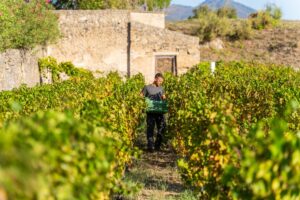
In 2025, the main agricultural sectors showed widely varying economic trends between crop and livestock production. Crop farming, which accounts for 52.7% of total production of goods and services, showed substantial resilience in production capacity: both volumes and prices rose by 0.6%, resulting in a production value of 37.5 billion euros (+1.2% compared to 2024). The production of herbaceous crops in 2025 increased by 1% in volume, but, due to a significant drop in prices (-2.9%), it decreased by 2% in value, reaching 18.7 billion euros. Among these, cereals performed very well (+4.1% in volume and +5.8% in value), while vegetables, with volumes remaining virtually stable (+0.1%), saw a sharp decline in value (-5.8%) due to falling prices (-5.9%). The wine sector is performing well; according to Istat, its production value in 2025 is projected to reach 4.6 billion euros (+3.1% in value), with volumes on the rise (+2.9%) and prices remaining stable (+0.1%), driven in particular by strong results from Central and Southern Italy and certain areas of the North. Olive oil benefited from more favorable weather conditions than the previous year, with a good yield especially in the South: production value increased by 5.9%, driven by growth in production volumes (+9.6%) despite a decline in prices (-3.4%). Fruit is the sector that showed the greatest imbalance: the value of production grew by 10.1%, solely due to the sharp rise in prices (+18.8%), which offset the sharp decline in volumes (-7.3%).
Livestock farms, which account for 35.2% of the sector, maintained the same production volumes but saw a 9.9% increase in value due to a sharp rise in prices (+9.8%), which was widespread throughout the supply chain and particularly pronounced for beef and poultry. In 2025, the value of production exceeded 25 billion euros, surpassing the record already set in 2024 (22.8 billion), reaching the highest level ever recorded by the sector.
Output from agricultural support activities, amounting to 8.6 billion euros in 2025, grew by 0.7% in value, with volumes declining (-0.9%) and prices rising (+1.6%). The value of production in non-agricultural secondary activities (€5.3 billion) increased by 5.2%, driven by growth in both volumes (+1.3%) and prices (+3.8%).
Costs are rising again, but profitability remains stable. In the crop sector, the average price increase was modest (+0.6%), though there were marked differences across the various production segments. In addition to fruit, the most significant increases were seen in forage crops (+10.4%), floriculture (+6.6%), and legumes (+4%). In contrast, prices for vegetables (-5.9%), citrus fruits (-2.4%), and industrial crops (-1.7%) bucked the trend. The main driver of the rise in agricultural prices was the livestock sector. Price increases were observed across most of the supply chain, with particularly sharp rises for beef (+19.9%), poultry (+15.5%), eggs (+15.4%), and milk (+8.7%). Prices also rose in agricultural support activities (+1.6%), driven in particular by contract processing; prices for secondary activities rose significantly (+3.8%), especially for the processing of feed, meat, and milk.
In terms of costs incurred, prices for goods and services used in agriculture began to rise again in 2025 (+1% on average) following declines in 2023 (-3.7%) and 2024 (-7.3%). The most significant increases were seen in prices for transportation (+3.5%), irrigation water (+2.9%), seeds (+2.8%), and fertilizers (+2.4%), while prices for energy (-2.8%) and feed (-0.4%) declined.
Istat further explains that in 2025, production in the agriculture, forestry, and fishing sector increased in volume in the Northwest (+0.7%) and in the Center and South (both +0.6%), while it decreased in the Northeast (-0.2%) and on the Islands (-0.1%). In terms of value added, growth in volume was recorded only in the South (+1.8%) and the Center (+0.2%). In the other regions, value added declined: by 1.6% in the Northeast, by 0.8% in the Northwest, and by 0.6% in the Islands. The positive performance in the Northwest was driven mainly by Liguria and Valle d’Aosta; that of the South by Abruzzo and Calabria; and that of the Center by Marche and Umbria. Conversely, the negative result in the Northeast was due in particular to Friuli Venezia Giulia and Emilia Romagna, while in the Islands, Sicily had the greatest impact.
At the regional level, agricultural performance varied widely. The strongest growth in production volume was recorded in Valle d’Aosta (+6.7%), Marche (+5%), and Abruzzo (+3.8%), while the most significant declines were seen in Emilia Romagna (-2.1%) and Friuli Venezia Giulia (-1.4%) . A similar picture emerges for value added, which showed the most substantial increases in Valle d’Aosta (+13.2%), Marche (+10%), and Abruzzo (+7.1%), and the sharpest contraction in Emilia Romagna (-6.0%). Producer prices rose in most regions, with particularly significant increases in Piedmont and Lombardy (+7.1%) and Emilia-Romagna (+6%), while they fell in Apulia (-1.7%) and Calabria (-1.1%). Prices for goods and services used in production processes rose mainly in Campania (+5.1%) and Valle d’Aosta (+4.6%).
By sector, the strongest growth in crop production was observed in Valle d’Aosta (+21.8%) and in the Marche region (+19.3%), driven primarily by wine, grain, and fruit production. In livestock farming, the greatest increase in volume occurred in the autonomous province of Bolzano, in Puglia, and in Campania, driven primarily by milk production. Support activities showed strong growth in Valle d’Aosta and Liguria, while secondary activities expanded in Lombardy and Tuscany.
Looking at the European landscape, production, value added, and income are on the rise. According to the provisional data currently available from the Agricultural Satellite Account for 2025, the agricultural sector of the EU-27 has shown positive growth in both production and income. The value of production reached €562.5 billion, an increase of 5.8% in value, driven by both volume growth (+3.1%) and rising prices (+2.6%). Value added grew even more sharply (+10.5%), reaching €251.8 billion.
The analysis by country shows that nearly all major producers recorded an increase in production volumes, particularly Romania (+11.3%), Spain (+6.7%), Austria (+5.2%), Poland (+5%), Denmark (+3.9%), and Germany (+3.6%). Among the few countries where a decline was observed are Hungary (-2.6%), Portugal (-1.4%), and Greece (-0.2%). France remained Europe leading agricultural producer, with a production value of 90.8 billion euros (accounting for 16.1% of EU-27 production), followed by Germany with 78.7 billion (14%). Spain, with 73.9 billion (13.1%), was just ahead of Italy, which ranked fourth with 73.6 billion (13.1%). Next came Poland (€45.5 billion; 8.1%), the Netherlands (€42.1 billion; 7.5%), and Romania (€23.4 billion; 4.2%). These seven countries account for 76.1% of the total value of EU-27 agricultural production estimated for 2025.
The EU-27 agricultural value added in 2025 increased by 10.5% compared to 2024, rising from 227.9 to 251.8 billion euros. This increase reflects growth in the value of agricultural production (+5.8%) that outpaced that of intermediate consumption (+2.3%). With €42.5 billion, accounting for 16.9% of the EU-27 value added, Italy confirmed its European leadership in 2025. It is followed by Spain with €41.5 billion (16.5% of the EU27 total), France with €34.4 billion (13.7%), and Germany with €32.4 billion (12.9%).
Copyright © 2000/2026
Contatti: info@winenews.it
Seguici anche su Twitter: @WineNewsIt
Seguici anche su Facebook: @winenewsit
Questo articolo è tratto dall'archivio di WineNews - Tutti i diritti riservati - Copyright © 2000/2026