







Sugar is the “new tobacco”. Pasta must be “managed”, much like a dangerous substance. Wine, even a single glass, supposedly no longer has any safe threshold. In recent years, many foods have found themselves in the dock, put on trial in the name of health and often condemned without appeal (just think of the recent BBC investigation which hypothesized a correlation between pasta consumption and childhood obesity in Italy, to the point of prompting a response from the pasta makers of Unione Italiana Food). This is a narrative which has gained ground with the force of a dogma, and perhaps the time has come for a counter-narrative. Of course, no one denies the importance of prevention, scientific research, and nutrition education. It is right and entirely legitimate to recognize that excessive consumption of refined sugars has metabolic consequences, that alcohol should be consumed responsibly, and that an unbalanced diet affects both personal and public health. It is equally essential that science continue to investigate, inform, and refine our understanding. The problem arises when this focus turns into a moralizing impulse that treats every traditional food as a threat, every pleasure as a sin to be atoned for, and every convivial occasion as a risk to be minimized. This is the subtle but crucial shift from prevention to demonization. Yet, health and well-being, both mental and physical, also depend on pleasure and social connection, as well as on moderation and common sense.
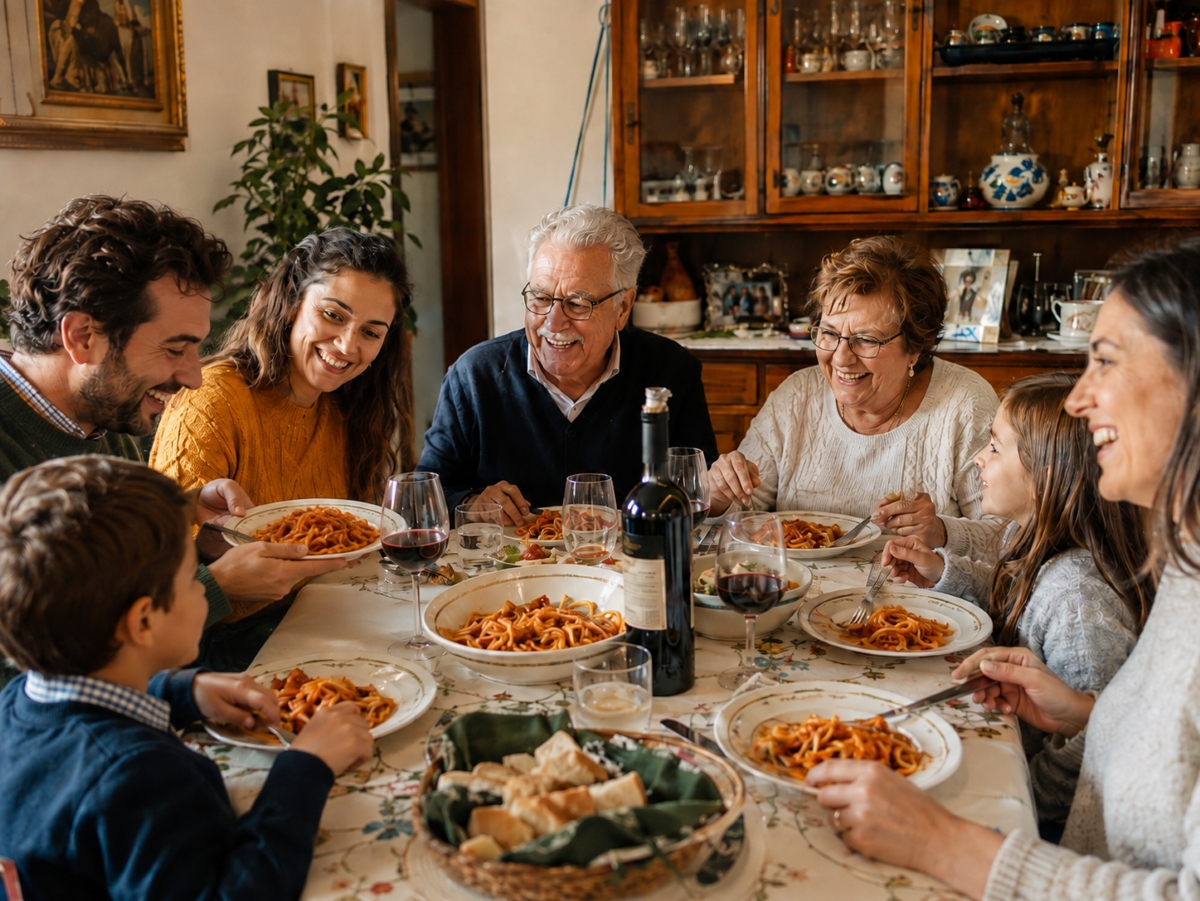
According to WineNews, many of these campaigns are based on a fundamental error of perspective: thinking of food exclusively as a sum of nutrients, calories, and molecules to be balanced in a biochemical equation. But the dining table has never been a laboratory; it is a social, emotional, and cultural space. It is where recipes are passed down, relationships are strengthened, celebrations are shared, and identities are formed. To reduce a plate of cacio e pepe, a glass of Sangiovese or Nebbiolo, or a tray of Sunday pastries solely to their nutritional dimension is to lose almost everything that makes them food rather than mere fuel.
It is no coincidence that the Mediterranean Diet was recognized by Unesco as an Intangible Cultural Heritage of Humanity in 2010, not because of its chemical composition, but because it embodies a set of skills, knowledge, practices, and traditions that extend from the landscape to the table, including cultivation, harvesting, fishing, preservation, preparation, and above all the sharing of food. Scientific studies have identified it for decades as one of the most balanced dietary models in the world, and it naturally includes bread, pasta, olive oil, and wine consumed with meals. Not in homeopathic doses, not with feelings of guilt, but as integral components of a way of life that has always managed to reconcile health and pleasure, moderation and conviviality. This is why it is surprising, to say the least, that at the very moment this model is being celebrated internationally, campaigns targeting its pillars are multiplying: pasta branded as a “fattening food”, wine treated as a substance to be avoided regardless of circumstances, and bread placed in the crosshairs of fad diets. It is a contradiction that should prompt reflection before indignation. This is especially true when one considers Italy’s leading position in terms of life expectancy: our country has long ranked among the highest in the world, alongside Japan, for both longevity and the proportion of elderly people in the population.
Wine deserves special consideration because it is perhaps the most emblematic example of this trend. In recent years, the notion has emerged that no level of wine consumption can be considered completely safe. Taken literally and out of context, such a statement flattens decades of epidemiological research and ignores a fundamental distinction: the difference between individual risk, which must always be assessed according to personal factors, and the transformation of that risk into a categorical imperative that applies to everyone, in every circumstance, regardless of the cultural context in which consumption occurs. In Italy, wine has never been merely an alcoholic beverage. It is part of the landscape, the economic lifeblood of entire regions, and a centuries-old winemaking culture. It is the glass which accompanies a family dinner or an evening with friends. To treat it as a dangerous product, without distinctions, without context, and without reference to the concepts of moderation and common sense, which remain the cornerstone of any sensible discussion about nutrition, is not only poor scientific communication but also an injustice to a deeply rooted millennia-old tradition.
There is also a side effect of this culture of prohibition that is rarely discussed, and perhaps it is the most insidious one: when our relationship with food is experienced solely through the lens of anxiety and guilt, it ceases to be beneficial even when it is, on paper, “correct”. Eating with anguish, counting every calorie, fearing every dish, is no less harmful, psychologically and in some cases even physiologically, than eating in a balanced way without fear. It is no coincidence that eating disorders (Eds), from anorexia and bulimia to orthorexia, a genuine obsession with healthy eating, are steadily increasing, especially among young people. The question, then, is not whether we should eat healthily, because there can be no doubt about that. Rather, it is what kind of concept of health we want to build. A health based solely on deprivation, or a health that recognizes pleasure as an essential component of well-being?
Italian gastronomic culture has always been able to answer this question better than many contemporary guidelines. Moderation, not prohibition, has always been the real rule. This is not about denying the scientific evidence regarding the risks of genuine excesses, but about restoring complexity to a debate that alarmist headlines have reduced to simplistic slogans. What is needed is communication that distinguishes between abuse and use, between large-scale statistical risk and conscious individual choice, between serious prevention and moralistic crusades.
Above all, what is needed is the courage to say that the pleasure of the table, the conviviality of a shared meal, the enjoyment of a traditional dish, the cultural value of a glass of wine consumed mindfully, is not a superfluous luxury to be sacrificed on the altar of health, but an integral part of health itself. Our grandparents understood this well: they lived long lives while eating pasta, bread, olive oil, and drinking wine, in an era when no one had yet thought of turning the dining table into a courtroom. Defending this idea today is not an exercise in nostalgia. It is a form of cultural resistance against a model which risks depriving us of something essential: the shared pleasure of gathering around the table, which remains, despite everything, one of humanity oldest and healthiest rituals.
Copyright © 2000/2026
Contatti: info@winenews.it
Seguici anche su Twitter: @WineNewsIt
Seguici anche su Facebook: @winenewsit
Questo articolo è tratto dall'archivio di WineNews - Tutti i diritti riservati - Copyright © 2000/2026