


Sunday 20th of September 2026 - Last Update: 21:50




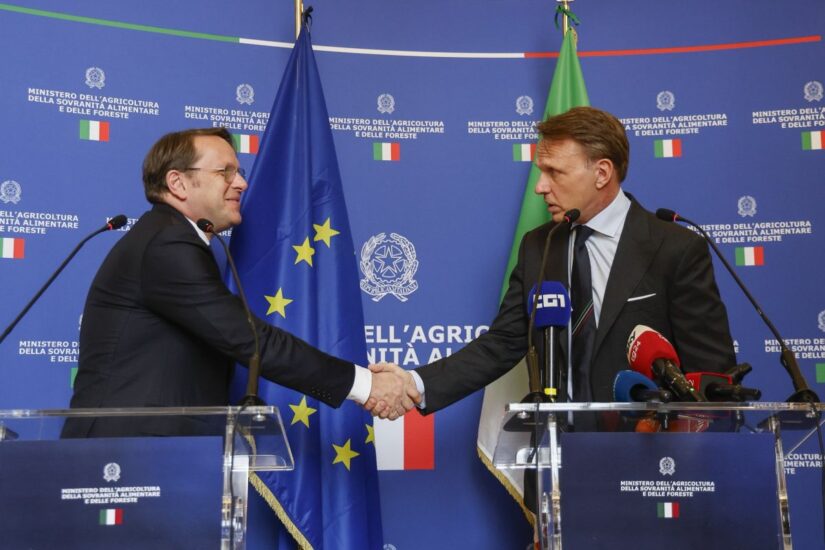
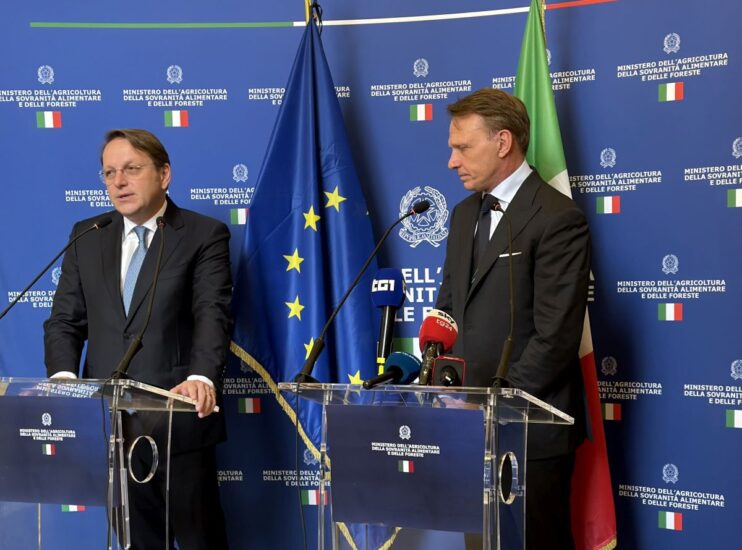
In 2025, the European Union reached a record level in agri-food exports, amounting to 238.4 billion euros, by +1.2%, with a total which accounted for 9% of overall EU exports. At the same time, however, there was also a record high in agri-food imports from third countries, which reached 188.6 billion euros, +9% on 2024, and representing 7.5% of total EU imports. These figures show just how much the EU is a global powerhouse in food production and exports, but at the same time an increasingly “attacked” market by foreign products. This is precisely why it is essential to guarantee European food sovereignty, as well as food safety, by demanding regulatory reciprocity with third countries, in order to protect both consumers, in terms of quality and health, and producers, from unfair competition by those who follow less stringent rules and production systems taking Italy as a virtuous model not only for quality, but also for food safety and its control system. This also requires further investment in animal welfare, while at the same time safeguarding animal health, paying close attention to increasingly pressing diseases (from African swine fever to dermatitis, among others), consumer health, and the profitability of farmers, who are already facing countless difficulties exacerbated by the international context, as illustrated, for example, by alarms over rising diesel fuel and fertilizer costs linked to the crisis in the Strait of Hormuz. This was the message delivered today by EU Commissioner for Health Olivér Várhelyi during a visit to the Ministry of Agriculture in Rome, hosted by Minister Francesco Lollobrigida.
“Thanks to Minister Lollobrigida for this very welcome meeting, which is part of a broader tour which has already taken me to the European Food Safety Authority (Efsa) in Parma, and to meetings with the Minister of Health Orazio Schillaci. I believe it is important that the European Union continues to do everything possible to defend the safety, quality, and full transparency of a system, that of agri-food production, which is the last bastion of European sovereignty, meaning an area where the European Union is still truly sovereign”, Várhelyi said at the outset. He added: “we will do everything we can to protect food safety and, clearly, consumer health, because people want safe food with the highest possible levels of safety on their tables. But, protecting the competitiveness of our farmers on the global scenario is no less important.
In this respect, Italy must continue to be able to supply those products in which it is self-sufficient and a major producer. Last year we strengthened efforts in this direction. This year we intend to double audits in third countries and also pay closer attention to points of entry such as ports, as I intend to do, for example, with the port of Genoa. We must continue to verify that products entering the European Union comply with and adhere to the rules in force within the Union,” said the EU Commissioner for Health. “Naturally, national authorities bear great responsibility, but we at EU level will do our utmost to support and improve these controls. We are already doing so: we are investing and have invested heavily, both in training activities and in responding to emergency situations. We have established a “Fast Reaction Team”, a group of experts from various countries that can intervene wherever local capacity is lacking or insufficient”. Várhelyi also highlighted the role of Italy: “I asked Minister Lollobrigida to strengthen cooperation with Italy, as I will do with other countries. But when it comes to food safety, Italy is a leader and therefore our key partner in this area. We will ensure full enforcement of European rules, so as to increase and maintain strong and stable confidence among European consumers and farmers”.
Another issue addressed by the Health Commissioner, and central to the meeting with Lollobrigida, was animal health. “We must do our utmost for animal welfare, but also for consumer health and to protect livestock farmers, who suffer serious losses from diseases such as African swine fever, for example, and not only that. We need to work more closely, also in coordination with Efsa, on vaccination policies to eradicate certain types of diseases”.
“I thank Commissioner Várhelyi - said Agriculture Minister Francesco Lollobrigida - because he has truly interpreted the role of a good European Commissioner. A European Commissioner doesn’t represent his or her own country beyond the moment of appointment; afterwards, they represent European interests. Some have managed to do this over time, others less so. Commissioner Várhelyi has, and as far as Italy is concerned, we have found in him a point of reference for the shared interests of our Europe. To protect the environment, to protect animal welfare, and to protect the economy and production from a global world with rules that differ from ours. I have found in Commissioner Várhelyi an important ally, for example, on issues related to plant protection products. Our position is to use plant protection products only when necessary, and to ban them only when possible. When this is not possible and production is damaged, the opposite effect occurs: we are forced to import more from countries that use plant protection products in quantities exceeding permitted levels, or even products banned in Europe. We asked, and I thank him for this, for increased controls, and today the Commissioner confirmed that activity and activism are making up for years of inaction that allowed goods to enter the European Union that should not and couldn’t have entered. My willingness to cooperate is total. In the coming hours, we will request additional controls at our ports, starting with the port of Genoa that you mentioned - said Lollobrigida addressing the Commissioner - because we need to guarantee maximum seriousness in controls in Italy, in order to achieve the same results from a Europe that, in our view, has too often allowed products to enter that should not have, as they create unfair competition for our producers and harm consumers. As for the rice sector, which is of particular interest to Italy, what happened in the European Parliament in recent hours is, in my view, shameful (with the EU Parliament rejecting the reduction from 45% to 20% of the safeguard clause activation threshold for imports from third countries, ed), because the logic of the majority prevailed over an issue that specifically concerns only 7 European countries, and especially Italy. Allowing rice to enter from countries where plant protection products are used in an uncontrolled manner, including substances banned in Italy, and where minors are exploited to produce it, slaves, not workers, is irresponsible. Unfortunately, part of the European left voted against this measure, which was intended to protect the European market from unfair imports. We have asked to strengthen controls and apply zero tolerance on plant protection products; we will once again ask Europe to protect workers in those countries and avoid financing those who exploit them. We will, of course, raise this with the Commissioner for Trade, Maroš Šefčovič, and with the President of the European Commission, Ursula von der Leyen. Enough hypocrisy, where workers are said to be defended here while turning a blind eye to the existence elsewhere in the world of slaves who lower production costs through labor exploitation, competing with entrepreneurs like ours who respect labor rules. We have also asked Commissioner Várhelyi, and I thank him for this, to expand the possibility of using drones in agriculture, because this is the future. We know that Commissioner Várhelyi agrees that drones are a tool to protect the environment, to use fewer plant protection products, and to support so-called heroic agriculture in those European, and clearly Italian areas where it is more difficult to use traditional methods, which, when used, have a greater environmental impact. We have offered Commissioner Várhelyi our full availability to strongly support the Omnibus Package, asking that the principle of reciprocity be upheld in international agreements. Zero tolerance is our starting point, but I go further. If products using plant protection products banned here are allowed onto our markets, it means those substances are deemed not harmful and therefore should also be allowed here. We believe they must continue to be banned; otherwise, positions of rigidity taken in recent years that have crippled some European production systems must be reconsidered”.
While these were the official positions expressed, WineNews would also have liked to ask the Health Commissioner, Olivér Várhelyi, for his stance on the issue of “wine, alcohol and health”, and on the return of the proposal for “health warnings” on wine and alcoholic beverage labels by the European Parliament Health Committee during the revision of Beca, but the Commissioner didn’t allow a question-and-answer session. Consequently, we asked Minister Lollobrigida whether the topic had been addressed during the meeting. “With Commissioner Várhelyi, from the very beginning, we made our position on wine clear; it was the moment of maximum concern when he became Commissioner. He is someone who visits Italy frequently, appreciates wine, as he himself has said, and also demonstrated this at Vinitaly in Verona, which he visited last year. He doesn’t agree with alarmist labels - said Lollobrigida - and even today he reiterated that we will work together to ensure maximum transparency. We want citizens to know how a product is made, what it contains, and what its effects may be. What we will never accept, however, are ‘conditioning’ labels. We said this with Nutri-Score and we reiterate it with alarmist labels that do not explain the product but frighten consumers into one choice or another. There are, obviously, different interests among European nations, we must acknowledge this. This applies to wine. And since we are the leading wine producer in Europe, we must be the first to protect this product by forming alliances with other nations that share the same interest, because not everyone in Europe has the same sensitivity and some tend to align their commercial strategies with sectors that produce something else, often exploiting alarmist research or similar arguments to influence political choices. That is why we have responded with studies carried out by highly authoritative international scholars, the most recent at a Vinitaly round table with professor Scapagnini, involving representatives from US universities, and with the presentation on March 25 by Federvini of a study based on scientific data to demonstrate that alarmism is useless. Information must always be provided fully and comprehensively, promoting when it comes to wine, which also contains alcohol correct and aware consumption, without demonizing the product. And on this - concluded Lollobrigida - we want to work together”.
This view is also shared by Coldiretti, which Commissioner Várhelyi met, receiving a petition with one million signatures containing requests aimed precisely at improving transparency and food safety. “Help us in a battle for transparency - Coldiretti president Ettore Prandini told the EU Health Commissioner - for a sector which represents the history of Italy, a millennia-old history, and that is the wine and winegrowing sector. We can’t accept the demonization of wine: let us fight together for the correct consumption of wine, avoiding energy drinks and cocktails. Wine is history and quality, and it is territory”.
Copyright © 2000/2026
Contatti: info@winenews.it
Seguici anche su Twitter: @WineNewsIt
Seguici anche su Facebook: @winenewsit
Questo articolo è tratto dall'archivio di WineNews - Tutti i diritti riservati - Copyright © 2000/2026