


Saturday 12th of September 2026 - Last Update: 11:47





More than 138 million tourists visited Italy in 2025. Tourism, a sector in good health, is above all fueling hopes for the wine industry as well, an industry which for years has believed in and invested in wine tourism, a choice that has proven to be a winning one. And it is a choice which may carry even greater weight in the future, at a time when the sector is looking for solutions to counter declining consumption and international issues that undeniably have an impact and create uncertainty. The strong state of health of wine tourism was clearly demonstrated at workshop “Enoturismo: opportunità di sviluppo per imprese e territori” - “Wine tourism: development opportunities for businesses and territories” held at Vinitaly Tourism during Vinitaly 2026 in Verona, with the presentation of the new Nomisma report, produced in partnership with UniCredit and Vinitaly, and in collaboration with the Città del Vino association. The report, which surveyed more than 300 Italian wineries based on a sample representative of the national wine sector’s structure, goes beyond the numbers to highlight growth prospects and, therefore, dynamics which can be acted upon.
Turnover generated by wine tourism for Italian wineries amounts to 3.1 billion euros, accounting for 21% of the average contribution to company revenues. Another positive sign, as explained by Denis Pantini, head of Wine Monitor at Nomisma, is the clear growth in tourist arrivals in the municipalities of some major PDO wines between 2019 and 2024: +26.5% for Conegliano Valdobbiadene Prosecco Superiore DOCG and +21.2% for Amarone della Valpolicella (compared to a regional average of +8.3% in Veneto). While Piedmont records +3.4% overall, Barolo soars at +17.6%; Franciacorta (+16%) outperforms Lombardy (+5.7%), as does Collio (+27.9%) compared to Friuli-Venezia Giulia as a whole (+11.4%). Tuscany’s denominations show particularly strong performances, led by Brunello di Montalcino (+39%), followed by Vino Nobile di Montepulciano (+33%), Bolgheri (+28%) and Chianti Classico (+8.6%), against a regional average of +6.7%. In Southern Italy, performance remains above average, with Etna DOC at +17.45% (compared to a total of +12.4% for Sicily).
In terms of services, 96% of wineries offer wine experiences, 56% provide food service and accommodation, 44% offer cultural activities, and 29% promote their territory. As for average spending per wine tourist at the winery, 145 euros are spent on accommodation, 123 euros on winery wine purchases, 54 euros on tourist grape harvest activities, and 41 euros on wine tastings. Wine tourism has a greater impact on the revenues of smaller wineries than on larger ones: it accounts for over 35% of turnover for wineries with revenues up to 1 million euros (which represent 70% of the total), more than 30% for those with revenues between 1 and 10 million euros, over 25% for those with revenues between 10 and 50 million euros, and 10% for wineries exceeding 50 million euros in revenues.
Geographically, wine tourism contributes more than 25% of revenues in Tuscany, 25% in Piedmont, over 20% in Sicily, and more than 15% in Veneto, which is followed closely by Lombardy, while its impact stands at 15% in Friuli-Venezia Giulia. American and German wine tourists dominate in Tuscany and Sicily, while in other regions Italian visitors prevail. Sicily, with a 55% share, shows the strongest growth prospects for wine tourism demand over the next 18 months.
In 2025, compared to the previous two-year period, 47% of wineries recorded an increase in wine tourist visits, while 50% experienced higher revenues from wine tourism. These figures are expected to rise further over the next 12-18 months, to 48% and 51% respectively, confirming a positive overall “sentiment”.
The identikit of the wine tourist reveals that 58% are Italian nationals (36% coming from the same region as the winery), while 42% are foreign visitors, with the top five countries of origin being Germany, the United States, the Netherlands, Switzerland and the United Kingdom. Visitors are mainly couples or families with children (51%), followed by groups (36%). The age group most interested in winery visits is 41-55 years old, but a noteworthy 32% are under 40, reflecting genuine interest in wine among younger generations. The future potential of wine tourism also lies in effective communication: 58% of visitors take part in winery visits despite not being wine experts.
The digital channels of wineries remain the primary tool for promotion and sales: for 74% of wineries, they rank first in importance, followed by collaborations with influencers and content creators (17%, but used by 31%), specialized media (4%, used by 19%), events, trade fairs and exhibitions (3%, used by 23%), and public tourism promotion portals (1%, used by 7%). There is ample room for growth through diversification, and this represents a key challenge for the sector.
But, what are the benefits deriving from offering wine tourism experiences? 40% of wineries, by far the majority, mention enhanced brand value, promotion and increased direct wine sales. Percentages narrow when examining obstacles and challenges in organizing activities: 20% point to a lack of financial incentives or dedicated resources, 19% to poor infrastructure and accessibility (an issue also highlighted at yesterday event organized by Movimento Turismo del Vino), 17% to a shortage of qualified staff and difficulties in recruiting or retaining employees, 13% to structural or logistical constraints at the winery, and 11% to weak coordination with local authorities, consortia or tourism operators. Consequently, 62% of wineries believe that economic incentives and dedicated financing instruments are the main actions needed to support wine tourism services, 53% call for greater collaboration among wineries, local authorities and tourism operators, and 41% highlight the need for bureaucratic and regulatory simplification.
According to wineries, the top three future trends that will drive wine tourism demand are immersive and multisensory experiences (48%), the development of proximity tourism/slow tourism (43%), and a preference for personalized, niche or exclusive experiences (42%).
It is worth noting that 35% of U.S. Tourists, historically crucial for Italian wineries, have taken part in at least one wine tourism experience. Their spending level is medium to high, reaching 150 euros for direct wine purchases and 300 euros for accommodation. Two out of three American wine tourists rate the experience as excellent, 79% are willing to recommend it, and 50% identify wine quality as the main strength of the Italian sector. Nearly all wine tourists (98%) say they are interested in undertaking new wine-related experiences within the next 2-3 years. Italy is by far the preferred destination, favored by 85% of respondents, followed by France at 65%. Italy also leads in “experiential” wine tourism: for U.S. wine tourists, it is the most explored country across multiple activities, including wine tastings, winery visits, vineyard tours and participation in the grape harvest.
Overall, the research findings highlight a growing wine tourism sector, characterized by an offering primarily centered on the winery experience, guided tours, immersive vineyard paths and tastings. Services such as hospitality, catering and premium experiences are still relatively limited, but they are emerging as key competitive differentiators for more structured businesses. Wine tourism should not be seen as a “Plan B”, given the numerous benefits it generates: it disintermediates sales through direct channels, turns visitors into global brand ambassadors, protects the landscape and ensures a future for rural communities.
Paolo De Castro, president of Nomisma, stated that “wine tourism represents 20% of revenues for wine companies, amounting to 3 billion euros nationwide. Responsibility for wine tourism has passed to consortia, which will be tasked with promoting initiatives. EU Agriculture Commissioner Christophe Hansen (interviewed yesterday by WineNews) announced that more resources will be allocated to promotion, and this is important news”.
Angelo Radica, president of Città del Vino, emphasized that “our role is to work on territories. We have been talking about wine tourism for 25 years, who was doing it at the time? Today, the soundness of that intuition is clear: in a very delicate phase, with the supply chain under pressure from multiple sources of tension, wine tourism can offer alternative paths for development and wealth creation. This applies to the economy, but also to local identity and culture. This report serves as a compass for entrepreneurs, a beacon pointing toward the future”.
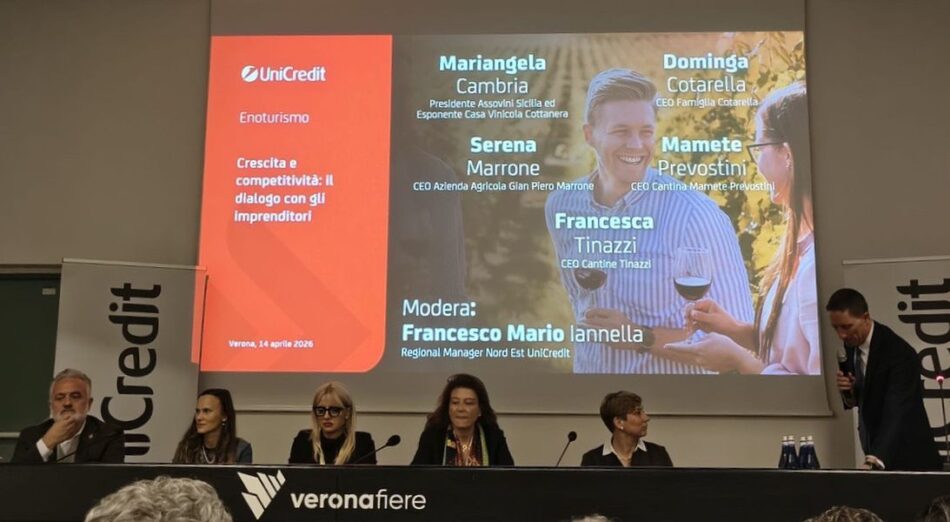
In the focus session “Crescita e competitività: il dialogo con gli imprenditori” - “Growth and competitiveness: dialogue with entrepreneurs”, Francesca Tinazzi, ceo of Cantine Tinazzi, a wine company with vineyards located in leading Italian territories, shared her company experience, stating that “the ability to provide hospitality is essential: it is another business that requires trained personnel, which is the biggest challenge. We are investing heavily in software to improve efficiency, and we have also invested in agritourism: three properties have been renovated over the last five years in Veneto and Tuscany. Americans prefer Tuscany to Valpolicella”.
Mariangela Cambria, president of Assovini Sicilia and producer at Cottanera, explained that “we Sicilians have a natural ability to open our doors: the tourist is a friend, the table is always open, just like in a family. Visitors cannot spend only one week in Sicily, we are not an island, but a continent, blessed with extraordinary biodiversity. As an association, we strongly believe in wine tourism, which has both economic and experiential value. Now the time has come to take tourism to the next level”.
Dominga Cotarella, ceo of the Cotarella family and president of Campagna Amica, stated that “agriculture is central to tourism because it creates differentiated experiences and helps reduce seasonality. It is a lever, not a fallback plan, but a true competitive strategy. For wine, we need to shift our focus away from current difficulties and toward opportunities. Training young people is crucial: they are bombarded with negative messaging about wine, and we need to tell them what lies behind the label. Wine is a protagonist at the Italian table, which, even with the best food, would feel incomplete without it”.
Serena Marrone, ceo of Gian Piero Marrone, highlighted that “my grandfather had vision: we have been welcoming visitors for 30 years, at a time when wine tourism did not yet exist. If a wine tourist travels 1,000 kilometers to discover what lies behind a bottle, they deserve time and respect. Last year we welcomed 40,000 visitors; ease of booking and direct contact are essential. In the Langhe region, the role of travel agencies has been useful, while younger generations show curiosity, but a coordinated system is needed. Infrastructures are essential to bring people to wineries and to tell the story behind this product”.
Finally, Mamete Prevostini, ceo of Cantine Mamete Prevostini, spoke about the Valtellina model: “it is a very small area, yet with more than 2,000 kilometers of dry-stone walls supporting 800 hectares of vineyards wrested from the rock. Such a territory naturally lends itself to a “slow” approach, and what was once a weakness has become a flagship. Electric bicycles have made it possible to explore the area more deeply, and we ourselves must be the first to be aware of what we have”.
Copyright © 2000/2026
Contatti: info@winenews.it
Seguici anche su Twitter: @WineNewsIt
Seguici anche su Facebook: @winenewsit
Questo articolo è tratto dall'archivio di WineNews - Tutti i diritti riservati - Copyright © 2000/2026