


Sunday 20th of September 2026 - Last Update: 21:57






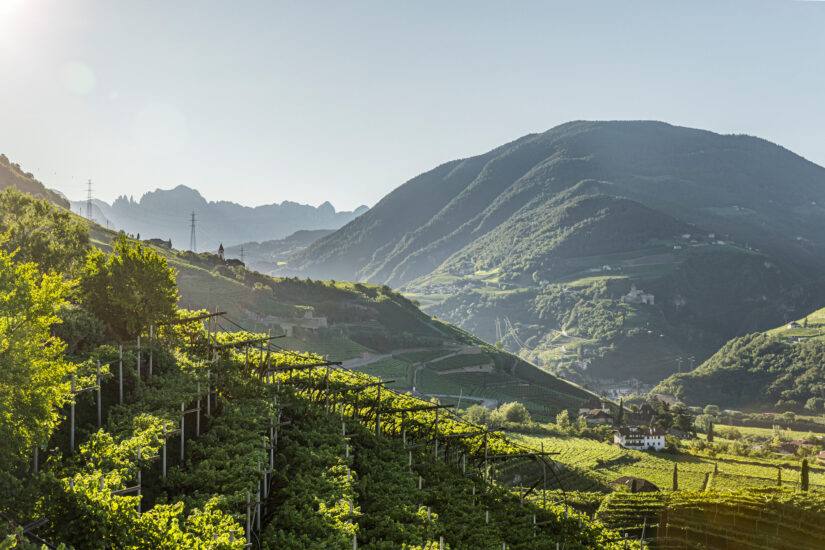
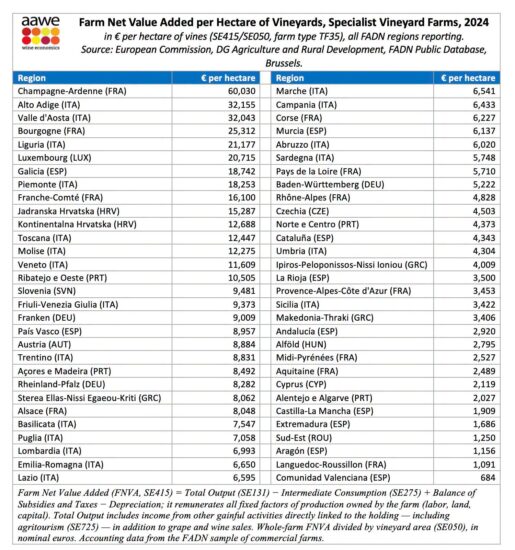
One of the most delicate and, at the same time, fundamental issues in the wine industry concerns the profitability of a winery. Many factors can influence this aspect, including the geographical location of the vineyards, the workforce employed, and production capacity. In Italy and around the world, there are many different wine-growing systems, each expressing different values and economic realities. It is not a given that the most prestigious wine regions are also the wealthiest. A study shedding light on these dynamics, but only partially and without including some important wine territories, has been provided by the American Association of Wine Economists (Aawe), basing on 2024 Fadn (Farm Accountancy Data Network) data. The study measures the wealth generated by vineyard cultivation per hectare of land, net of intermediate costs. The result is a highly diverse European landscape, with a wide range of values, from Champagne, France iconic sparkling wine region, generating 60,030 euros per hectare in net farm value added, down to just 684 euros per hectare in Spain Valencian Community. Alongside the French giant on the podium, there is Italy, represented by two regions which are not among the country largest producers in terms of volume, but rank among the highest for value added per hectare of vineyard land. In second position, there is South Tyrol, Italy renowned “white wine jewel”, with 32,155 euros per hectare, followed closely in third place by the Aosta Valley, with 32,043 euros per hectare. Its mountainous and heroic vineyards produce niche wines that are nevertheless highly sought after.
Position No. 4 goes to Burgundy, the homeland of France great red wines (and much more), with 25,312 euros per hectare, ahead of Liguria (No. 5) with 21,177 euros per hectare, thanks to its spectacular seaside vineyards overlooking the Cinque Terre and the western Ligurian coast. The Top 10 continues with Luxembourg (position No. 6, 20,715 euros per hectare), Galicia in Spain (position No. 7, 18,742 euros per hectare), and Piedmont in position No. 8. Home to Barolo, Barbaresco, Barbera d’Asti, Alta Langa, Gavi, and Asti, among others, Piedmont records 18,253 euros in value added per hectare. Back in France, Franche-Comté (the Jura region) ranks No. 9 with 16,100 euros per hectare, followed by Croatia Jadranska Hrvatska region in position No. 10 with 15,287 euros per hectare.
Moving down to the Top 20, Tuscany appears in position No. 12. Home to Chianti Classico, Bolgheri, Toscana IGT, Chianti, Maremma, Brunello di Montalcino, Vino Nobile di Montepulciano, and Vernaccia di San Gimignano, among many others, Tuscany generates 12,447 euros per hectare. It is followed by Molise (position No. 13), known for Tintilia, the signature wine of the region, with 12,275 euros per hectare, and then Veneto (position No. 14, 11,609 euros per hectare), one of Italy major wine-producing regions. Veneto boasts renowned denominations such as Amarone della Valpolicella, Conegliano Valdobbiadene Prosecco Superiore DOCG, Asolo Prosecco Superiore DOCG, and Prosecco DOC, as well as Soave, Valpolicella, Bardolino, Lugana, and many others.
Friuli-Venezia Giulia, home to Collio and Colli Orientali among other prestigious wine areas, ranks No. 17 with 9,373 euros in value added per hectare.
It should be emphasized that this ranking is only partial and aggregates data across broad regions, within which the value gap can be enormous. Consider, for example, the differences in value between the most celebrated areas and the less prestigious, volume-driven zones within Tuscany, Piedmont, or Burgundy itself. Nevertheless, the study provides an important snapshot of how much income vineyard growers can derive from a single hectare of vines, a crucial issue for the future of viticulture.
Copyright © 2000/2026
Contatti: info@winenews.it
Seguici anche su Twitter: @WineNewsIt
Seguici anche su Facebook: @winenewsit
Questo articolo è tratto dall'archivio di WineNews - Tutti i diritti riservati - Copyright © 2000/2026