


Wednesday 7th of October 2026 - Last Update: 19:20







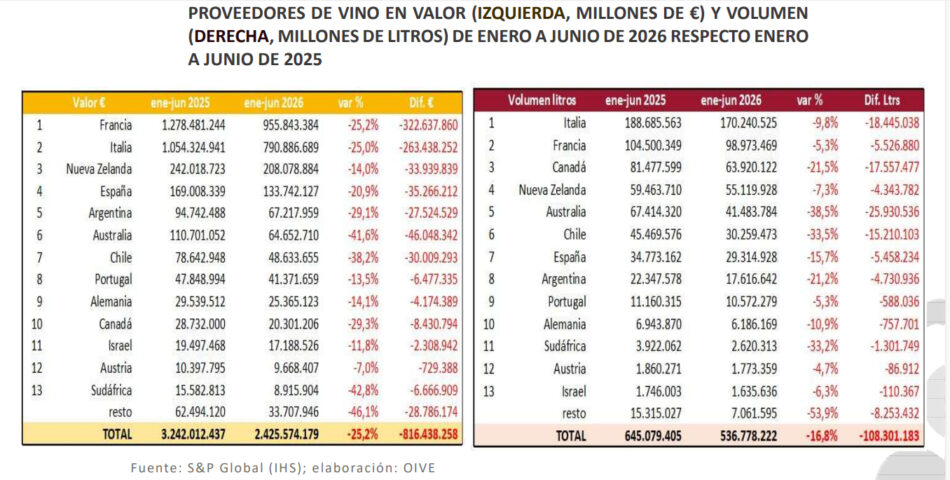
According to U.S. customs data analyzed by the Spanish Wine Interprofessional Organization (Oive), in the first half of 2026 compared with the first half of 2025, wine imports into the United States, where Trump-imposed tariffs are in force, declined both in value (-25.2%), falling to 2.4 billion euros, and in volume (-16.8%), dropping to 536.8 million liters. During this period, compared with the same period in 2025, the United States imported 108.3 million fewer liters of wine and reduced its wine purchasing expenditure by 816.4 million euros. The average price fell by 10.1% to 4.52 euros per liter.
Monthly performance from January through June 2026 shows that each of the six months recorded negative results compared with the corresponding months of 2025, although the declines were much steeper in the first three months. This at least leaves some room for optimism regarding the months ahead. Bottled wine was the most imported category, with a value of 1.7 billion euros (-26.6%) and a volume of 318.2 million liters (-12.4%). This category accounted for 70% of the total value and 59% of the total volume of wine imported by the United States during the first six months of 2026. Sparkling wines saw imports decline by 19.8% in value, to 630.2 million euros, and by 9.6% in volume, to 90.3 million liters, with an average price of 6.98 euros per liter (-11.3%).
The United States recorded a strong increase in bag-in-Box wine imports (+12% in value and +49.6% in volume), although this category still represented only a small share of total imports, at 16.3 million euros and 7.9 million liters. Bulk wine purchases, on the other hand, decreased both in value (-36.4%), falling to 85.9 million euros, and in volume (-31.9%), dropping to 120.3 million liters. As for supplier countries, France remained the leading exporter by value, with 955.8 million euros, despite a decline of 25.2% (equivalent to 322.6 million). Italy ranked second with 790.8 million euros ( down 25%, or 263.4 million euros less than in the same period of 2025. Notably, this figure differs significantly from the data for the first five months of the year reported by Italy’s national statistics institute-Istat, which indicated a decline of only 15%). New Zealand ranked third with 208.1 million euros, down 14%. Spain maintained fourth place with 133.7 million euros, a decrease of 20.9% compared with the first half of 2025 (equivalent to 35.3 million euros).
In terms of volume, Italy was the leading source of U.S. wine imports in the first half of 2026, with 170.2 million liters (-9.8%). France ranked second with nearly 99 million liters (-5.3%), while Canada recorded a sharp decline of 21.5%, falling to 63.8 million liters, though it retained third place. In absolute terms, Australia (-25.9 million liters), Italy (-18.4 million liters), Canada (-17.6 million liters), and Chile (-15.2 million liters) experienced the largest reductions in sales.
A sharp overall decline was also recorded in average prices per liter. France remained the highest-priced supplier, at 9.66 euros per liter (-21.1%, or 2.58 euros less per liter), followed by Italy at 4.65 euros per liter (-16.9%, equivalent to a 0.94 euros decline). Bottled wine continued to be Italy leading category in the U.S. market, reaching a value of 524.5 million euros (-28.2%), behind France, which totaled 603.7 million euros (-28.6%). For bottled wines, Italy recorded an average price of 5.00 euros per liter (-19.3%), compared with France’s 8.29 euros per liter (-21.2%). As for sparkling wines, Italy exported 255.3 million euros worth to the United States (meaning sparkling wines accounted for 33.3% of Italy U.S. wine exports), dropping by -18.4% from the first half of 2025, with volumes reaching 60.6 million liters (-9%). While France decline in value was not far from Italy (-19.3%), in volume terms France, although still behind Italy, increased its market share in the first half of 2026 to 20.3 million liters (+0.4%).
Oive data provides yet another confirmation that, at mid-year, conditions remain challenging for the wine sector, both in Italy and elsewhere, in what continues to be its most important export destination, the U.S. Market.
Copyright © 2000/2026
Contatti: info@winenews.it
Seguici anche su Twitter: @WineNewsIt
Seguici anche su Facebook: @winenewsit
Questo articolo è tratto dall'archivio di WineNews - Tutti i diritti riservati - Copyright © 2000/2026