


Sunday 25th of October 2026 - Last Update: 14:37







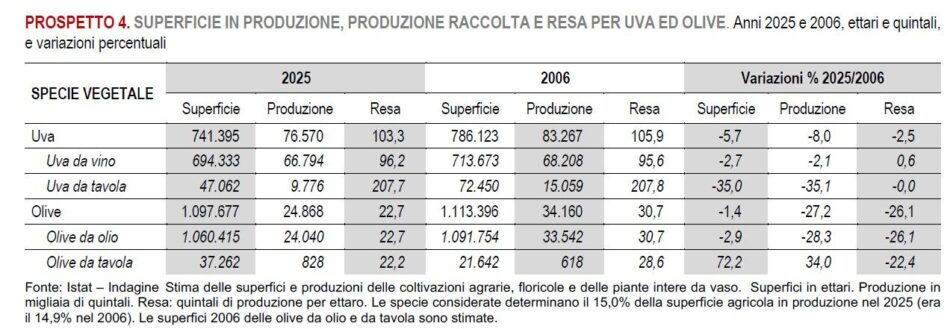
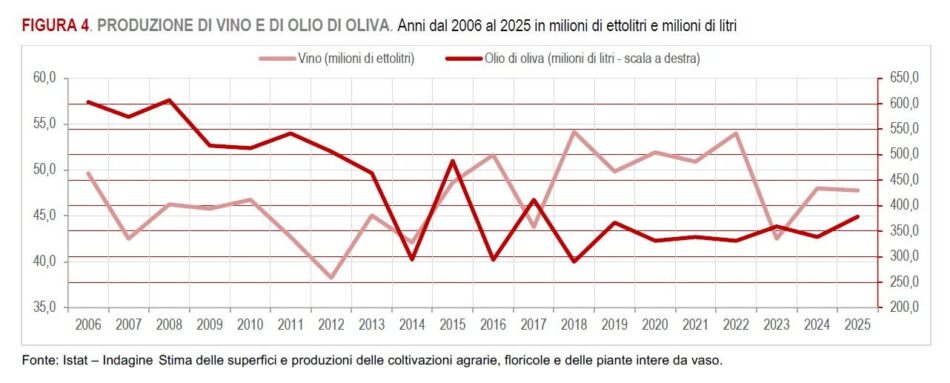
In an Italian agricultural sector marked by profound transformations in recent decades, between 2006 and 2025, wine has proven to be one of the most resilient products. According to the new Istat report on the evolution of agricultural and livestock production, the wine sector has maintained high and competitive production levels despite a slight reduction in vineyard area and production volumes, clearly distinguishing itself from other sectors affected by severe contractions. The area under vineyards fell from 786,123 hectares in 2006 to 741,395 hectares in 2025 (-5.7%), while total grape production fell from 83.267 to 76.570 million quintals (-8%) and the average yield decreased by -2.5%, from 105.9 to 103.3 quintals per hectare. The trend for wine grapes was even more stable, with planted area down by 2.7%, falling from 713,673 to 694,333 hectares, production remaining nearly unchanged from 68.208 to 66.794 million quintals (-2.1%), and yield rising slightly from 95.6 to 96.2 quintals per hectare (+0.6%). The trend for table grapes was the opposite, with a decline of approximately -35% in both planted area and harvest volume. Overall, national wine production fell from 49.6 million hectoliters in 2006 to 47.8 million in 2025, representing a limited decrease of -3.6% over nearly 20 years.
At the same time, the importance of foreign markets is growing: in 2025, Italy exported 21 million hectoliters of wine (compared to 18.8 million hectoliters in 2006), sold 26.7 million hectoliters on the domestic market, and imported just 2.4 million hectoliters. The share of exports rose from 39.9 to 44 liters per 100 liters of Italian wine, confirming the sector’s growing international focus.
In terms of grape production, the Northeast accounts for 41.2%, followed by the South with 29.1%, the Center with 13.1%, the Islands with 9.3%, and the Northwest with 7.3%. Between 2006 and 2025, production in the Northeast will increase by 25.7%, and in the South by 1.7%, while production will decline in the Northwest (-22.2%), the Center (-15.7%), and especially the Islands (-41.1%).
At the European level, Italy accounts for 33.2% of the European Union’s grape production and remains among the leaders alongside Spain (22.3%) and France (23.4%).
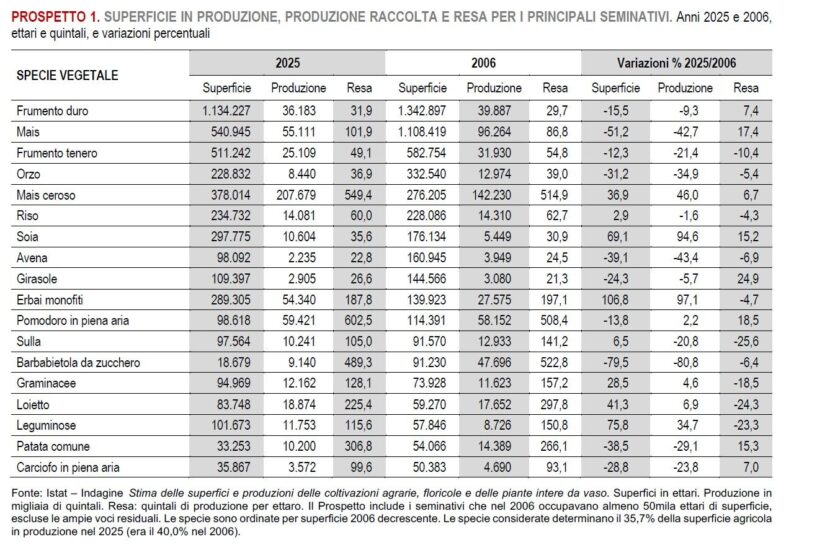
The report highlights, however, that outside the wine sector, the situation is much more complex. In arable crops, there were sharp declines in corn (-42.7%), soft wheat (-21.4%), and durum wheat (-9.3%). The case of corn is particularly significant, with planted area halved (-51.2%), production down sharply, and yields up by +17.4%. In contrast, production is growing for soybeans (+94.6%), single-crop forage (+97.1%), waxy corn (+46%), and legumes (+34.7%). Domestic production, however, is unable to meet demand: in 2025, wheat imports reached 97 million quintals compared to domestic production of 59.5 million, while corn imports reached 70 million quintals, exceeding the 55 million produced in Italy (in 2006, less than 20 million quintals were imported, compared to domestic production of nearly 96 million).
Fruit is among the hardest-hit crops. Pear production plummeted by 60.6%, nectarines by 43.5%, peaches by 40.7%, hazelnuts by 30.3%, almonds by 29.7%, and oranges by 23.7%. The only positive exceptions are clementines (+20.3%), kiwis (+17.8%), and apples (+13.2%). The pear sector is the hardest hit, with production more than halved (-60.6%, from 9.104 to 3.583 million quintals) and cultivated area reduced by -52.8% (from 42,250 hectares to 19,941 hectares), while imports of peaches (+413.6%), pears (+199.1%), hazelnuts (+144.1%), and almonds (+144.3%) have increased significantly.
The situation in olive cultivation is also critical: the area under cultivation is expected to decrease by -1.4% (from 1,113,396 to 1,097,677 hectares between 2006 and 2025), but olive production is expected to fall by 27.2% (from 34.160 to 24.868 million quintals) and yield by 26.1% (from 30.7 to 22.7 quintals per hectare). Olive oil production will drop from 603.3 to 378.6 million liters (-37.6%), a decline that Istat attributes to climate change, plant stress, the spread of pests and pathogens, and structural challenges in the sector. In 2025, with 379 million liters produced, Italy will export 298 million liters, have just 81 million liters available for the domestic market, and rely on imports totaling 565 million liters.
The livestock sector is also showing signs of contraction. Livestock numbers are down for sheep (-28.1%), pigs (-15.6%), and cattle (-12.2%), while buffalo numbers are up (+92.6%) and, to a lesser extent, goats (+3.4%). In meat production, cattle numbers have fallen sharply, with the number of animals slaughtered down by -37.5% and carcass weight down by -40.9%; sheep and goats have seen a production decline of -56.2%; and pigs have decreased by -16.9%. The poultry sector bucked this trend, recording a +53% increase in the number of birds slaughtered and a +56.8% increase in production, with chickens and hens accounting for 89.4% of the total weight produced.
Among the few growing sectors, the dairy sector also stands out: milk production increased by +27.2% between 2006 and 2024 (reaching 108 million liters in 2026), thanks to higher productivity per animal, with cow’s milk production rising by +28.6% (rising from 101.9 to 131.1 million quintals), buffalo milk by +19.4% (from 1,948 to 2,326 thousand quintals), goat milk by +50.4% (from 272 to 409 thousand quintals), and a +54% increase in yield per head of cattle. Cheese production also increased (+17.7%, from 11.540 to 13.586 million quintals) as did cream production (+18%, from 1.301 to 1.535 million quintals), while butter (-21.3%, from 1,196 to 941 thousand quintals) and yogurt and fermented products (-11.6%, from 3.015 to 2.663 million quintals) declined.
In the European context, despite accounting for only 8.7% of the Union’s agricultural land, Italy maintains a leading position with 75.2% of hazelnut production, 52.8% of rice, 43.2% of durum wheat, 42.1% of processing tomatoes, 37.9% of soybeans, 33.2% of grapes, and 30.5% of oranges. The picture painted by Istat thus reveals an increasingly polarized agricultural sector: on the one hand, sectors that are holding steady or growing, such as wine, wine grapes, soybeans, kiwifruit, apples, milk, cheese, and poultry farming; on the other, sectors facing serious difficulties, including corn, soft wheat, pears, peaches, nectarines, olive cultivation, cattle and sheep farming, and red meat production.
Copyright © 2000/2026
Contatti: info@winenews.it
Seguici anche su Twitter: @WineNewsIt
Seguici anche su Facebook: @winenewsit
Questo articolo è tratto dall'archivio di WineNews - Tutti i diritti riservati - Copyright © 2000/2026