


Thursday 10th of September 2026 - Last Update: 19:19






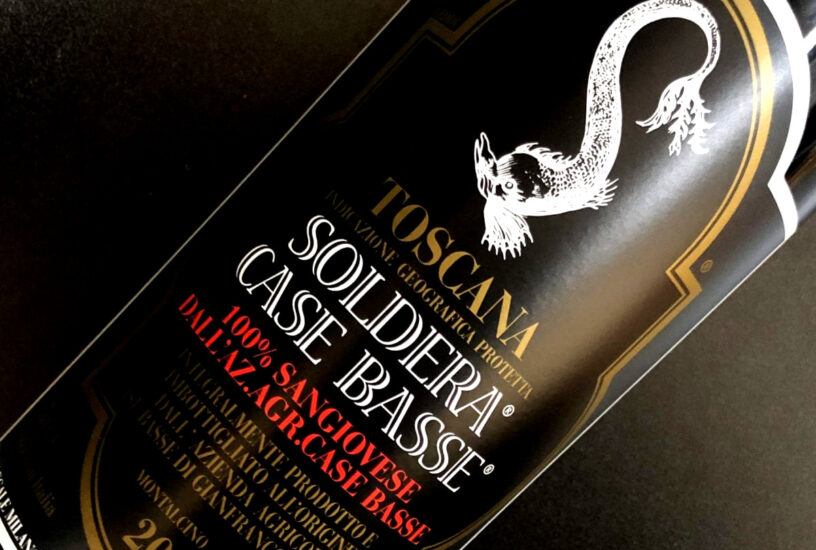
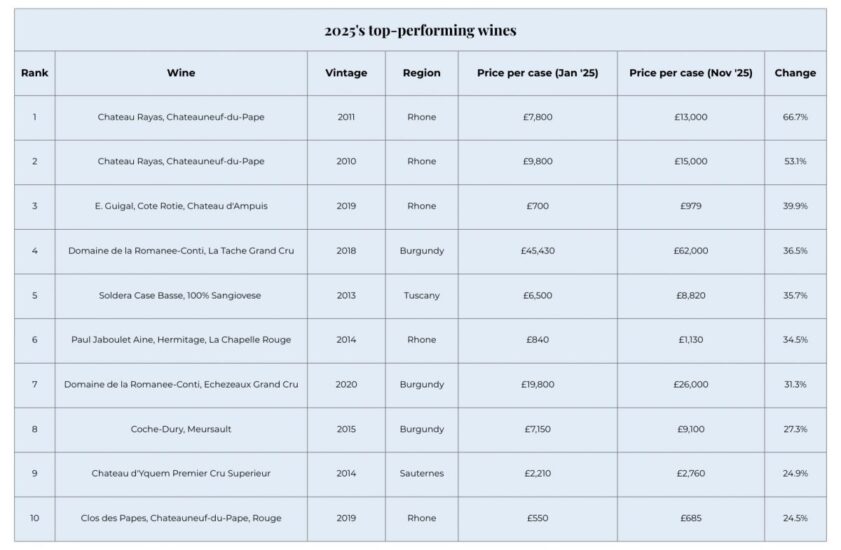
A podium dominated by the Rhône, with Château Rayas at No. 1 thanks to its Châteauneuf-du-Pape 2011, which marks a performance of +66.7% from January to November 2025 (corresponding to 13,000 pounds per case). The same label, but the 2010 vintage, ranks No. 2 (+53.1%, 15,000 pounds per case) of the ranking (prices reacted strongly to the passing of owner Emmanuel Reynaud in November), ahead of Côte-Rôtie Château d’Ampuis 2019 by E. Guigal, which recorded a 39.9% increase (979 pounds per case). Position No. 4 for Domaine de La Romanée-Conti La Tâche Grand Cru 2018, a Burgundy icon (+36.5%, 62,000 pounds per case), and No. 5 goes to the only Italian wine in the ranking, Soldera Case Basse 100% Sangiovese 2013 (+35.7%, 8,820 pounds per case), a jewel of Montalcino and Tuscan winemaking, which continues its stellar performance (it was No. 10 in the ranking first semester), so that, over the past decade, its prices have risen by +224%, far outpacing those of the Supertuscans. This is the top 5 of the best-performing wines of 2025 (January to November), according to WineCap, a reality specializing in fine wines, which notes that this year strongest performances were concentrated in a few key regions. The Rhône dominated the ranking with 50% of the top wines, followed by Burgundy (30%), Tuscany (10%), and Sauternes (10%).
The list continues with another Rhône standout at No. 6, Paul Jaboulet Aîné Hermitage La Chapelle Rouge 2014 (1,130 pounds per case, +34.5%), at No. 7, there is Domaine de La Romanée-Conti Échézeaux Grand Cru 2020 (+31.3%, 26,000 pounds per case), and Burgundy remains in the spotlight at No. 8 with Coche-Dury Meursault 2015 (+27.3%, 9,100 pounds per case). Closing the top 10, at No. 9, there is Château d’Yquem Premier Cru Supérieur 2014 (+24.9%, 2,760 pounds per case), a Sauternes gem, and No. 10, back to the Rhône with Clos des Papes Châteauneuf-du-Pape Rouge 2019 (+24.5%, 685 pounds per case). So, while the year drawing to a close wasn’t memorable for fine wines overall, some labels recorded double-digit growth.
In general, the fine wine market, according to WineCap, in 2025 showed “signs of recovery after three years of decline”, adding that 95% of wealth managers in the UK and US stated that fine wine will remain a high-performing collectible asset despite political uncertainty and interest rate fluctuations. In both countries, fine wine was considered one of the best alternative investments, outperforming other luxury assets such as art, watches, whisky, and handbags. Stability returned to fine wines in July 2025, when the US and EU agreed on a 15% tariff on European wine exports, far lower than the threatened 200% tariffs. From that point, buyers re-entered the market, particularly in regions initially hardest hit, such as Champagne and Spain, which were among the first to recover, explains WineCap. The Rhône also saw stronger demand, and “off-market” vintages in Bordeaux recorded positive trends. The Italian fine wine market also performed well, with Tuscany gaining ground thanks to investor interest in Brunello di Montalcino and Supertuscans like Sassicaia, Ornellaia, and Masseto. However, the performance of the main Piedmont wines remained weaker, explains WineCap, and it is “due to investors’ preference for regions with broader international recognition and greater liquidity in the current economic context. In California, global demand and strong branding fueled growing interest in labels such as Opus One and Screaming Eagle.
Looking to the present, but with a gaze ahead, WineCap underlines that “in the last quarter of 2025, the fine wine market began to emerge from its most prolonged recession in the past ten years. The recovery remains uneven and can’t yet be considered complete. However, underlying indicators suggest that the foundations for 2026 will be more solid”. Which regions are expected to lead the rebound in 2026? Champagne, Tuscany, Napa Valley, Rhône, and Bordeaux appear to be the most likely candidates for an initial boost, according to WineCap. In any case, “diversity is likely to shape the next phase of recovery. As fine wine continues to evolve into a mainstream portfolio tool, investors will broaden their focus beyond blue-chip labels. This shift is supported by the rapid modernization of the sector. Expanded global distribution networks, greater transparency, sustainability initiatives, and improved data access are making fine wine more accessible. The industry still have to face an image challenge, but significant innovation is helping reshape perceptions. The foundations for a slow, sustainable, and more widely distributed recovery have now been laid. For medium- to long-term investors, 2026 is expected to offer clearer opportunities, better sentiment, and a more diversified set of growth paths compared to the immediately preceding volatile years”.
Copyright © 2000/2026
Contatti: info@winenews.it
Seguici anche su Twitter: @WineNewsIt
Seguici anche su Facebook: @winenewsit
Questo articolo è tratto dall'archivio di WineNews - Tutti i diritti riservati - Copyright © 2000/2026