







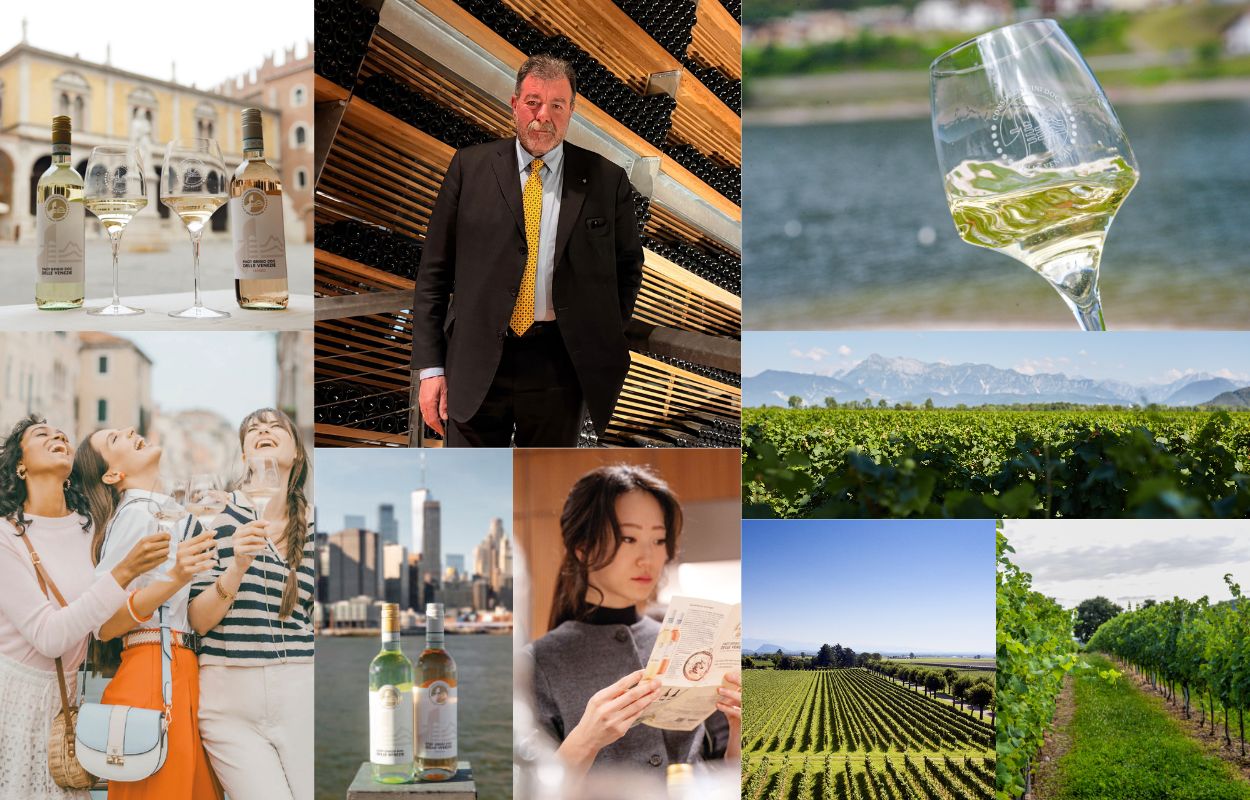
Protection and promotion of the landscape, transparency towards consumers, synergy between businesses, inspectors and institutions, enhancement of quality and positioning: these are the pillars guiding the Consorzio del Pinot Grigio DOC delle Venezie, headed by Luca Rigotti. It is the largest white-wine denomination in the country (27,000 hectares across Veneto, Friuli Venezia Giulia and the Autonomous Province of Trento, with an average production of 230 million bottles per year, accounting for 85% of Italian Pinot Grigio and 43% of global production, involving 6,142 grape growers, 575 winemaking companies and 376 bottlers). The denomination reports positive results even in 2025, a challenging year for the wine sector, with data from Triveneta Certificazioni confirming the bottling of 1,694,176 hectolitres compared to 1,707,064 in 2024, figures which reflect the substantial stability of the DOC delle Venezie. In the 2025 calendar year, however, certifications reached 1,795,740 hectoliters, up from 1,755,636 in 2024 (+2.5%). This reflects a wine increasingly rooted in its vast territory and ever more committed to the new State Seal introduced by Istituto Poligrafico e Zecca dello Stato - Italian State Printing Office and Mint, now also available in digital form. These were the key messages shared during the press conference held yesterday at Villa Necchi Campiglio in Milan, one of the most elegant architectural landmarks of Italian Rationalism, now a Fai - Fondo per l’Ambiente Italiano heritage site, with a focus on the new positioning strategy of the denomination and the role of the Tricolor State Seal, which has evolved from an effective control tool into a digital passport for each bottle and a strategic lever for enhancing wine value and origin.
This forward-looking vision comes after a journey retraced by the Consortium president Luca Rigotti, starting from the denomination creation in 2016 and the founding of the Consortium itself, recognized by the Ministry of Agriculture with Erga Omnes authority for protection, promotion and market oversight. Over recent years, this structure has guided a path of growth and consolidation, strengthening the organizational model of the DOC. Even in 2025, the system achieved positive results, with stable volumes and increasing coordination capacity across the territories of Veneto, Friuli Venezia Giulia, and the Autonomous Province of Trento. “Pinot Grigio DOC delle Venezie arose from the ability of the North-East territories to work as a system and build shared governance, also through common management tools and an interregional coordination committee. This is our strength today and proof that cohesion is the key to effectively facing the challenges of global markets”, said Rigotti, who highlighted that “2025 data confirms the solidity of one of the main Italian and European wine denominations, with stable bottlings at 1.69 million hectoliters and certifications reaching 1.79 million hectoliters, up 2.3%. Reclassifications entering the system, corresponding to 195,000 hectoliters, also confirm the proper functioning of the interregional Pinot Grigio model and the supply-management measures implemented by the Consortium. These are significant results in a complex international context marked by contracting and shifting consumption patterns and geopolitical uncertainties”. In this scenario - concluded Rigotti - the Consortium will keep working to strengthen supply-governance tools and promotional activities in international markets. The 2025 Report reflects an intense year of activity, consolidating cultural and institutional partnerships and launching the interregional Pinot Grigio coordination table: essential tools for addressing future challenges and reinforcing the denomination value and market positioning.
Among the highlighted partnerships, there was the one with Fai with managing director Davide Usai who emphasized that “the protection of landscape and artistic and cultural heritage is one of the deepest components of our national identity. Wine, and particularly a wine like Pinot Grigio DOC delle Venezie, closely linked to highly distinctive territories, naturally embodies these values. The collaboration with the Consortium aligns perfectly with this vision: enhancing a product also means enhancing the places, history and people that make it possible. The Fai audience represents an ideal counterpart for a project aimed at elevating the perception of the DOC, embedding it in a narrative capable of integrating viticulture, landscape and culture”.
But, as mentioned, the denomination is also strongly focused on transparency and traceability, thanks in part to the new tricolor State Seal, which is increasingly evolving toward a digital dimension. This was emphasized during the debate moderated by Luciano Ferraro, deputy editor of Corriere della Sera by Matteo Taglienti, director of private markets Italy at the Istituto Poligrafico e Zecca dello Stato: “the Seal was created as a tool to guarantee and control production, with the goal of ensuring product authenticity and traceability. Over time, this system has evolved by integrating increasingly advanced technologies capable of responding to the growing market demands for safety and transparency”. Taglienti highlighted how the introduction of the QR code now marks a significant step in the relationship between producers and consumers: “the Seal is no longer just a paper label affixed to the bottle, but a genuine digital platform. Thanks to the integration of technological tools and anti-counterfeiting systems, it becomes a sort of passport for the product, capable of narrating its origin, territory and production chain”. The project developed together with the DOC delle Venezie, Taglienti added, represents a concrete example of innovation applied to made in Italy: “we are working with the Consortium to build a system whcih enhances not only the wine, but also the businesses, services and wine-growing territories that make up the supply chain. The objective is to integrate traceability, safety and the ability to communicate the production system, strengthening consumer trust in the Italian Geographical Indications framework”.
Certification and supply-chain controls were also central themes in the debate, addressed by Francesco Liantonio, president of Triveneta Certificazioni - one of Italy main wine sector control bodies, created through the collaboration of Ceviq, Siquria, Valoritalia and the Chamber of Commerce of Trento - who illustrated the role of the certification system and the importance of strengthening synergies for the benefit of the interregional wine heritage. “Our task is to carry out systematic compliance checks at all stages of production, ensuring that each segment of the supply chain meets the requirements laid out in the Pinot Grigio DOC delle Venezie production protocol. Only after this process is successfully completed - explained Liantonio - the State Seals can be applied to bottles be issued, guaranteeing product conformity”. Liantonio also underscored how the newly inaugurated Triveneto Wine Hub in San Vito al Tagliamento represents a concrete example of collaboration between certification bodies and the consortium system: “the Hub demonstrates just how essential it is to work as a team. Bringing together skills, experience and tools strengthens the entire denomination system and offers greater guarantees to consumers and markets.” In this context, the new State Seal represents a further step forward in traceability and product valorization: “Qr-code technology makes it possible to go beyond mere technical traceability and to tell the story of the wine, its origin and its production chain, through information validated by the certifying body checks, ensuring its reliability. It is a tool that strengthens transparency while also enhancing the work of producers”, concluded Liantonio.
“We chose to adopt the Seal from the very beginning of our project - added Luca Rigotti, - because it represents a tool of guarantee, transparency and protection, as well as a distinctive feature capable of strengthening the DOC identity and recognizability in international markets. Today, we are extremely pleased with its evolution towards an increasingly complete and innovative system, which connects the product with its territory and production chain, offering consumers clear information and greater trust. It is not just a band placed on the bottle, but the symbol of a system that unites controls, innovation and shared responsibility throughout the entire supply chain”. Rigotti also recalled that the denomination positioning strategy is supported by a structured network of high-profile cultural and institutional partnerships: “the collaborations launched by the Consortium, such as those with Fai-Fondo per l’Ambiente Italiano and the Symbola Foundation, help reinforce the perception of the denomination and place it within meaningful cultural contexts, expanding the Consortium scope of action. At the same time, we also promote conscious and responsible consumption, contributing to social sustainability, which the Consortium has chosen to pursue, including through its partnership with “Wine in Moderation”. This keeps us at the forefront in promoting moderate consumption and recognizing wine’s full cultural value, in a global scenario where this product is often under attack”.
Italian wine is a product appreciated all over the world, and for this reason often subject to counterfeiting, imitation and evocation, underlined Biagio Morana, director of the Icqrf North-East Office of the Ministry of Agriculture. He emphasized the central role of the control system in defending the reputation of Italian Geographical Indications on international markets. “Precisely because they are so appreciated, high-quality Italian products are frequently targeted by counterfeiting, imitation and evocation”, explained Morana, recalling how the Italian control system is built on collaboration between public authorities, certification bodies and protection consortia. “Icqrf operates along the entire supply chain through targeted checks at different production stages, monitoring activities and close collaboration with consortia, including in foreign markets”. Data from the 2024 and 2025 Icqrf reports indicate that around 15,000 checks are carried out each year in the wine sector, covering about 8,000 operators, with an average irregularity rate of around 20%. In the Triveneto area alone, over 4,000 checks are conducted, more than 50% of which concern the wine sector, confirming the strategic importance of this region for the Italian denomination system. Counterfeiting remains significant, and the goal of inspection activities is precisely to protect the reputation of Italian excellence. “The production value of Italian PDO and PGI wines exceeds 11 billion euros, of which about 6 billion come from the Triveneto region - 4.3 billion from Veneto, 0.8 from Friuli Venezia Giulia and 0.7 from South Tyrol, based on the Ismea-Qualivita Report. Tools such as the State Seal help strengthen the protection of this extraordinary heritage”, concluded Morana.
And while quality, supply management and traceability are pillars of the DOC delle Venezie strategy, cultural and identity-driven value is also a priority. This was underscored by Paolo Pigliacelli of Symbola, the Foundation for Italian Qualities, partner of the Consortium on a path which links wine, territory and social responsibility. “Italian wine is not just an agricultural product: it is a tale of origin, community and landscapes. Every bottle reflects knowledge passed down over generations, biodiversity and local identity. Telling its story from this perspective means reinforcing the value of made in Italy and explaining how quality arises from the intersection of culture, sustainability and territory”. According to Pigliacelli, protecting and enhancing territories necessarily requires a system of alliances: “when businesses, consortia, institutions and cultural organizations work together, they create a model capable of generating long-term economic, social and cultural value. The experience of the DOC delle Venezie Consortium demonstrates how collaboration can become a concrete project of territorial and wine-sector enhancement”.
It is a story which begins in the territory and travels around the world, given that over 90% of Pinot Grigio DOC delle Venezie production is exported. For a wine and denomination which “continues to be a benchmark for quality, territorial identity and its ability to communicate with global markets, thanks to the combined efforts of grape growers, enologists, cellar workers and bottlers who, together with public institutions, share with the Consortium a common vision for growth and the determination to meet the challenges necessary to guide changes in the production system and the market”, writes Rigotti in the introduction to the Report.
Copyright © 2000/2026
Contatti: info@winenews.it
Seguici anche su Twitter: @WineNewsIt
Seguici anche su Facebook: @winenewsit
Questo articolo è tratto dall'archivio di WineNews - Tutti i diritti riservati - Copyright © 2000/2026