


Wednesday 28th of October 2026 - Last Update: 17:39






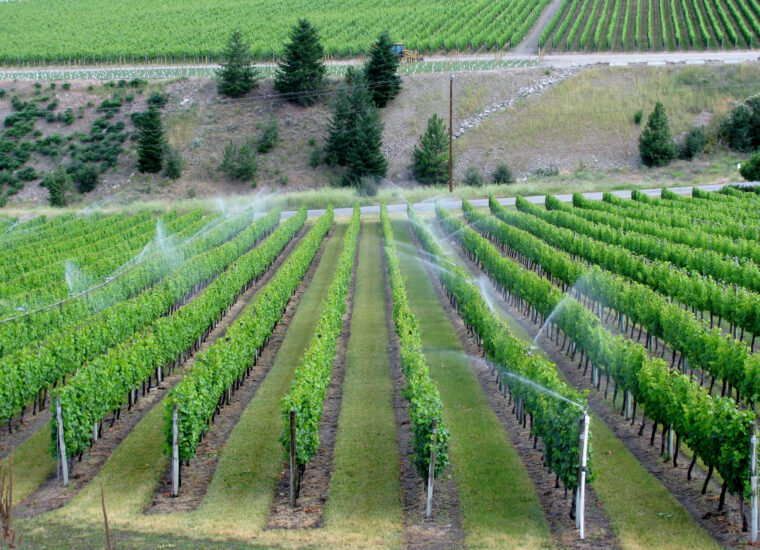

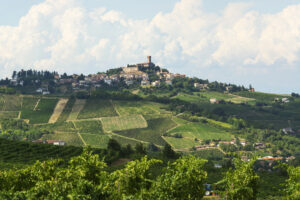
In Mediterranean regions (such as central-southern Italy and Spain), winters bring heavy rainfall and summers are long and hot, so it becomes essential to use cover crops, manage the canopy to limit evaporation, and implement reservoirs, terracing, and landscape design to manage the soil. In Atlantic areas (such as Bordeaux), the problem is the opposite: water is not lacking but stagnates, because it rains often and humidity promotes fungal diseases. In this case, water should not be retained but made to move, which requires drainage systems and biodiversity to combat pests. In continental regions (such as Piedmont, Burgundy, Germany, and the more inland parts of Oregon), rainfall is unpredictable and late frosts strike bare, cold soils: cover crops are needed to warm the soil in spring and protect it in summer, reduce evaporation through mulching (a grass-cutting technique, editor’s note), and increase the soil rooting depth.
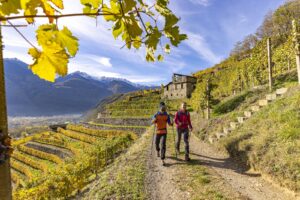
In arid regions (such as Australia, South Africa, and parts of California), water is scarce and therefore precious: soils must be covered, stored water must be recovered and reused, and irrigation is necessary. In mountain areas (such as Mount Etna and the Aosta Valley), water never stays still, so terracing, natural barriers to slow it down, and compost are needed to restore structure to soils depleted by intense downhill rainfall. In short, it is not water that must be managed, but the landscape. And, “Saving Every Drop in Wine” explains it, the new report produced by the Porto Protocol Foundation - the global network founded by Taylor’s Port that brings together companies from around the world to share information and work on sustainability and how to address climate change in the wine sector (including Italian players such as Salcheto, Pasqua, Manincor, San Polino, and Equalitas, among others, as well as global names like Gonzalez Byass from Spain, Concha y Toro from Chile, Catena Zapata from Argentina, and Joseph Drouhin and M. Chapoutier from France, just to name a few of them) - which in more than 200 pages, analyzed by WineNews, the report compiles insights and solutions with a clear goal: to guide how the wine sector manages water.
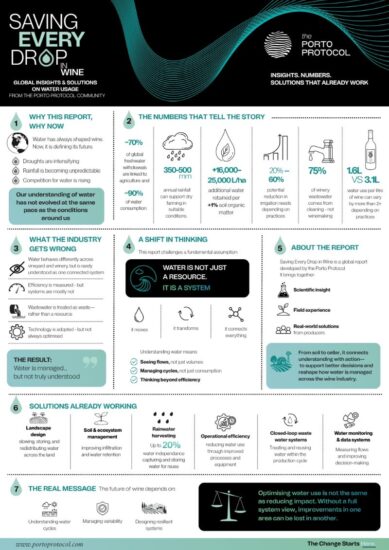
Water is becoming increasingly more unpredictable, due to droughts, irregular rainfall, and extreme weather events which are disrupting established patterns, making water availability less reliable and more difficult to manage. However, the report doesn’t propose a single solution. While all wine regions in the world face the issue, not all can address it in the same way due to differences in climate, terrain, and geography. The only shared direction is to work with natural systems, rather than treating them as simple external inputs.
The report, developed with contributions from experts Cornelis van Leeuwen, Hervé Quénol, Linda Johnson-Bell, Lucrezia Lamastra, Mimi Casteel, and Nicolas Quillé, analyzes water through multiple interconnected lenses: from broader ecological cycles to traditional and indigenous practices, from water footprint methodologies to the role of soil and regenerative hydrology in how water is captured, stored, and circulated within living systems, both in the vineyard and in the winery. It is headed by Brazilian winemaker Jihany Brecci: “the wine sector is at a crossroads when it comes to water - she said - this report draws on both scientific knowledge and the direct experience of producers to guide more informed, long-term decisions”. The study explains that water should not simply be managed, but understood within its cycle, it should not be “found in greater quantities, but lost less”, and every drop must be functional, otherwise it is wasted.
Related to this, the report lists several figures that can be improved through the proposed “best practices”: 70% of freshwater withdrawals are linked to agriculture, as are 90% of total water consumption; 350-500 millimeters of annual rainfall would be sufficient, if the suggested techniques are followed, for dry farming; every additional +1% of organic matter in soils would save between 16,000 and 25,000 liters of water per hectare; depending on the practices adopted, irrigation needs can be reduced by 20%-60%; 75% of winery wastewater comes from equipment washing rather than wine production; and by adopting the right techniques, producing one liter of wine can require almost half the water (1.6 against 3.1 liters).
“Water is not yet at the center of how our sector measures its impact. And this is a mistake - affirms Adrian Bridge, leader of the Porto Protocol Foundation - but this report changes the perspective: it invites us to see water as part of a broader living system and to recognize which our responsibility is to work with it, not against it”.
Copyright © 2000/2026
Contatti: info@winenews.it
Seguici anche su Twitter: @WineNewsIt
Seguici anche su Facebook: @winenewsit
Questo articolo è tratto dall'archivio di WineNews - Tutti i diritti riservati - Copyright © 2000/2026