


Tuesday 27th of October 2026 - Last Update: 17:03








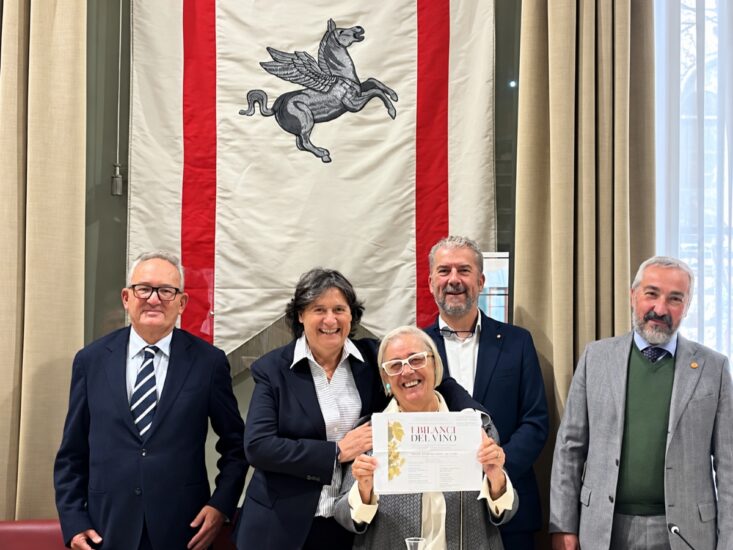
Total revenues reached 1.43 billion euros in 2025, showing a very slight decline of -0.2% compared to 2024, while remaining 2.2% higher than in 2023. Meanwhile, the Ebitda margin (earnings before interest, taxes, depreciation and amortization) declined for 63% of the companies analyzed. On the other hand, 64 companies increased their turnover, and among these, 28 also improved their margins. This is the picture, unprecedented in both scope and depth, outlined by the Management DiVino Research Center of Studio Impresa, basing on a sample of 130 Tuscan wine companies to assess the sector overall health. The findings were presented recently in the Sala del Gonfalone of the Regional Council of Tuscany in Florence during the financial education event “Wine Balance Sheets”, organized by the Italian Academy of Vine and Wine and Le Donne del Vino.
The picture that emerges is of a sector that is holding up at the regional level, albeit with margins under pressure and smaller businesses facing the greatest challenges. However, observers stress that the figures should not be viewed dramatically, especially in light of the international crisis affecting red wines, the category that has traditionally characterized most of Tuscany wine production. In any case, the results remain preliminary: the sample will soon be expanded to analyze the dynamics of the Italian wine sector at a national level and across other regions. In the meantime, and all the more so in the current climate, it is essential for companies to understand balance sheets, key indicators and costs in order to improve efficiency and support growth, even during periods of economic uncertainty.
This was confirmed by Luca Castagnetti of the Management DiVino Research Center of Studio Impresa, who presented the findings: “to navigate the ongoing selection process among wineries, clear figures and timely decisions are needed: first financial continuity, then a strategy focused on markets, investments and value creation”, he explained. Likewise, Davide Gaeta, professor of Wine Business Economics, Agri-food Markets and Competitiveness at the University of Verona, identified the balance sheet and management control systems as the two decisive tools for assessing corporate solidity, investment sustainability and production profitability, also highlighting the importance of production costs. “Analyzing cost centers, from the vineyard to marketing, makes it possible to calculate the full cost and the actual margin of each product. Accurate data on costs and revenues also allow companies to determine the break-even point, namely the minimum sales volume required to reach economic equilibrium”, he noted.
Economic and financial literacy is “essential for wine businesses, especially at a time when consumption patterns, markets and costs are changing,” said Donatella Cinelli Colombini, Tuscany delegate of Le Donne del Vino. “For this reason, we wanted to provide a framework based on practical tools to help companies better understand their businesses, protect their value and make more informed decisions”. These remarks were echoed by Rosario Di Lorenzo, president of the Italian Academy of Vine and Wine: “correctly interpreting financial statements, margins and capital structure means understanding a company current strength and building its future,” he commented. “The Academy promotes dialogue among research, managerial expertise and the production sector so that the wine industry can face change with the appropriate tools and a long-term vision”.
The Region of Tuscany has also extended its support to the sector. “at a time marked by changes in international markets and consumer habits, it is important to continue supporting our businesses by enhancing their quality, capacity for innovation and export vocation - concluded Stefania Saccardi, president of the Regional Council of Tuscany - the Region of Tuscany has long been committed to promoting the regional production system, including through initiatives such as Buy Wine and Buy Tuscany, which foster connections between companies and international operators”.
Copyright © 2000/2026
Contatti: info@winenews.it
Seguici anche su Twitter: @WineNewsIt
Seguici anche su Facebook: @winenewsit
Questo articolo è tratto dall'archivio di WineNews - Tutti i diritti riservati - Copyright © 2000/2026