


Wednesday 7th of October 2026 - Last Update: 13:36






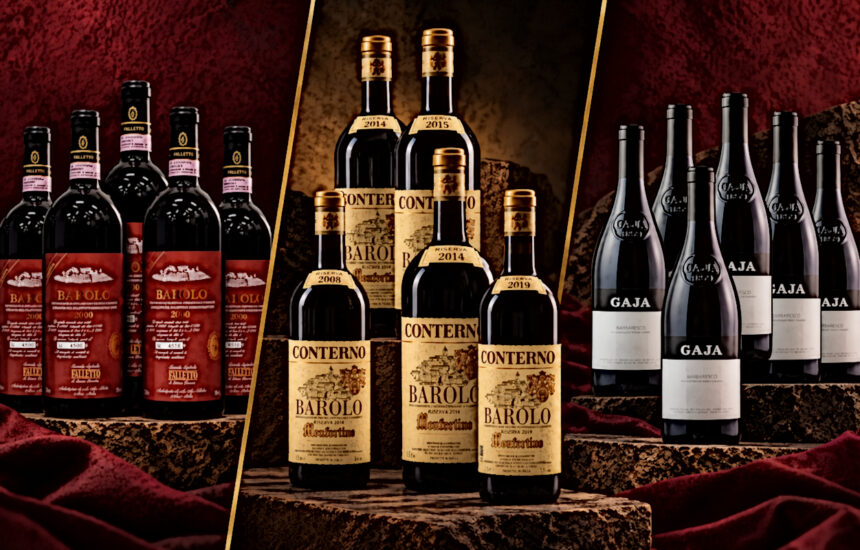
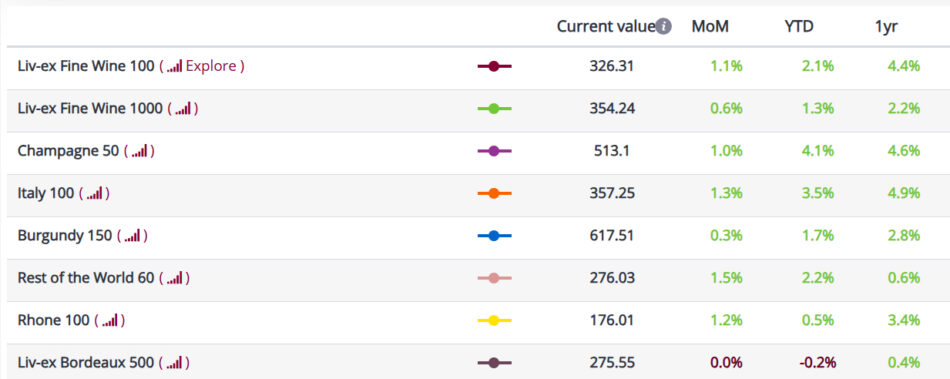
The fine wine market’s return to growth is gaining momentum, with Italy (and the Langhe region in particular) playing an increasingly prominent role (alongside Champagne). This trend comes from a niche comprising a very small number of wines of great prestige on the global stage, but whose performance offers some cause for optimism and serves as a counterpoint to a wine market that, in general, is still in a slump. This emerges from WineNews’ analysis of the performance of the Liv-Ex indices, the benchmark platform for the secondary market. From January through September, the Liv-Ex 100 - the platform’s benchmark index, which currently includes the following Italian wines: Bartolo Mascarello’s 2019 Barolo, Bruno Giacosa’s 2016 Barolo Falletto Vigna Le Rocche Riserva, Gaja’s 2019 Barbaresco, Giacomo Conterno’s 2015 and 2019 Barolo Monfortino Riserva, the 2021 and 2022 Masseto, and the 2021 Ornellaia (Frescobaldi Group), the 2016, 2021, and 2022 Sassicaia from Tenuta San Guido, the 2021 Solaia and the 2021 and 2022 Tignanello from Marchesi Antinori, and the 100% Sangiovese IGT Toscana 2020 from Soldera Case Basse - in the first nine months of 2026, it achieved a solid +2.1% increase, which rises to +4.4% when viewed over a one-year period. With Italy accounting for four of the top 10 best-performing wines in the index, starting with No. 1, Bruno Giacosa’s Barolo Falletto Vigna Le Rocche Riserva 2016, which has risen 31.7% year-to-date, alongside Conterno’s Barolo Monfortino Riserva 2019, up 19.4%, the 100% Sangiovese IGT Toscana 2020 from Soldera Case Basse, up 18.7%, and Antinori’s Solaia 2021, up 14.1%.
And with Monfortino and Giacosa also ranking in the “top 10” of the Liv-Ex 1000, the broadest of the Liv-Ex indices, which rose by +1.3% in 2026 and +2.2% over the past 12 months. This is largely thanks to the Champagne 50 (up 4.1% in 2026 and 4.6% over the past 12 months), the Italy 100, up 3.5% in the first 9 months of 2026, and up 4.9% over the past year (during which it was the best-performing index overall). An important result for the Italian index, which now includes Bartolo Mascarello’s Barolo from the 2012 to 2021 vintages, followed by Bruno Giacosa’s Barolos, including the Barolo Falletto Le Rocche del Falletto Riserva 2007 and 2008, the 2001 and 2004 Barolo Falletto Le Rocche del Falletto di Serralunga d’Alba Riserva, and the 2011, 2012, 2014, 2016, 2017, and 2020; and, furthermore, Gaja’s Barbaresco from the vintages 2013 through 2022, Giacomo Conterno’s Barolo Monfortino Riserva from the vintages 2002, 2004, 2005, 2006, 2008, 2010, 2013, 2014, 2015, and 2019; all vintages from 2013 through 2022 of the most famous Super Tuscans, from Tenuta San Guido’s Sassicaia to Marchesi Antinori’s Solaia and Tignanello, and Frescobaldi’s Ornellaia and Masseto; and from all vintages from 2011 to 2020 of Soldera Case Basse’s 100% Sangiovese IGT Toscana.
With a “top 10” list for the category headed by the Langhe region, because in addition to the aforementioned Liv-Ex 100 “record-holder” from Giacosa, the podium also features the 2005 Barolo Monfortino Riserva, up 30.4%, and Gaja’s 2015 Barbaresco, which has appreciated by 22.5% since the start of the year. Next comes another Barolo from Giacosa, this time the 2020 vintage, up 21.3%, followed by another Monfortino vintage, the 2019, up 19.4%. Then comes Tuscany, with the star of the show, once again, being Soldera Case Basse’s 100% Sangiovese IGT Toscana (with the 2020, 2012, and 2011 vintages up 18.7%, 16.1%, and 13.5%, respectively), along with Frescobaldi’s 2016 Masseto (up 17.7% year-to-date) and Antinori’s 2021 Solaia (up 14.1%).
But what makes this even more significant is the recovery of nearly all the indices, because while the Bordeaux 500 is the only one still slightly in negative territory, albeit essentially flat (-0.2% in 2026 and +0.4% over the past 12 months), the Burgundy 150 (+1.7% and +2.8%), the Rhône 100 (+0.5% and +3.4%), and even the Rest of the World 60 (+2.2% year-to-date and +0.6% over 12 months).
As mentioned, this is a sign of recovery coming from a niche market of a few rare and sought-after wines, but it nonetheless offers hope during a period when the overall wine market remains extremely challenging.
Copyright © 2000/2026
Contatti: info@winenews.it
Seguici anche su Twitter: @WineNewsIt
Seguici anche su Facebook: @winenewsit
Questo articolo è tratto dall'archivio di WineNews - Tutti i diritti riservati - Copyright © 2000/2026