








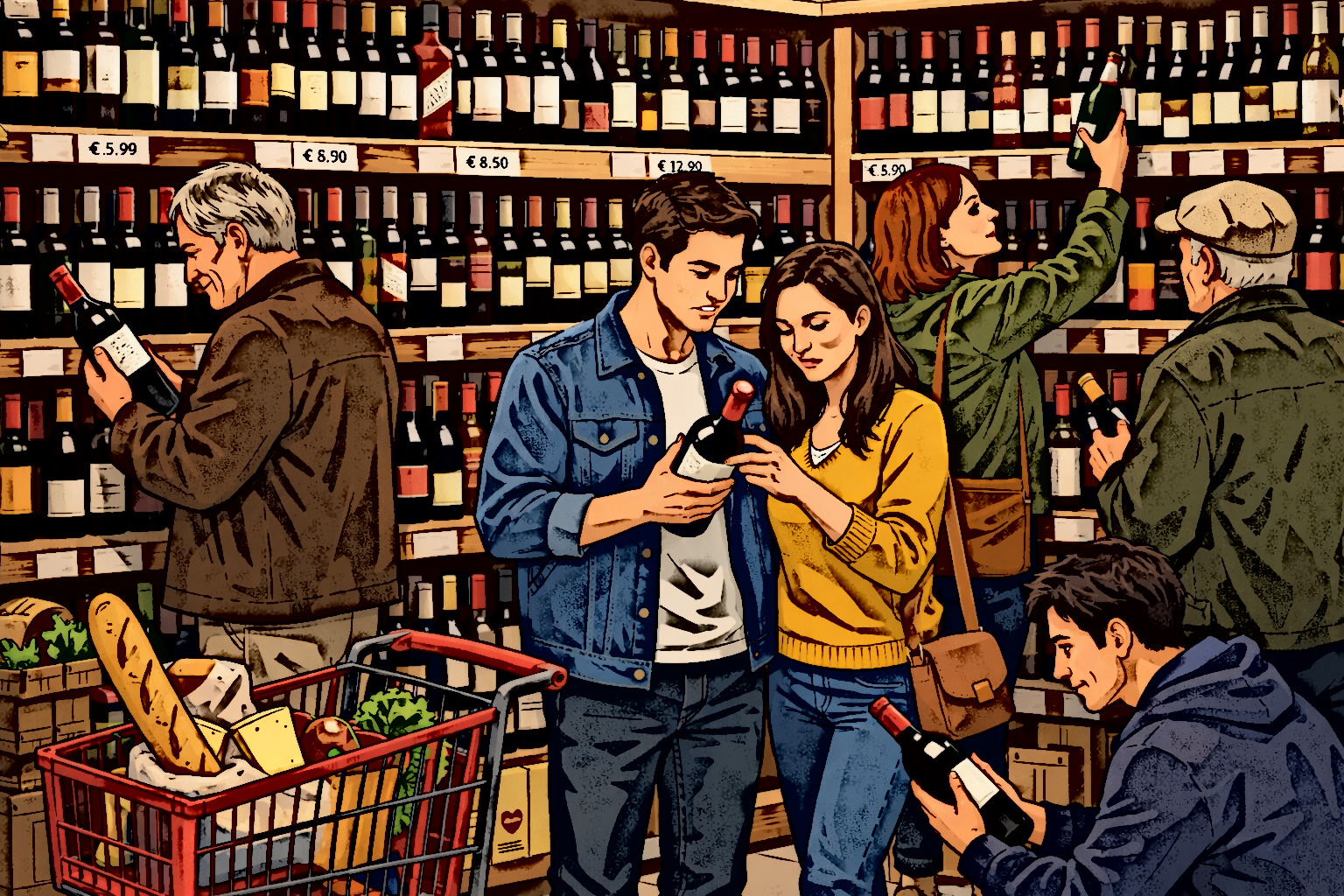
Slight decline in volumes, essentially stable in value: waiting for the year-end holidays which, however, are unlikely to work the miracle of reversing the trend, wine sales in large-scale retail in 2025 will close down for the fifth consecutive time. This emerges from Circana summary data about the first 11 months of the year, reported by WineNews, according to which from January to November, just over 552 million liters of wine were sold on the shelves of Italian large-scale distribution (hypermarkets, supermarkets, discount stores, and small self-service) (-3% compared to the same period in 2024), for a total value of 2.05 billion euros (-0.4%), at an average price of 3.72 euros per liter (+2.7% compared to 2024). The category with the greatest impact, that of wines in the classic 0.75-liter bottle, performed better than average in volume (-1.8% for 293.6 million liters) and moved slightly more money (1.58 billion euros, +0.4%), with an average price per liter of 5.4 euros (+2.3% compared to 2024).
In the coming weeks, the final balance will arrive, which, however, seems already determined in its dynamics, as Virgilio Romano of Circana explains to WineNews: “we are heading toward closing a year that, for the fifth consecutive time, will see declining figures for wine. We will have to wait just a few weeks to understand whether it will still be an improvement compared to 2024. At the risk of repeating ourselves, socio-demographic factors do not help, and the economic situation rather pushes for caution in purchases, resulting in declining sales. Promotions are in line with 2024 for the same period, and price tensions appear to be cooling, so the likely negative closure of 2025 should not be read with resignation but as an acknowledgment of consumption settling at different levels than in the past, allowing companies to implement appropriate strategies to compete within the new (which is not so new) market scenario”.
Moreover, an increasingly “older” Italian population, a general spending capacity which has been declining for years, the rise of health-consciousness, and changing consumption habits, especially among younger groups, who have a much wider variety of choices for what to put in their glass compared to previous generations (as one can also read in the latest Istat report on the subject), leave little room for imagination for a wine sector already facing shrinking consumption spaces, making it an obligatory choice to work on the value chain.
Copyright © 2000/2026
Contatti: info@winenews.it
Seguici anche su Twitter: @WineNewsIt
Seguici anche su Facebook: @winenewsit
Questo articolo è tratto dall'archivio di WineNews - Tutti i diritti riservati - Copyright © 2000/2026