


Tuesday 3rd of March 2026 - Last Update: 11:29







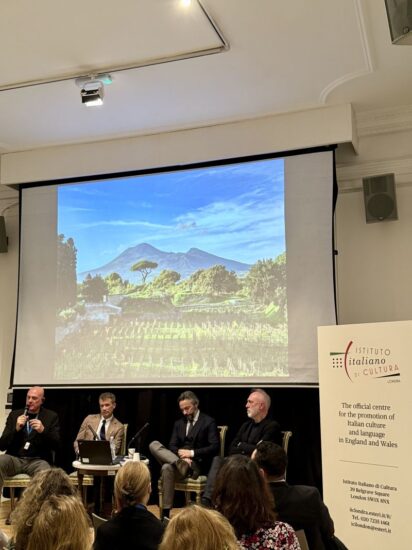
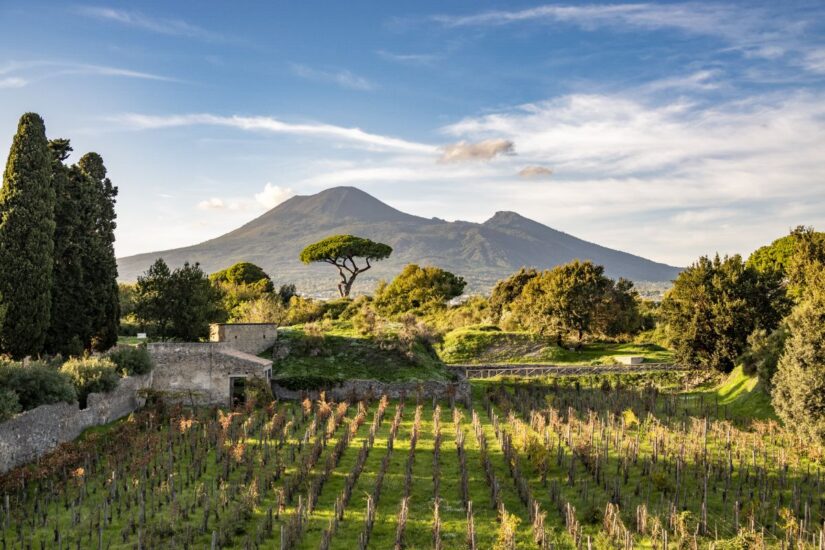
Telling and promoting Pompeii wine project through the network of Italian Cultural Institutes abroad, under the Ministry of Foreign Affairs, with the aim of sharing the enthusiasm, vision, and uniqueness of a one-of-a-kind public-private partnership model founded on culture, sustainability, scientific research, and the enhancement of made in Italy. It is one of the most important and prestigious examples in the long history linking the world of wine with that of culture, and it is now writing a new chapter for Italian and global viticulture and cultural heritage. This is what the Archaeological Park of Pompeii and the Tenute Capaldo Group did in recent days, with the first stop at the Italian Cultural Institute in London, launching a new phase of the project which is seeing the (re)birth, among the excavations of the Roman city buried by the eruption of Vesuvius in AD 79, of an “archaeological vineyard” which will eventually exceed six hectares, planted with local native varieties on soils untouched for over two thousand years, along with the creation of an organic winery within the Park to bring “Pompeian wine” back into production. This is made possible thanks to significant research carried out in collaboration with Attilio Scienza, professor of Viticulture at the University of Milan and one of the world's leading experts in the field, and the know-how of the Basilisco and Feudi di San Gregorio wineries and their head of production, agronomist Pierpaolo Sirch. The project is taking shape in one of the most important archaeological areas in the world, which will welcome over four million visitors in 2025.
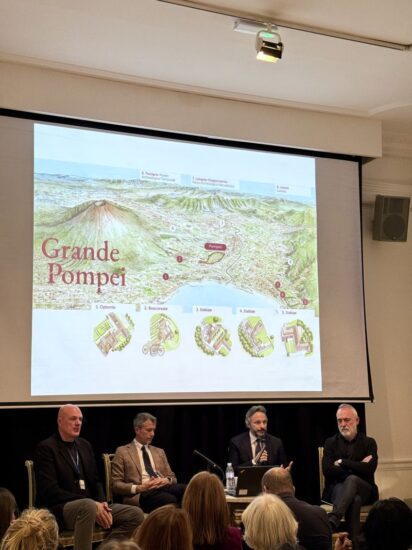
Following the official presentation held at the Ministry of Agriculture in Rome, Pompeii wine project is entering a new phase with its international promotion through the network of Italian Cultural Institutes. The first leg on this international journey was London, on February 25th, with a presentation event hosted by the Italian Cultural Institute, attended by its director Francesco Bongarrà, along with Gabriel Zuchtriegel, director of the Archaeological Park of Pompeii; Antonio Capaldo, èresident of Feudi di San Gregorio; Pierpaolo Sirch, head of production at Feudi di San Gregorio; and Nic Palmarini, director of Nica - National Innovation Centre for Ageing (the UK), one of the world leading experts on longevity, lifestyle, and innovation. Their presence underscored the contemporary and cross-disciplinary dimension of the project, which is able to engage with the major challenges of our time.
“Wine is culture, history, economy, research, taste. And more. This is why we are delighted to host this wonderful initiative, through which we share with the British public an extraordinary story of archaeology, wine, taste, and Italian culture”, underlined Francesco Bongarrà. “For us, this project represents a great responsibility and an extraordinary opportunity - said Antonio Capaldo - wine has always been a central element of Mediterranean culture and of human history. Pompeii gives us the chance to recall this in a direct way and to demonstrate, as entrepreneurs, the ability to invest sustainably in long-term projects and in the cultural value of wine”. “Frescoes and objects found in Pompeii show that wine had something sacred for the Romans: this implied the protection of cultivation knowledge and practices, as well as conscious use, conviviality, and rituality - recalled Gabriel Zuchtriegel - our project ultimately aims to show how this ancient tradition continues to survive and re-emerge in Campania, thanks to research and excavations in Pompeii, Longola, Oplontis, Boscoreale, and Stabia, but also thanks to the work of the women and men who, by cultivating the land over centuries and millennia, have shaped the Italian landscape. Agriculture and culture, sharing the same root, not by chance, are deeply interconnected.” “With this project - pointed out Pierpaolo Sirch - we intend to deepen our understanding of ancient viticultural models, native grape varieties, and tree-trained vine systems typical of Etruscan viticulture in Pompeii at the time, creating true vineyard-gardens capable of telling this story through a strategic relationship between archaeology, vines, and wine, in order to promote quality tourism and offer an interpretive model for the immense richness of Italian viticulture.”
“The Mediterranean cultures which truly taught the world the art of living long didn’t do so despite their conviviality, but because of it. If you remove the moment of being together and leave only the wine, nothing remains. But if you preserve the ritual of gathering, you obtain something no medicine has yet been able to reproduce. This, in its deepest sense, is the meaning of the project in Pompeii. It is not simply a winery: it is a statement of principle”, explained Nic Palmarini.
The Pompeii initiative is unique in its kind: more than 6 hectares of vineyards cultivated according to organic and sustainable practices within the archaeological area, and a winery located in one of the most iconic sites of world cultural heritage. It is a project with cultural aims before commercial ones, seeking to revive the historical role of wine as an ambassador of civilization. After London, the project will continue its international journey across Europe, with the intention of extending its story overseas as well through a series of events in major Italian Cultural Institutes abroad: a journey which weaves together archaeology, agriculture, research, and culture, showcasing an Italy capable of preserving its roots while speaking the language of the future through an innovative and forward-looking public-private partnership.
Copyright © 2000/2026
Contatti: info@winenews.it
Seguici anche su Twitter: @WineNewsIt
Seguici anche su Facebook: @winenewsit
Questo articolo è tratto dall'archivio di WineNews - Tutti i diritti riservati - Copyright © 2000/2026