


Wednesday 25th of February 2026 - Last Update: 14:29





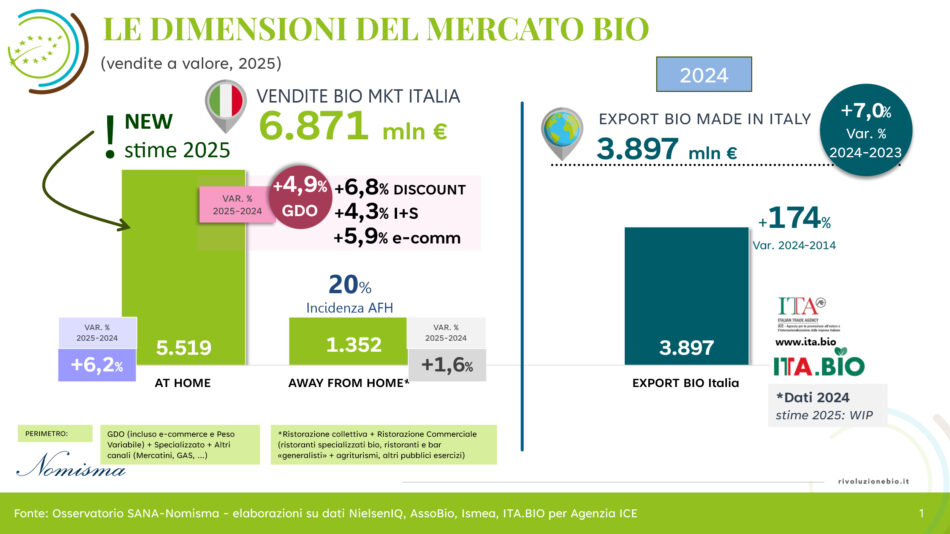
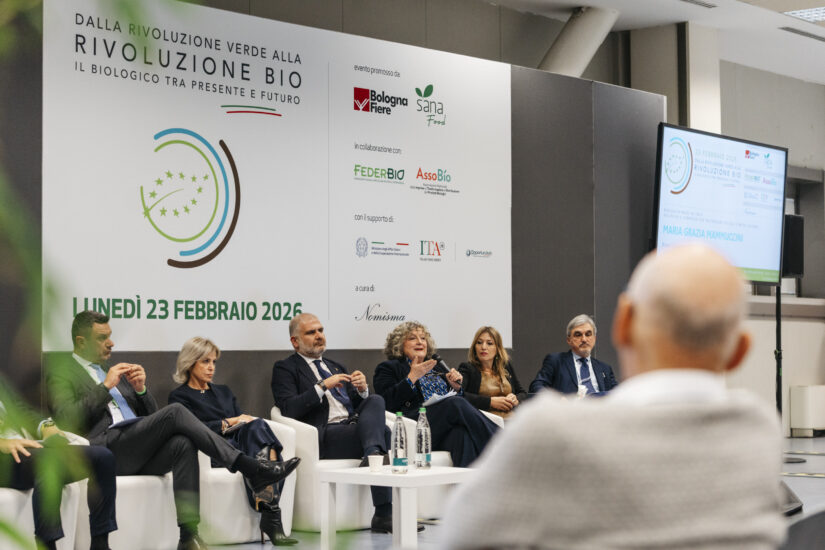
A growing market which has reached 6.9 billion euros (+6.2%), with positive trends across all categories, from the domestic segment, which is worth 5.5 billion euros (+4.9% for large-scale retail in 2024), to out-of-home consumption, which accounts for 20% (+1.6% in 2024 for a total value of 1.35 billion euros). There are also positive signs for large-scale retail, which recorded a +4.9% increase over the previous year, with growth in discount stores (+6.8%), hypermarkets and supermarkets (+4.3%), and even e-commerce (+5.9%). Modern distribution is consolidating its role as the primary purchasing channel for organic products (64%). These findings come from “Mercato italiano del bio” - “Italian Organic Market” report, presented by Nomisma today at BolognaFiere during “Organic Revolution” - “Rivoluzione Bio” 2026 at Sana Food and the Slow Wine Fair, based on the Sana Observatory 2026. Data shows that organic products are no longer a niche phenomenon, but rather a growing category driven by values such as health, well-being, and sustainability. The sector still holds significant potential, though challenges remain.
It is enough to consider that two-thirds of consumption is concentrated among just 20% of households. This comes despite a slight increase in food inflation in 2025, rising to +2.9% compared to the general index of 1.5%. This is particularly relevant given that one in three Italians plans to reduce out-of-home spending over the next 12-18 months, while one in two looks for deals and fixed-price menus to better manage their budget without giving up dining out. Promotions, low-cost offerings, and private-label products are rising in consumer sentiment, in contrast to well-known and industrial brands. The growth of organic aligns well with 2026 domestic consumption intentions, with Italians aiming to bring to the table healthy food (61%), simple and authentic food (54%), and traditional dishes (46%). For the current year, domestic food spending is expected to grow (+20%) more than it decreases (-11%), unlike out-of-home consumption, where a +12% increase coexists with a projected -30% among those choosing to cut back.
In 2025, domestic consumption of organic products accounted for 64% of modern distribution (+6.1% compared to 2024), worth 3.5 billion euros. Specialized organic stores cover 20% of total domestic sales (1.1 billion euros, +7.5%) and represent 20% of the channel share. In 2025, organic products within modern distribution grew by +4.9% in value over 2024 (+2.9% for food overall), +3.6% in volume (+0.8% for food overall), and promotions accounted for 15.6% of organic sales (-1%). Yet, only 25% of distributors increased organic assortments (by at least 2%) to seize growth opportunities.
Among informed organic-purchasing households, demand rose from 53% in 2014 to 93% in 2025, and the number of families who purchased organic food & beverage at least once in the past year increased from 13 million (2012) to 24 million (2025). Vegetarians, health-oriented consumers, university graduates, Millennials, and younger age groups are among the main users of the category.
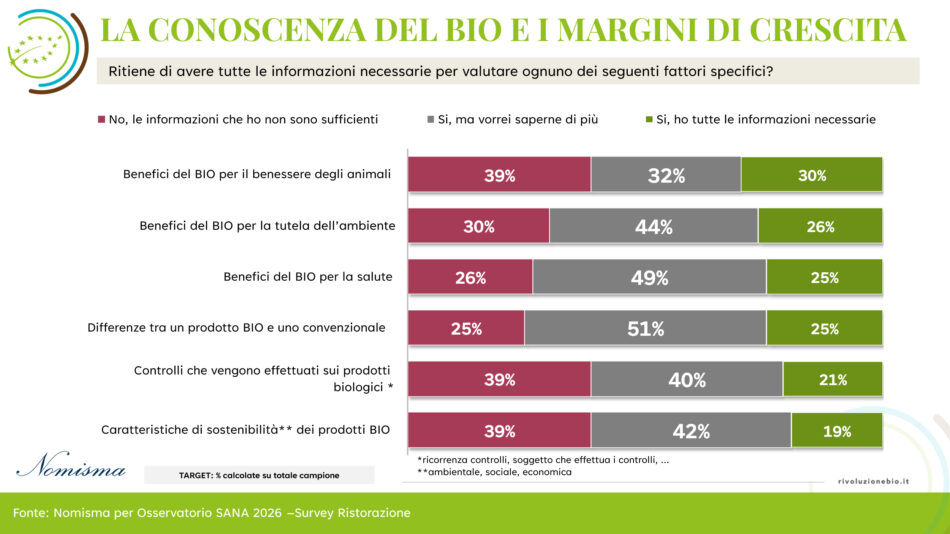
In terms of sales value, the top 15 categories in modern distribution (1.1 billion euros) represent 47% of total organic sales in 2025. The top 5 alone account for 27% of the total, led by chicken eggs (212.8 million euros), rice cakes (125.6 million euros), Uht milk substitutes (119.2 million euros), fruit jams and spreads (118 million euros), and extra virgin olive oil (70.5 million euros). Wine doesn’t fall within the top 15. In modern distribution, the share of organic products within total food is 2.8%, stable (+0.1%), demonstrating significant room for future growth. Among purchased products, 79.9% of rice cakes are organic, 40.3% of bananas, and 38.4% of seeds. The study also focused on out-of-home demand in 2025: only 3% reported “always” consuming organic meals or beverages (3-4 times per week) in restaurants, trattorias, bars, or canteens; 14% once a week; 18% 1-2 times per month; 35% occasionally (more rarely); 23% never; and 7% don’t plan to in the next twelve months. Furthermore, 35% of consumers want more organic products in hospital cafeterias, 33% in corporate canteens, 30% in school canteens, 24% in bars, and 14% in restaurants, where 24% already find all the organic products they want. The satisfaction gap is -28% in bars, -3% in restaurants, and -43% in hospital canteens. When asked whether the establishment offers dishes made with organic ingredients, wines, or other certified organic beverages, 86% reported the presence of organic ingredients, 85% organic wines, and 67% other organic options. Organic is perceived as an expression of ethical choice and sustainability (46%), as well as a response to consumer needs for health and well-being (40%). One motivation for adopting organic products is the synergy among supply chain actors: some restaurateurs (38%) offer organic products after being encouraged by local producers. A deeper understanding of organic, its certification values and distinctions from conventional products, is key to strengthening its presence in the out-of-home channel. Yet, today, 75% of operators lack sufficient information about production methods and their environmental, health, and animal welfare impacts: an information gap which limits organic full potential and underscores the need for better training and communication. Among obstacles to the success of organic in food service, 64% cite high purchase costs, and 24% say customers appreciate other product characteristics more.
Out of the four growth drivers identified for organic products, the two related to the domestic market focus on increasing the share of frequent-user households and expanding assortments, with greater breadth and depth in emerging categories. For out-of-home consumption, the emphasis is on experimenting with new products and ingredients, as well as new uses, encouraging consumption beyond traditional categories. Furthermore, the transfer of product value knowledge to consumers could be better leveraged through the “mediation” of restaurateurs, whose role as cultural touchpoints should be strengthened. When asked about trends for the coming years, restaurateurs and bartenders agree that customers are increasingly attentive to ingredient quality, transparency, and environmental impact. Organic therefore emerges as a natural and coherent response: 26% of operators expect an increase in spending on organic raw materials in the next 2-3 years, signaling growing trust in its potential. Meanwhile, 28% foresee fewer out-of-home dining occasions, as families try to control expenses, making each outing more selective and oriented toward experiential venues and high-quality offerings.
“Here is exactly where organic finds its full coherence - comments Silvia Zucconi, New Market Intelligence Director at Nomisma - its characteristics align perfectly with new consumer expectations, who seek authentic, valuable out-of-home experiences based on simple, minimally processed dishes which can meet the growing demand for alternatives tailored to specific diets or healthier, lighter lifestyles”.
The value of organic emerges clearly from the contributions presented at “Organic Revolution”, including the Pnrr supply chain contracts: 88 in total, worth 1.76 billion euros, of which 28 involve organic production, attracting 458.17 million euros (including 4 for the wine sector, worth 60.4 million euros out of 12 total programs for the wine industry, which received 245.9 million euros in funding). There are also 56 biodistricts across 12 Italian regions, 46% of them located in Central Italy.
Copyright © 2000/2026
Contatti: info@winenews.it
Seguici anche su Twitter: @WineNewsIt
Seguici anche su Facebook: @winenewsit
Questo articolo è tratto dall'archivio di WineNews - Tutti i diritti riservati - Copyright © 2000/2026