


Tuesday 3rd of March 2026 - Last Update: 11:26






In 2025, the organic market celebrated a record year, reaching 6.9 billion euros (+6.2%), with positive trends across all categories, from the domestic market, worth 5.5 billion euros (+4.9% for large-scale retail compared to 2024), to out-of-home consumption, which accounts for 20% (+1.6% compared to 2024 for a total value of 1.35 billion euros). There were also positive signals for discount stores (+6.8%), hypermarkets and supermarkets (+4.3%), and e-commerce (+5.9%). As a result, modern retail has consolidated its position as the leading sales channel for organic products (64%), as revealed by data from the “Italian Organic Market” presented by Nomisma in recent days at BolognaFiere, during “Rivoluzione Bio” - “Organic Revolution” at the Sana Food & Slow Wine Fair, produced by the Sana 2026 Observatory (as reported by WineNews) among growth and still-untapped potential. But what is the role of organic wine (which doesn’t rank among the top 15 products by sales value, ed) in the main distribution channels? Nomisma explained that 85% of venues offer organic wines, although the data suggests there is still room for growth. Consider that in restaurants, only 4% offer exclusively organic wines, 87% offer “also” organic wines alongside conventional ones, and 9% don’t include organic wines on their wine lists. The results differ for bars, where only a very small share offers exclusively organic wines; 78% offer them alongside conventional wines, while 21%, more than one bar out of five, don’t sell organic wines at all. Yet, operators clearly recognize the value of the organic label, starting from factors such as environmental sustainability (49%), traceability (40%), and reduced pesticide use (35%). According to 51% of respondents, organic products also support premium positioning and differentiation, ensuring high quality in menu offerings; for 40%, they represent an ethical and sustainable choice.
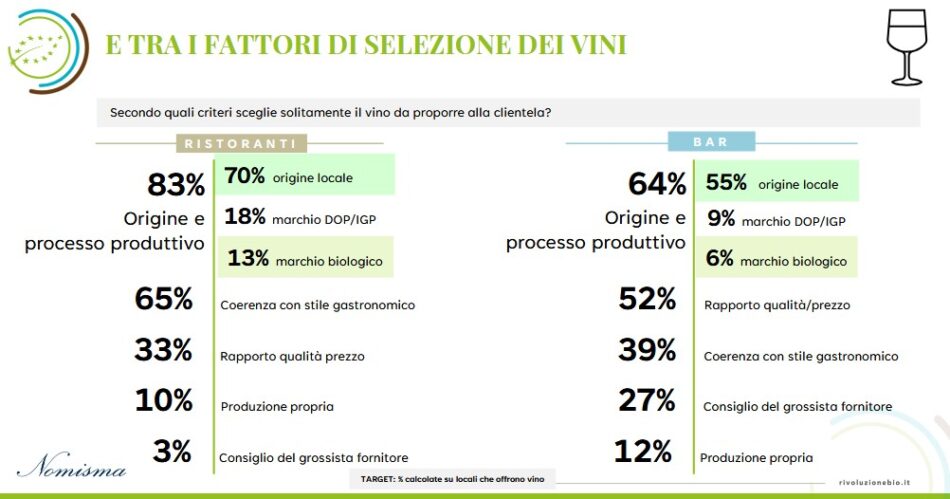
In restaurants, venues mainly source organic wines directly from producers (67%), while fewer rely on wholesalers (22%), local retailers (6%), supermarket chains (2%), or their own agricultural production (2%). When asked, “according to which criteria do you usually choose the wine to offer customers?”, 83% of restaurants consider origin and production process (70% local origin, 18% PDO/PGI certification, 13% organic certification), 65% look at consistency with the gastronomic style, 33% at the quality-price ratio, 10% at in-house production, and 3% at recommendations from the wholesale supplier. For bars, origin and production process account for 64% (55% local origin, 9% PDO/PGI certification, 6% organic certification). The quality-price ratio (52%) weighs more heavily than in restaurants, while consistency with gastronomic style (39%) matters less. Bars also place greater importance on guidance from their wholesale supplier (27%) and on their own production (12%).
For “non-users”, more accessible prices and promotions (69%) would encourage the inclusion of more organic dishes and wines on menus, while 44% cite the need for more information on product characteristics and customer interest. High costs (50%) are the main reason why they don’t offer organic options, but 38% also point to a lack of knowledge and the inability to showcase organic products effectively. “Non-users” appear resistant to organic products, with 78% considering the likelihood of introducing organic food or wine in the next 2-3 years “low or nonexistent”.
Having more information could further accelerate the presence of organic products in the out-of-home sector: 30% feel they lack sufficient information on the benefits of organic production for animal welfare, 26% for environmental protection, 25% for health, 25% for differences between organic and conventional products, 21% for the controls carried out on organic products, and 19% for the sustainability characteristics of organic items.
Finally, regarding collective catering, organic products are perceived as an added value, but their growth will depend on the balance between regulatory requirements, product availability, and economic sustainability.
Copyright © 2000/2026
Contatti: info@winenews.it
Seguici anche su Twitter: @WineNewsIt
Seguici anche su Facebook: @winenewsit
Questo articolo è tratto dall'archivio di WineNews - Tutti i diritti riservati - Copyright © 2000/2026