


Sunday 20th of September 2026 - Last Update: 21:50







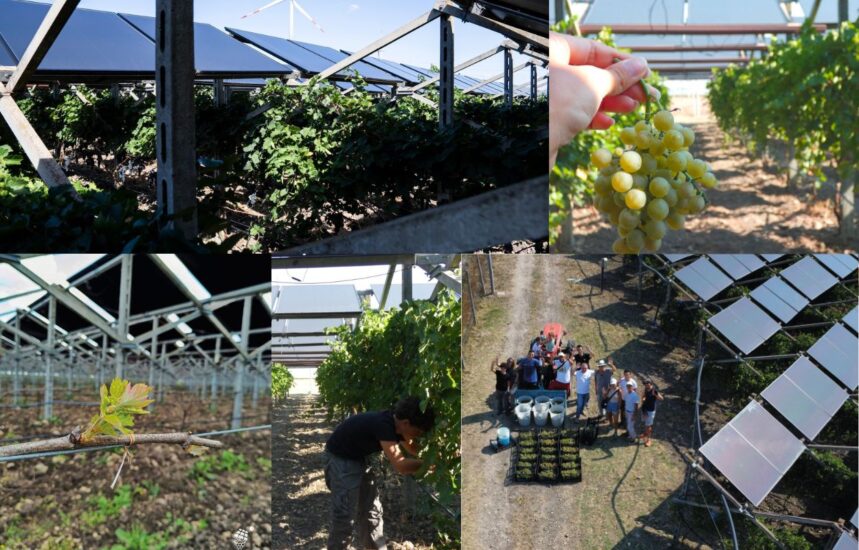
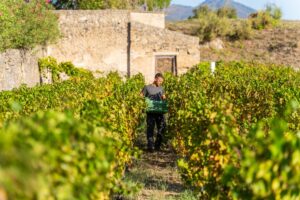
As farms and livestock facilities are increasingly more often producing energy, thanks to the many funds allocated by the Government through various agrivoltaic incentive schemes, the issue of solar panels installed above fields and vineyards is proving more controversial. And yet, there is no shortage of virtuous experiences. One such example (which we had already reported on here) is linked to one of the many vineyards of the Caviro Group, among the leaders of Italian wine cooperatives. Another is the “made in Puglia” initiative known as the “Community Agrivoltaic Vineyard”, founded by Nicola Mele and Emilio Roggero: a production model which combines viticulture and renewable energy, and one of the most advanced experiences discussed also at Vinitaly 2026 in Verona (with, among others, Davide Gangi, president of Vinoway Italia, enologist Antonio Scatigna, and Donato Giorgio, Head of Commercial Development). “The project,” explains agricultural entrepreneur and head of commercial development Donato Giorgio, “represents a concrete synthesis between agriculture and renewable energy: the photovoltaic pergolas installed above the vine rows create a favorable microclimate, reduce water requirements and protect the plants from extreme weather events, while at the same time contributing to the production of electricity.” The “Community Agrivoltaic Vineyard”, the first installation of its kind in Puglia and among the first in Europe, covers 18 hectares in the Matine area, a wide plain of the Murgia region that includes the municipalities of Altamura, Santeramo in Colle, Laterza and Matera.
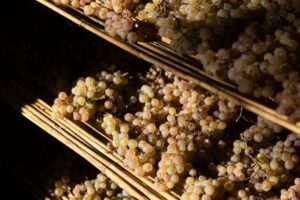
“Thanks to the shading provided by the photovoltaic panels, the 2025 growing season eliminated water consumption for irrigation, resulting in significant water savings - underlined Giorgio - and the production of electricity from photovoltaic sources also makes it possible to substantially offset Co2 emissions, strengthening the sustainability profile of these wines.” These results are supported by analyses conducted with the University of Bari, which highlight a carbon footprint of around 1.17 kg of Co2 equivalent per bottle (0.5 L), calculated according to the ISO 14067:2018 standard and verified within the UniBA Agritech research partnership. The agrivoltaic system also enables the generation of renewable energy sufficient to prevent the emission of 148 tonnes of Co2 each year, thanks to production exceeding 450,000 kWh per hectare. “The wines produced from Falanghina, Aromatic Traminer and Primitivo grapes - over 2,000 bottles in total in 2025 - continues Giorgio - represent some of the first examples in Puglia and Italy of agrivoltaic wines made available to the public, opening up a new perspective in the national wine landscape”.
From a technical standpoint, agrivoltaics also introduce a paradigm shift in the winery. “Vinifying grapes grown under agrivoltaic systems - explains enologist Antonio Scatigna - requires a profoundly different stylistic approach. The delay in technological ripening allows us to work on more interesting balance curves, preserving greater aromatic integrity and more precise management of the acid–sugar components. From a wine perspective, the extraordinary health of the grapes makes it possible to enhance a genuine freshness, which translates into wines which are more dynamic, taut and clearly defined on the palate. It is a new interpretation of traditional grape varieties, opening up to a contemporary vision of wine, where sustainability and technical precision meet in a concrete and expressive way”. This work is also made possible by the continuous fine-tuning of specific oenological protocols for agrivoltaic grapes, developed and refined through active collaboration with the Crsfa “Basile Caramia” of Locorotondo, a leading centre for agricultural research and experimentation.
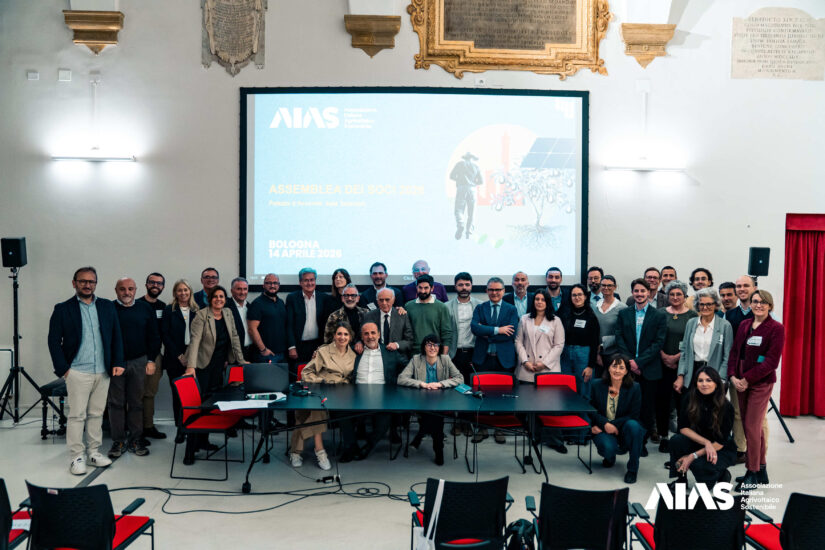
More broadly, the agrivoltaic theme is extremely topical, given the prolonged phase of “energy crisis”, both in terms of costs and supply security, which began with the war between Russia and Ukraine and has now been further exacerbated by the conflict between the USA and Iran. The topic was also debated at a recent conference organized by the Italian Association for Sustainable Agrivoltaics in Bologna, which highlighted “the need to transform the transition toward sustainable agrivoltaics into a participatory pathway for local territories, based on mutual dialogue between businesses, communities and institutions”. Among others, Alessandra Scognamiglio, president of Aias and Coordinator of the Sustainable Agrivoltaics Task Force at Enea (the Italian National Agency for New Technologies, Energy and Sustainable Economic Development), stressed that “the turning point in the design of sustainable agrivoltaic infrastructure lies in abandoning the logic of impact and “compensation” in favor of projects which are truly transformative tools, capable of generating positive environmental, economic and social outcomes”. Only this approach, explains Aias, will allow for the full integration and social acceptance of a valuable instrument for domestic energy production, especially in light of the fragility demonstrated by Italy and Europe in the most recent period, as highlighted during the conference by Vincenzo Colla, vicepresident and Councillor for Economic Development and Green Economy, Energy, Vocational Training, Universities and Research, and International Relations of the Municipality of Bologna. This is “within a context in which agrivoltaic technology is not in opposition to agriculture, but becomes one of its fundamental allies. Protecting crops from increasingly frequent extreme weather events (hail above all, but also drought and abnormal rainfall) through the installation of agrivoltaic panels allows farmers to diversify their income without sacrificing the quality of agricultural production”. As also emphasized by Claudia Romano, head of the Energy and Ecological Transition of Enterprises Department of the Emilia-Romagna Region, in Italy there is an evident need to overcome significant legislative criticalities in the dialogue between the State and the Regions. National regulations often contain definitions that do not take local specificities into account (for example, regarding the inclusion of Unesco areas), thus creating implementation problems that force Regions to adopt overly cautious interpretations, potentially slowing down the country’s innovation process. Genuine collaboration and open dialogue between businesses, institutions and citizens are essential.
The real point of implementation of national and regional laws lies with municipalities, which often face the first backlash when it comes to social acceptability by citizens, as described by Monica Cinti, mayor of Monte San Pietro (Bologna) and Energy and Environment Coordinator for Anci Emilia-Romagna, and Benedetta Brighenti, president of the Agency for Energy and Sustainable Development (Aess) and director general of the National Network of Local Energy Agencies (Renael). Mauro Sarrica, professor of Social Psychology at the University of Padua, also emphasized that, in order to overcome territorial distrust, design processes must be participatory, considering communities as stakeholders. And for sustainable agrivoltaics to find a definitive positive space in the public debate, before even reaching the fields, it is crucial to keep high-quality, conscious and landscape-respectful design at the center, as underlined by Gioia Gattamorta, president of the National Institute of Architecture (In/Arch) Emilia-Romagna. “Sustainable agrivoltaics are not just about combining energy and agricultural production, but represent a true territorial project involving local productive activities, farmers, energy-sector investors, and also territorial stakeholders: those who physically host the plants and those responsible for planning their integration”, stated Simona De Iuliis of Enea, head of Strategic Technical Support in the Department of Energy Technologies and Renewable Sources.
An extensive five-year research project presented by Filippo Lafleur (Land) has shown that the Po Valley, currently affected by a strong simplification of land use, still holds enormous potential worth exploring: for example, in Castelguglielmo (Rovigo), a 24-hectare existing agrivoltaic plant is being redeveloped, going beyond merely compensating for the environmental damage caused by energy production and instead using the agrivoltaic project itself as leverage to restore ecology within the site. The plant will include wetland areas for biodiversity and integrated rest areas to promote local cycling tourism, thus giving space back to the community. Another example of this virtuous integration emerged during the roundtable discussion in Bologna entitled “Unire i puntini: qualità del progetto, paesaggio, beneficio pubblico e concertazione pubblico-privato per l’ecosistema dell’agrivoltaico” - “Connecting the dots: project quality, landscape, public benefit and public–private collaboration for the agrivoltaic ecosystem”.
Enrico Piraccini, head of Energy Innovation at Hera, illustrated how in Faenza the construction of an “Energy Park” is underway, combining 7 hectares of agrivoltaics with as many as 15 hectares of ultra-high-density urban forest (over 27,000 plants in some lots, designed using the Japanese Miyawaki method), supported by rigorous monitoring by the University of Bologna, with the aim of measuring and mapping the actual increase in plant and animal biodiversity.
Copyright © 2000/2026
Contatti: info@winenews.it
Seguici anche su Twitter: @WineNewsIt
Seguici anche su Facebook: @winenewsit
Questo articolo è tratto dall'archivio di WineNews - Tutti i diritti riservati - Copyright © 2000/2026