






In Italy, there is an extremely rich “green lung” which represents not only environmental protection and biodiversity, but also a driver for the economy and a valuable ally for agriculture, including viticulture, against climate change and beyond. In the Belpaese, forests now exceed 100,000 square kilometers in extent, covering over a third of the national territory and, since 2020, surpassing even the Utilized Agricultural Area (Uaa), something that had not happened since the Middle Ages. This deep change has taken place over recent decades, primarily as a result of the abandonment of agricultural land, marginal pastures, and traditional crops which are no longer profitable. It has transformed the Italian landscape and the role that forests play within territories. These forests, however, must be planned, managed, and certified in a process in which local communities play, and are playing a crucial role. These are some of the findings of report “Foreste in Comune” - “Forests in Municipalities”, the first socio-economic study on the forest heritage of Italian municipalities promoted by Pefc Italia (the association that serves as the national governing body of the Pefc certification system, the Programme for the Endorsement of Forest Certification schemes), with the support and collaboration of Uncem (National Union of Mountain Municipalities and Communities), Legambiente, and Consorzio Caire. For the first time, the report analyzes and shares previously unpublished data such as the forest cover index, i.e., the ratio between forest area and the total area of a municipality, and the total forest area of each municipal territory.
Marcetelli, in Lazio, where the report was also presented, with 98.4% of its surface covered by forests, is the Italian municipality with the highest percentage of woodland, while Gubbio holds the record for the largest absolute forest area with 26,804.26 hectares. The analysis also highlights how the national forest heritage is heavily concentrated in mountainous areas. In the 3,596 Italian mountain municipalities, which account for 47.8% of the national territory and host 13.5% of the population, 75.7% of the country total forest area is concentrated.
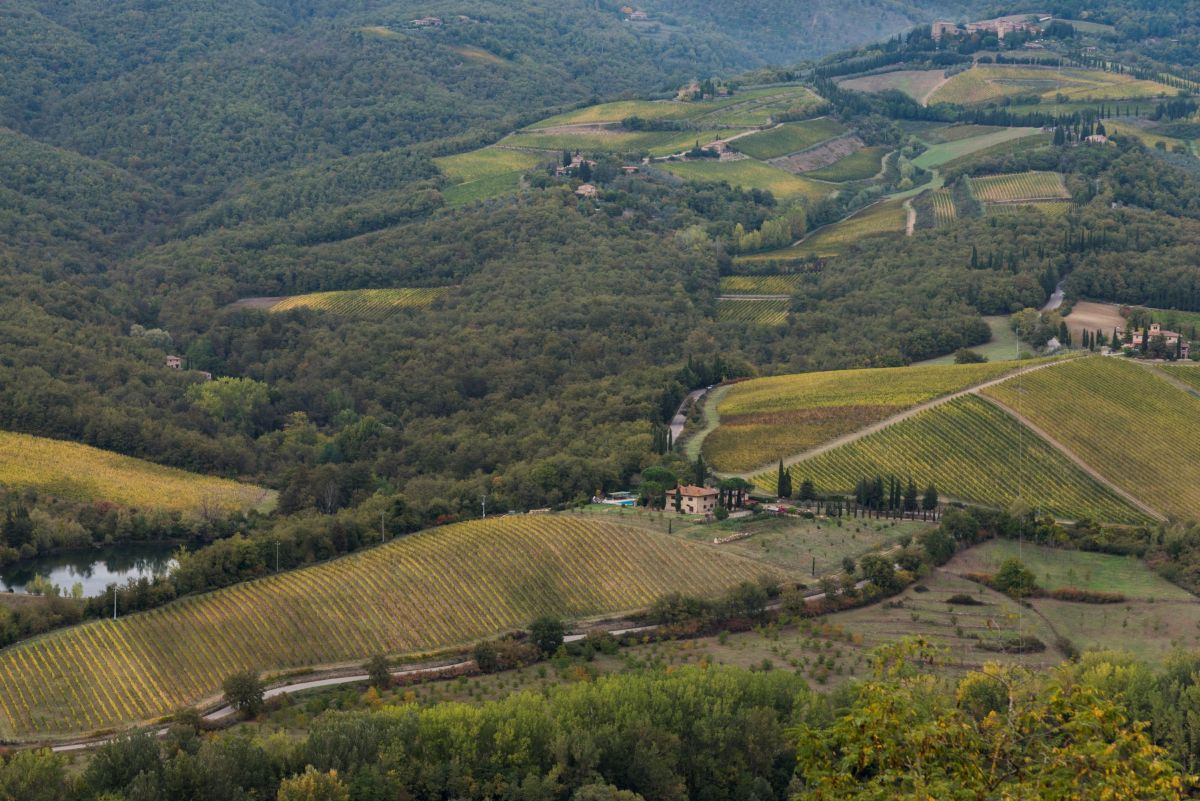
Italy is therefore becoming increasingly more forested, a trend which also affects wine-producing municipalities, where there is often concern about the risk of monoculture (to the detriment of biodiversity). However, the data shows that the link between wine and forests is becoming stronger. In recent years, particularly in the wine sector, there has been a renewed appreciation for the importance of the proximity and synergy between forests and vineyards, with company and territorial projects like those we have reported on over the years. Among trees, forests, and vineyards, thanks to biodiversity and “thermal” effects (and more), a mutually beneficial relationship has developed and gained broader recognition (as explained by professor Attilio Scienza, one of the world leading viticulture experts, in an interview). Returning to the figures, WineNews selected 75 wine municipalities (excluding possible oversights due to the large sample size and the widespread nature of viticulture in Italy, ed) for their strong historical and economic connection to viticulture compared to other production sectors. Then, it analyzed, for each of them, report data on total forest area in hectares and the forest cover index. The results show that 29.3% of the selected wine municipalities (22 out of 75) exceed a 40% forest cover index, an important percentage that broadens the “green” boundaries, also considering that forest areas do not include agricultural land. Not surprisingly, the study highlights a positive relationship between forest presence and specialized agricultural supply chains, suggesting that the most dynamic territories are often those capable of integrating quality agriculture, forest management, tourism, and the enhancement of natural resources.
And, if Radda in Chianti, one of the cradles of Chianti Classico, has the highest forest cover index among wine municipalities at 75.3%, Montalcino, another red wine denomination among the most prestigious ones with its Brunello, is ranked first among Italy most important wine municipalities in terms of total forest area, with 13,255.1 hectares (corresponding to a forest cover index of 42.7%). In particular, among the 22 municipalities with a forest cover index above 40%, in addition to the already mentioned Radda in Chianti (75.3%), there are Gaiole in Chianti (72.8%), Sorbo Serpico (67.2%), Greve in Chianti (62.7%), Gattinara (62.6%), Caldaro sulla Strada del Vino (54.2%), Castellina in Chianti (53.5%), Mezzocorona (52.1%), Castagneto Carducci (51.3%), Santadi (50.5%), Predappio (49.7%), Gavi (49.6%), Valdobbiadene (48.3%), Aymavilles (46.8%), Orvieto (46%), Scansano (45.5%), San Gimignano (45.4%), Tempio Pausania (44.2%), San Michele all’Adige (44%), the already mentioned Montalcino (42.7%), Morgex (41.9%), and Jerzu (41.4%).
Returning to the overall picture, forests are, of course, not evenly distributed across the national territory. In about half of Italy nearly 7,900 municipalities, forest presence is marginal or almost absent: the forest cover index is below 20%, and these areas, where more than two-thirds of the Italian population lives—host less than 10% of the national forests. By contrast, there are 3,149 Italian municipalities in which more than 40% of the territory is covered by forests, territories which safeguard more than three-quarters of the country’s entire forest heritage. The situation of the 495 “hyper-forested” municipalities is even more significant, where forests cover more than 80% of the municipal area. In these municipalities, only 1% of the Italian population resides, yet they contain 13.94% of the national forest area, a share greater than that found in the entire half of the country where forests are almost absent.
The Pefc study also challenges one of the most widespread assumptions about Italy’s forest heritage, namely, that forests are necessarily associated with the most marginal and underdeveloped areas. While it is true that forest presence is closely linked to low population density areas, it also emerges that many municipalities most characterized by forests are now at the forefront of new dynamics of social and economic attractiveness. Particularly significant is the data related to migration flows. Between 2021 and 2025, 932 Italian municipalities recorded a positive migration balance of more than 10 per thousand, indicating a renewed ability to attract population. These municipalities account for just 11.8% of the national total and host only 5% of the Italian population, yet they contain 10.65% of the country total forest area. More than three-quarters of this area lies in municipalities with a forest cover index above 60%.
According to the authors of the research, the growing attention to environmental quality, well-being, contact with nature, and quality of life could be one of the drivers of this new territorial attractiveness, with forests becoming an increasingly important factor in decisions to live or invest in inland and mountain areas. From an economic perspective as well, noteworthy elements emerge, since forest presence does not necessarily coincide with the economically weakest areas of the country. In the 1,113 mountain municipalities with the highest levels of Gdp per capita, where 40.4% of the mountain population lives, 32.25% of the forest area across the entire mountain range is concentrated. Nearly half of these territories also have a forest cover index above 60%. The forest surrounding Marcetelli, the most forested municipality in Italy, generates value every day through the ecosystem services it provides to the territory: from air purification to groundwater recharge, from protection against soil erosion to flood mitigation, from carbon sequestration to the production of timber and mushrooms. These benefits are provided free of charge to the community. For the small town in the province of Rieti, an estimate amounts to nearly 8 million euros per year, about 150,000 euros per resident in natural value for the community, as shown by a study conducted by Cursa within the Nrrp strategy in Alta Sabina.
Antonio Brunori, secretary general of Pefc Italia, affirms that “the “Forests in Municipalities” report gives us, for the first time, a detailed picture of Italy forest heritage at the municipal level and allows us to interpret forests not just as an environmental component, but as a strategic infrastructure capable of generating ecological, social, and economic benefits. Understanding where forests are located and how they relate to local communities is the first step in building effective policies for sustainable forest management and the development of forest-based value chains”. According to Antonio Nicoletti, national head of Protected Areas at Legambiente, “the sustainable management of forest ecosystems represents one of the most effective responses to the major environmental challenges of our time, from the climate crisis to biodiversity loss. It is also key to decarbonizing the economy and supporting the territories and communities which care for forests. This research shows that Italy forest heritage is far more extensive and significant than often assumed and, contrary to common belief, is rich in biodiversity and in at-risk species. Today, the challenge is not only to preserve it, but to guide its evolution through sustainable and participatory management capable of combining environmental protection with the development of local communities”.
Copyright © 2000/2026
Contatti: info@winenews.it
Seguici anche su Twitter: @WineNewsIt
Seguici anche su Facebook: @winenewsit
Questo articolo è tratto dall'archivio di WineNews - Tutti i diritti riservati - Copyright © 2000/2026