







As often pointed out, the topic of no- and low-alcohol wines which today represent a global market worth 2.4 billion dollars and are expected, according to estimates, to reach 3.3 billion by 2028,continues to spark debate. Not only because the industry is divided between those who do not consider them wine and those who, on the contrary, see these products as part of the future of the supply chain, but also because, overall in Italy, despite the fact that the law has allowed them for a few months now, it is still complicated for many businesses to officially start production, as several companies that have invested in the sector have told us in this video.
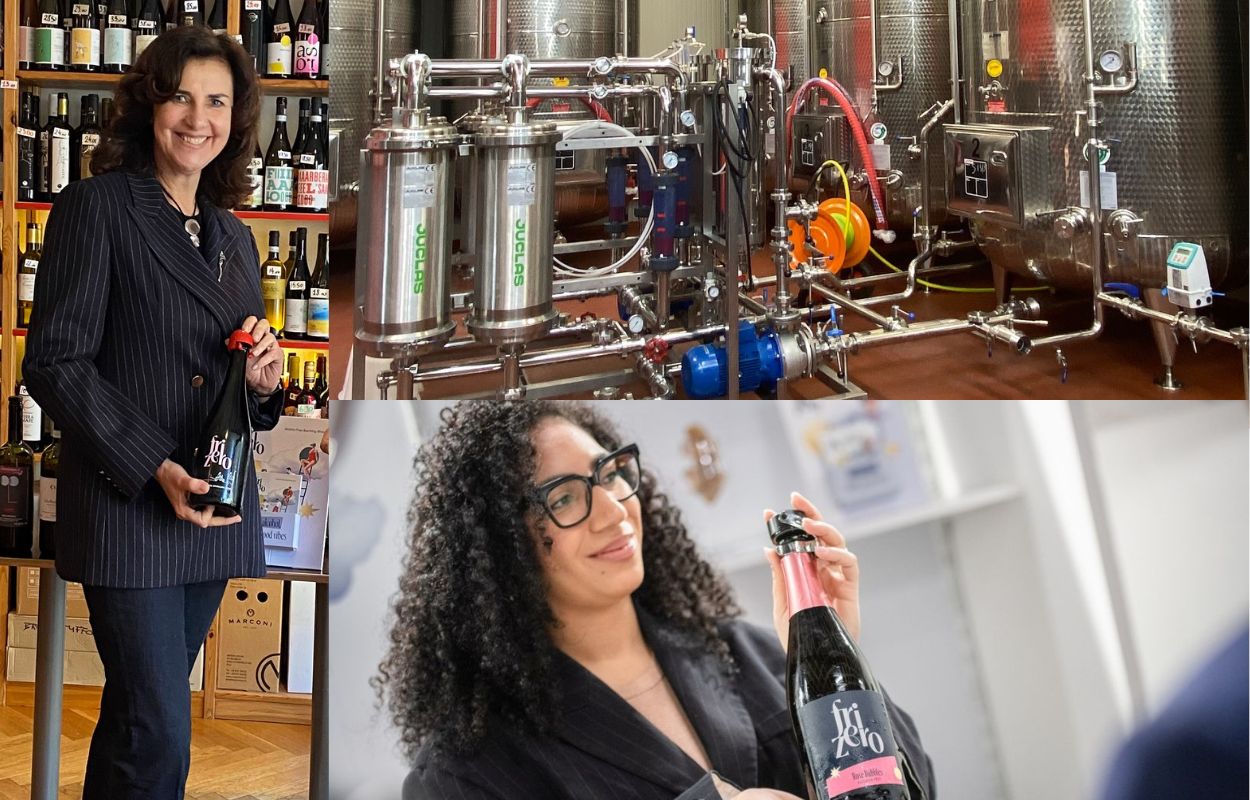
Yet, in a context where many companies that have invested in dealcoholization plants are still grappling with the complications of obtaining the necessary authorizations, in Valpolicella, in Arbizzano, there is a facility which began dealcoholizing wine in March, the first in Italy to do so. Frizero, headed by ceo Roberta Mottadelli, obtained the last of the required authorizations from the Italian Customs Agency on March 11th and immediately launched its first production cycle, both to produce its own two namesake sparkling wines, Frizero White and Rosé, in Italy, and to provide dealcoholization services for third parties.
“We believed in the production of dealcoholized wines as early as two years ago - explains Roberta Mottadelli - fully aware that the real challenge lies in quality. As Frizero, we therefore began producing dealcoholized sparkling wine elsewhere, while at the same time investing one million euros in the construction of a discontinuous membrane system using Italian Juclas Vason technology, as well as in the subsequent modifications required by the Customs Agency. The plant has limited production capacity compared to other technological solutions, and we are using it to produce about 200,000 bottles per year of sparkling wines under our own brand, which we will continue to export to the USA, Canada, Germany and Poland (sparkling wines that sell on average for 12-15 euros per bottle, with peaks of 20 euros in more advanced markets for this category). The remaining production potential of 100,000-150,000 bottles will be dedicated to third-party processing for small and medium-sized wine companies looking to enter the premium dealcoholized segment (ed, the plant’s capacity is scalable up to 1.8 million bottles per year)”.
The path which led to this milestone last March, although virtuous and in some respects fortunate, was not all smooth sailing. The application for authorization of the plant was submitted as early as the beginning of 2025, immediately after the Ministry of Agriculture decree of December 20th, 2024. This was quickly followed by registration with the Ministry, assignment of the Icq code, and activation of the digital register as required by EU Regulation No. 1308/2013. Then everything came to a halt while awaiting clarification on the tax treatment of the residual alcohol resulting from wine dealcoholization, a crucial issue resolved by the joint decree of the Ministries of Agriculture and Economy on December 29th, 2025. Then, almost a year later, effective cooperation began with officials from the Customs and Monopolies Agency of Verona, leading to the granting of the license to start wine dealcoholization activities on March 11th, 2026.
Up to this point, this is the chronology of the bureaucratic steps, illustrating the ability to navigate within a regulatory framework still under definition, as explained by Luca Bortolazzi, Frizero consultant, but it does not fully capture the technical difficulties encountered. “During the first inspection, the Customs Agency examined the plant - explains Giulio Corbellani, the enologist responsible for the facility - and suggested specific technical requirements to make it fully compliant with the provisions of the Ministry of Economy decree. We carried out the modifications in a very short time, which required additional investments. Once the plant’s compliance was verified, at the subsequent inspection the Customs Agency granted the requested license and final authorization on March 1th1, 2026. We then began dealcoholizing, and today we are at the fourth production cycle”. Plants like the one chosen by Frizero operate at temperatures between 10 and 25 degrees Celsius and use a membrane which allows only alcohol and some other small volatile molecules to pass into the water - the extraction medium, used in very large quantities - while the rest remains in the wine. At the end of the discontinuous process, dealcoholized wine is obtained along with a hydroalcoholic solution containing less than 1.2% alcohol, a threshold below which excise duties are not due, although obligations related to alcohol management still apply, such as seals and the presence of Customs officials when opening effluent tanks, and so on. The decree of the Ministries of Agriculture and Economy mirrors existing rules for distilleries, which are easily applicable to systems basing on distillation column technology which operate at high temperatures and produce dealcoholized wine on one side and concentrated alcohol on the other. This suggests that the regulations inspiring the decree may not, after all, represent an insurmountable obstacle to obtaining authorizations.
“We chose to use a technology that respects the raw material - continues Roberta Mottadelli - starting, for productions under the Frizero brand, from wines produced by the family-owned Marchesi Fumanelli estate in our area. This, together with a dealcoholization process which is gentle on the base wine, but at high cost, allows us to obtain products that are very interesting in terms of sensory experience and price positioning”.
Copyright © 2000/2026
Contatti: info@winenews.it
Seguici anche su Twitter: @WineNewsIt
Seguici anche su Facebook: @winenewsit
Questo articolo è tratto dall'archivio di WineNews - Tutti i diritti riservati - Copyright © 2000/2026