


Wednesday 1st of April 2026 - Last Update: 12:17






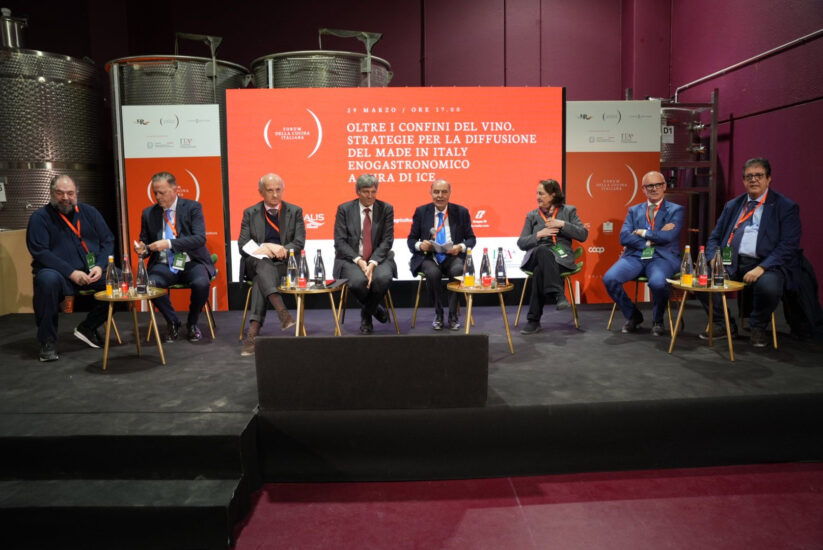
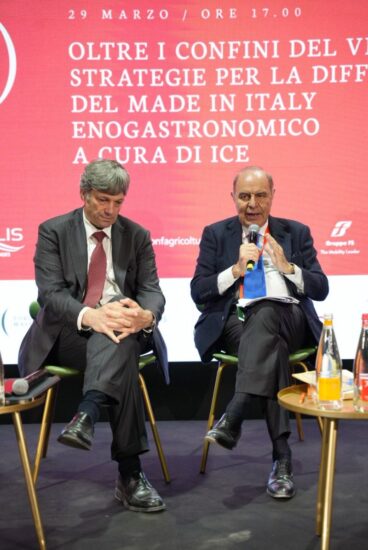

In a historical moment when wine is facing one of its most critical phases, the way out may lie in defending one strengths, typically Italian ones, while at the same time being able to ride the wave of change. This can also mean producing less, because it is the market, through its demand which inevitably sets the pace. At the same time, investment must continue in that “Italian Way” made up of mindful drinking - reaffirming that wine consumed in moderation and with meals is not harmful to health - and of food pairing, areas in which Italy is an admired example. And one must never forget the opportunities that the world continues to offer, for instance, by sowing the first seeds in those markets that are small and marginal today in terms of figures, but which may one day sit at the table of the “big players”. These are some of the messages which emerged from meeting “Oltre i confini del vino. Strategie per la diffusione del Made in Italy enogastronomico”, - “Beyond the borders of wine. Strategies for the promotion of made in Italy wine and food”, organized by the Ice-Italian Trade Agency, which brought together leading figures from the sector at the Forum in Masseria No. 6, the economic and political event organized by Bruno Vespa and Comin & Partners, held through today at Masseria Li Reni in Manduria. This location lies at the heart of the wine producing area of the doyen of Italian journalism (who has also been a “vigneron” for over ten years with “Vespa Vignaioli” project). Seated around the table, among others, there were president of Ice Matteo Zoppas; producers and heads of supply chain organizations Albiera Antinori (Marchesi Antinori and Gruppo Vini Federvini) and Lamberto Frescobaldi (Frescobaldi and Unione Italiana Vini - Uiv); Federico Bricolo (president Veronafiere), and Andrea Cipolloni (ceo Eataly).
The issue of the difficulties facing wine, and how to overcome them, was central. For Lamberto Frescobaldi, president of Unione Italiana Vini (Uiv) and producer at the helm of the Frescobaldi Group, a historic name in Italian wine, the recipe is clear and doesn’t include vineyard extirpation, as it is happening, for example, in France: “we need to produce less; cellars are full, and this is a very sore point. We must face at least a couple of years in which it is necessary to reduce yields per hectare. Wine is a discretionary product: if there is a lot of supply, prices fall; if there is a lot of demand, prices rise”. A decline in consumption, and therefore an increase in stocks, affects not only red wines but also white wines. Frescobaldi mentions data by “Cantina Italia”, showing that a comparison between February 2025 and the same month in 2026 indicates that “stocks of white wines have increased significantly. Many areas in Italy produce 400 quintals of grapes per hectare; there are production regulations which are generous. We need a freeze on new plantings and a reduction in yields: then all efforts, including promotion, can help. And we need to put more money in young people pockets; people drink later because they reach economic stability later than my generation did. Today, it is different for 25-year-olds. We talk about wine being consumed with meals, but an Ikea study says that kitchen tables are no longer being bought, and that people eat standing up, on the sofa, or on the bed”.
For Albiera Antinori, president of Gruppo Vini Federvini and head of the most admired-Italian wine brand in the world, Marchesi Antinori, it is important at this historical moment to emphasize the distinctly Italian feature of virtuous wine consumption, and of alcoholic beverages in general, as highlighted by a recent Federvini study carried out in collaboration with La Sapienza University of Rome: “within difficulties there are opportunities, new ideas, the opening of new markets, and then there is the commitment to combating this trend which runs counter to wine consumption. Italy is the second country in terms of life expectancy, and 80% of wine consumption takes place during meals. Consumption linked to food brings benefits, and at a time when Italian cuisine is becoming Unesco heritage, and wine is part of that cuisine, it should be used as a communication opportunity and a marketing lever, as it is already being done, from Ice to the Government”. Given the interest shown by visitors in food and wine, “we need to encourage tourism to come to Italy for wine and food”. Wine tourism is a resource for the present and the future, and Albiera Antinori also put forward an institutional proposal: to request that responsibility for wine tourism be delegated to the Ministry of Agriculture, following the model adopted when Gian Marco Centinaio was at the helm of the ministry on Via XX Settembre. As for cellar stocks, the president of Gruppo Vini Federvini stated that “Cantina Italia” data indicates that there has been a slowdown; ideally, yields should be reduced where the product has no market, but there are denomination where this problem doesn’t exist. A freeze on new plantings is not a measure that resolves the emergency because when a vineyard is planted, production is halted for the first three years”.
According to Matteo Zoppas, president of Ice-Italian Trade Agency, “wine is one of the categories that Ice is supporting the most. In numerical terms, it is going through a critical phase, but that doesn’t mean we should not step up our support, and we are doing so. We are putting together a structured strategy. At the moment, wine is experiencing a slowdown especially in America. There are three elements to be considered: tariffs, which go hand in hand with the euro-dollar exchange rate; consumer behavior; and there was also, even if according to most importers it did not have an impact, the well-known law liberalizing cannabis. January opened with a -35%, which is a huge figure, but it is a “distorted” number following a massive increase (due to the rush to build stocks ahead of tariffs, as Zoppas also explained in an interview with WineNews, ed) of +19% in January 2025 compared to 2024. In reality, we would be at -16% compared to a “normal” year, a figure probably still influenced by the “stock in-stock out” logic. In the meantime, we must do everything we can, offsetting negativity with the tools at our disposal, such as increasing incoming buyers at trade fairs. At Vinitaly 2026 we accelerated with a +20% compared to last year. And there are three very important opportunities for wine: Mercosur, India, and Australia. Opening new markets is not easy, but we must succeed in taking the product outside its traditional context”.
At Vinitaly 2026 in Verona (Veronafiere, April 12th - 15th), there will be “buyers and stakeholders arriving from 130 countries - recalled Federico Bricolo, president of Veronafiere - the wines presented at Vinitaly will be told all over the world. At a time of great challenges for the wine sector, Italy has extra cards to play: a unique biodiversity and Italian cuisine, which is the foremost ambassador for Italian wine”. For Bricolo, promotion is essential, both within and beyond national borders: “in our country we need to focus on wine tourism; hospitality at wineries is becoming increasingly more structured, but it must also be supported in terms of regulations. Abroad, high-quality promotion is necessary, and Ice is doing an enormous amount of work”.
Andrea Cipolloni, ceo of Eataly, also shared his perspective. Founded by Oscar Farinetti, Eataly is a brand that, especially abroad, has made a significant contribution over the past 15-20 years to establishing high-quality made in Italy around the world, above all in the United States market. There, however, “we are seeing constant and rapid changes - underlines Cipolloni - which affect many aspects including wine. In the United States, the second dinner service in restaurants no longer exists. Since Covid, after 9 p.m. restaurants are empty”. Peak time has shifted to the 5:00-5:30 p.m. window, and as a result, “we have had to revise all our menus. Today people prefer to “snack” on food, and this also affects the way they drink. Wine consumption has declined; we fight back as best we can, above all through events. And there is a very important trend toward healthy living and wellness that we must acknowledge”.
Another perspective came from Raffaele Alajmo, founder and ceo of the Alajmo Group, who, in addition to Le Calandre in Rubano, a three-Michelin-star restaurant, runs, together with his brother Massimiliano, many other establishments in Italy and around the world, and produces high-quality food through Alajmo Food and Design (with numerous product lines, from biscuits to preserves). “I believe that young people have a food culture that shouldn’t be underestimated: they read labels, they pay attention to organic and natural products. However, I think that Italian hospitality needs the experience one lives inside a restaurant, a trattoria, an Italian pizzeria, something unique and currently in demand worldwide. The Italian spirit - explains Alajmo - is sought after; it relaxes people, makes them feel good, makes them feel at home. We need to invest in the profession of those working in the dining room, because they are the true ambassadors of the sector, including wine. But Italian waiters are disappearing; they need to have more money in their pockets, and their role must be considered as important as that of the chef, who today is treated like a deity.
Looking ahead to the next five years, many historic restaurants will no longer exist because they will close; running a restaurant is becoming increasingly more difficult, and if you aren’t structured like a company, you burn out. I believe that more chains and more groups will emerge, with more brands and fewer families at the helm of restaurants”.
In short, many trends observed from multiple perspectives contribute to defining a constantly evolving scenario, one that clearly also concerns, and above all, wine and its role at the table.
Copyright © 2000/2026
Contatti: info@winenews.it
Seguici anche su Twitter: @WineNewsIt
Seguici anche su Facebook: @winenewsit
Questo articolo è tratto dall'archivio di WineNews - Tutti i diritti riservati - Copyright © 2000/2026