


Tuesday 10th of February 2026 - Last Update: 20:07







The growth in wine quality, together with the geographical expansion of production and markets, has been the defining feature of this first quarter of the 21st century. Robert Parker, founder of “The Wine Advocate” and the “100 point system,” is considered the personality of the century. Looking ahead, the greatest opportunities for producers will come from changes in product style (which will need to become increasingly elegant, fresh, lighter, and more approachable for consumers) and from wine tourism, provided that everyone works to protect the cultural value of wine, whose primary element is conviviality and its ability to foster human connection. These are the key strengths highlighted in “Wine Lister Leagues” 2025, the report by Wine Lister (owned by “Le Figaro Vin”), created collecting the opinions of “57 Ceos, managing directors, and heads of wine departments from companies representing well over one-third of global fine wine revenues”, explains a note, from which, despite many challenges, the report portrays “an industry that continues to diversify, expand, and adapt, while remaining anchored to cultural meaning and human connection”, comments Wine-Lister.
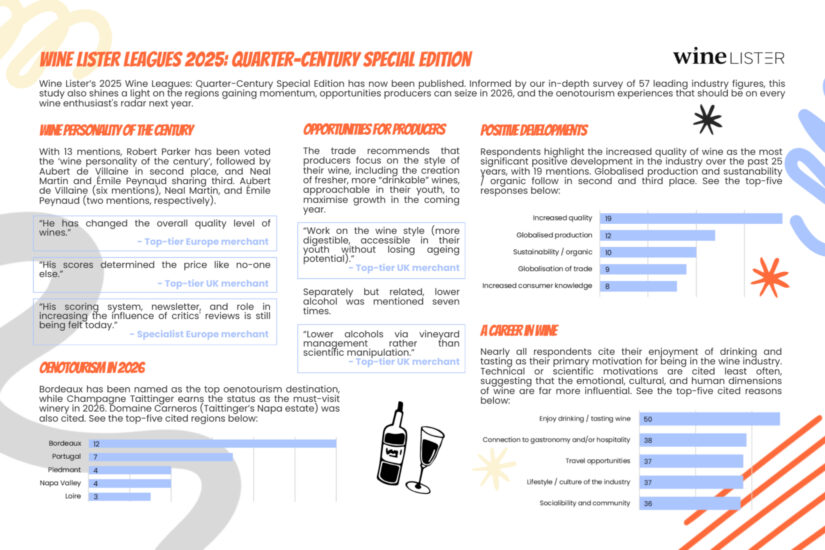
Looking back to the recent past, over the last 25 years of wine history, the most significant trend has been the improvement in wine quality, followed by the globalization of production, with many “emerging” countries gaining important positions on the scene, but also the growth of sustainability throughout the supply chain, increasingly globalized markets, greater consumer knowledge (also thanks to the web and social media), and advances in winemaking technology. The “Wine Personality of the Century” with 13 mentions, is Robert Parker, founder of “The Wine Advocate” (today, as known, part of the Michelin group) and of the “100-point system” which undoubtedly transformed wine criticism and communication (here is our video interview with the famous critic from 10 years ago, featuring reflections that remain highly relevant). Followed, with six votes, by one of the names behind the legendary Domaine de la Romanée-Conti, Aubert de Villaine, (here is our latest interview), followed, at a distance, by critic Neal Martin, now signature for “Vinous” by Antonio Galloni, and one of the fathers of modern winemaking, French winemaker Émile Peynaud (who passed away in 2004, ed).
Looking to the future, in a 2026 which, as often said, will undoubtedly remain challenging, the trends which will allow producers to seize opportunities include changes in product style (16 responses), which generally, (and for some time now) have been moving toward wines which are more elegant, fresh, and approachable, especially for younger consumers. Wine tourism (14 responses) will also be crucial, focusing increasingly on experiential and personalized experiences, including improved accessibility to the “direct-to-consumer” channel, meaning direct sales (both physical and online), and still, another key factor will be rebalancing bottle prices (10 responses). Among the 15 identified “key points”, there are sustainability, actions to address climate change, lower-alcohol wines, digital growth, initiatives to attract younger consumers, packaging and format innovation, distribution control, portfolio and production strategy rationalization, changing consumption patterns, dealcoholized wines, and even the gradual abandonment of the “La Place de Bordeaux” system.
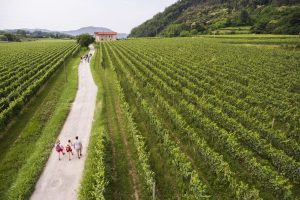
And, talking about wine tourism, a sector which is increasingly more important for both wineries and regions at every level, experts highlight Bordeaux as the top destination to carefully look in 2026, followed by Portugal, with Piedmont and Napa Valley tied for position No. 3 on the podium, closely followed by Sicily and the Loire. Still, among wine regions with the most wineries listed as “rising stars” for 2026, Burgundy stands out (with 39 wineries mentioned) and Bordeaux (with 30), followed by Spain, Champagne, and the Loire (9 each), and then Tuscany, Piedmont, and the rest of Italy (with 7 mentions per category). And if, as many say, reaffirming the cultural value of wine is essential, the main mentioned reasons are “because it brings people together”, because it is “a connection to history and tradition”, and because it plays a central role “in moments of joy and celebration”.
Copyright © 2000/2026
Contatti: info@winenews.it
Seguici anche su Twitter: @WineNewsIt
Seguici anche su Facebook: @winenewsit
Questo articolo è tratto dall'archivio di WineNews - Tutti i diritti riservati - Copyright © 2000/2026