







The wait is all focused on tomorrow, waiting for the Unesco Intergovernmental Committee for Intangible Cultural Heritage to announce the hoped recognition of “Italian cuisine, between sustainability and biocultural diversity”, which could provide an additional boost to a sector that is already a cultural heritage in practice, but also an economic one, considering that, according to the 2025 “Foodservice Market Monitor” 2025 by Deloitte, Italian cuisine worldwide generates a total value of 251 billion euros and accounts for 19% of the global “Full Service Restaurant” market. Moreover, Unesco recognition helps sites and traditions grow compared to those without the Unesco label. In particular, looking at arrival and attendance data for 2023-2024, there was a 3.26% decrease in non-Unesco cultural sites compared to a 7.39% increase in arrivals at Unesco sites; while presences rose by an average of 2.5% at sites without recognition, Unesco sites saw a 14.87% increase (2024 compared to 2023). At least, these are the initial findings of the interdisciplinary study on “Impatto economico dei riconoscimenti Unesco” - the “Economic impact of Unesco recognitions”, launched in 2023 by the Unesco Chair at Unitelma Sapienza University of Rome, directed by Pier Luigi Petrillo, professor of Cultural Heritage and Food at Luiss Guido Carli and chief curator of the Italian cuisine candidacy dossier: “analyzing data related to tourism, local production, and the global workforce, it emerges that places and agri-food traditions with Unesco recognition are more attractive and more productive than similar places without recognition”, Petrillo explained to Ansa.
The research also shows that in 2021, the first post-Covid period, arrivals at Unesco sites increased by +53.59% compared to 2020; in 2022, the increase was 67.83%. At non-Unesco sites of equal cultural value, the increase was 41.24% in the first year and 50.65% in the second, with a gap of over 17 percentage points in favor of Unesco sites. For presences, the gap between non-Unesco and Unesco sites widened to 24 percentage points in the first post-Covid year (in favor of Unesco sites) and 17 points in the second year.
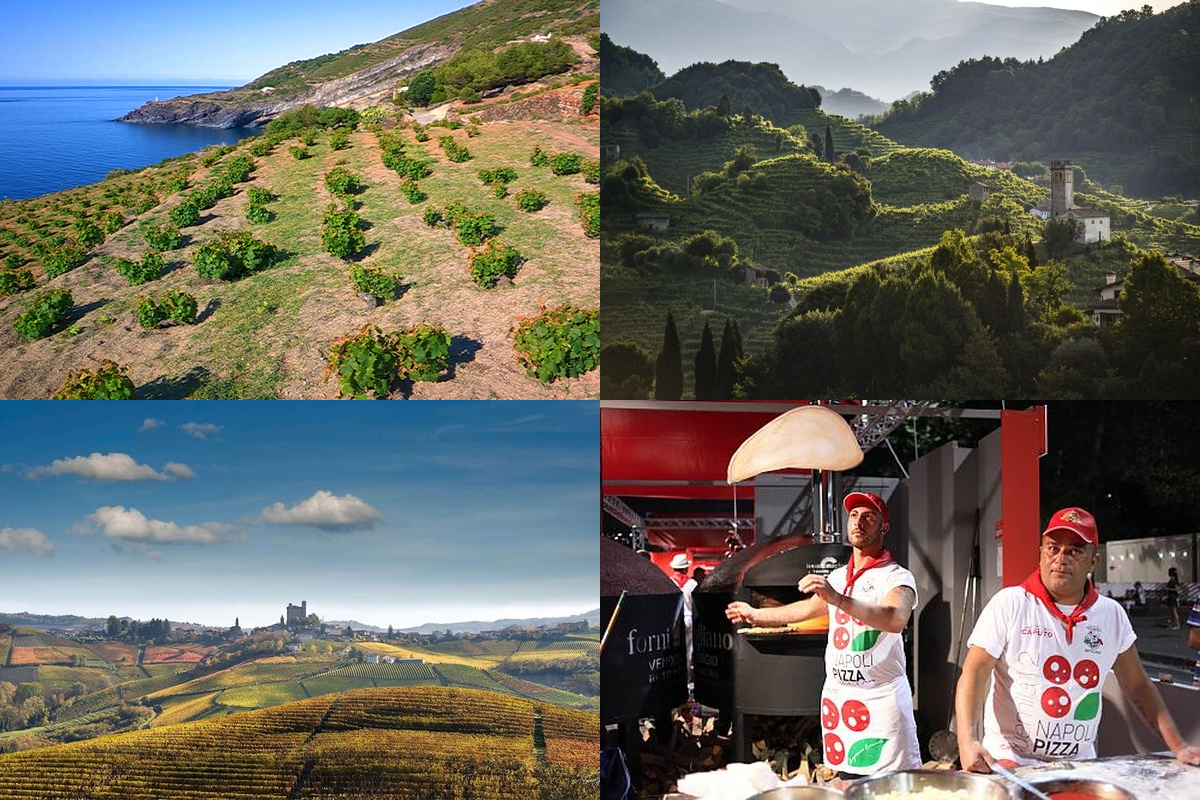
Among the mentioned cases Pantelleria, with its Unesco-listed heritage “Coltivazione della vite ad alberello di Pantelleria” - “Alberello vine cultivation” data says: +9.7% annual tourism growth, +75% off-season tourism, and a +500% increase in agritourism workforce over ten years; regarding the Art of Neapolitan Pizzaiuolo, there was a +283% increase in professional courses and +420% in accredited pizzaiolo schools (all abroad); in the Prosecco Hills of Conegliano and Valdobbiadene, there was a +45.4% increase in tourist facilities (compared to an average of 3% in similar sites) and +35.4% in bed capacity (compared to 8.2% in similar sites). Meanwhile, in ten years of Unesco recognition (since 2015) for the Vineyard Landscapes of Langhe, Roero, and Monferrato, the economic impact exceeded 209 million euros, plus media coverage valued at 32 million euros, according to research by Guido Guerzoni, ceo of Formules (a consulting firm in Cultural and Creative Industries). For the research methodology, the first phase (2023-2024) defined sample models in Italy and seven other countries and established the basis for collecting data on tourist flows, businesses, related cultural services, and the global workforce. The second phase (2024-2025) developed a causal correspondence analysis using statistical and logical methods to determine whether an event (cause) directly triggers another (effect). This analysis identified factors to isolate the data and attribute it specifically to Unesco recognition, distinguishing result from mere correlation (two events which move together).
“In this phase,” explains director Pier Luigi Petrillo, professor of Cultural Heritage & Food at Luiss Guido Carli and chief curator of the “Italian Cuisine” candidacy dossier - we identified indicator systems and policy variables and Unesco internal and external comparisons. The initial results show that economic effects linked to Unesco recognition are never immediate but occur in the medium term under two conditions: that there is an effort to promote the recognition in line with the reasons for Unesco inscription and that attention is focused on cultural and identity dimensions rather than individual products”. The third phase of the study will conclude at the end of 2026.
But for now, all eyes are on tomorrow, when the Unesco Committee for Intangible Cultural Heritage will deliver its verdict on Italian cuisine (and on over 50 other dossiers, ed): delegates from 185 states will participate, but only 24 will vote for or against new proposals for inscription as World Heritage: Algeria, Angola, Bangladesh, Barbados, Burkina Faso, China, Dominican Republic, Ethiopia, France, Germany, Haiti, India, Malaysia, Mauritania, Nigeria, Paraguay, Slovakia, Spain, Uganda, Ukraine, United Arab Emirates, Uzbekistan, Vietnam, and Zambia. The Italian delegation will be headed by Liborio Stellino, Ambassador at Unesco, accompanied by Maddalena Fossati (chair of the committee promoting the Italian cuisine candidacy and editor-in-chief of the historic magazine “La Cucina Italiana”), dossier curator Pier Luigi Petrillo, and Ministry of Culture officials Maria Assunta Peci and Eleonora Sinibaldi.
Copyright © 2000/2026
Contatti: info@winenews.it
Seguici anche su Twitter: @WineNewsIt
Seguici anche su Facebook: @winenewsit
Questo articolo è tratto dall'archivio di WineNews - Tutti i diritti riservati - Copyright © 2000/2026