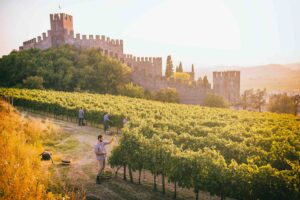







“Est modus in rebus”, meaning “there is a measure in all things”, wrote Latin poet Horace in the first century BC. A sentence that today, when applied to the world of natural wine, translates into a wine which must indeed be natural but, at the same time, must not have flaws which are “passed off” as typicity or something else. Not just any wine critic, but the person who more than anyone else in Italy has inspired the natural wine movement states this clearly, and reiterates it forcefully: Angiolino Maule, president of VinNatur (and producer at the La Biancara winery in Montebello Vicentino). Maule writes in no uncertain terms: “it is time to call a flaw by its proper name: volatile acidity, Brettanomyces, oxidation, souris. Too often these aromas are confused with terroir, but they are not. I started producing natural wine almost 40 years ago: back then we didn’t know how to make consistently pleasant and balanced wines without the help of conventional winemaking. Today - says Maule - we have the knowledge and experience to do so; no excuses. There is still more to learn. That is why we continue to collaborate with the scientific community, with the goal of improving quality and supporting our members in bottling the best possible wines: we don’t want wines without identity, but neither do we accept flaws being considered normal”. Clear, unequivocal words which come on the eve of VinNatur Tasting, scheduled from April 11th to 13th at the Margraf Showroom in Gambellara (Vicenza).
Maule also issues an “unprecedented,” or at least unusual, appeal in the wine world: “producers, I’m addressing you directly: please, do not bring flawed wines”. A call intended to give meaning to VinNatur as an event, which “was also created to support the research and training projects of the organization headed by Angiolino Maule, long engaged in technical research, education, and collaboration with universities and research centers. This approach is something VinNatur also wants to place at the center of public debate”, explains a note. It goes on to reiterate that “VinNatur Tasting is a fair in which craftsmanship and agriculture are central: the producer hand, work in the vineyard, and terroir are essential elements”. But it also clearly states that all of this can’t be separated from the quality of a wine that must not have flaws. Maule call for discipline and production rigor rings loud and clear on the eve of an event that, over three days (April 11 th - 13th, Margraf Showroom, Gambellara, Vicenza), will bring together 180 producers from six foreign countries - Albania, Austria, France, Germany, Slovenia, and Spain - and from 19 Italian regions, alongside industry professionals and enthusiasts.
It is a heartfelt appeal from a producer, Angiolino Maule, who has always, and especially in more recent times, rejected the idea that the concept of “naturalness” in wine should be associated with “lax production standards” or tolerance of defects, starting from the vineyard itself. As Maule himself explained some time ago in a previous intervention, he stated plainly: “practicing natural viticulture doesn’t mean relying on witchcraft; on the contrary, it means using science and all the knowledge we have to work our vineyards in the best possible way, improving their health and, consequently, their resistance to stress, thus avoiding the need to resort to chemicals”.
A clear message from Angiolino Maule that strikes at the heart of a phenomenon, the growing interest in the world of “natural wines”, which in recent years has attracted enormous attention in the wine sector. According to a study by Raisin, venues explicitly dedicated to this production philosophy have grown by 60% in 3 years, increasing from 5,000 in 2021 to 8,000 in 2024, with cities such as Paris, New York, and Rome at the top.
Copyright © 2000/2026
Contatti: info@winenews.it
Seguici anche su Twitter: @WineNewsIt
Seguici anche su Facebook: @winenewsit
Questo articolo è tratto dall'archivio di WineNews - Tutti i diritti riservati - Copyright © 2000/2026