


Wednesday 28th of October 2026 - Last Update: 17:39






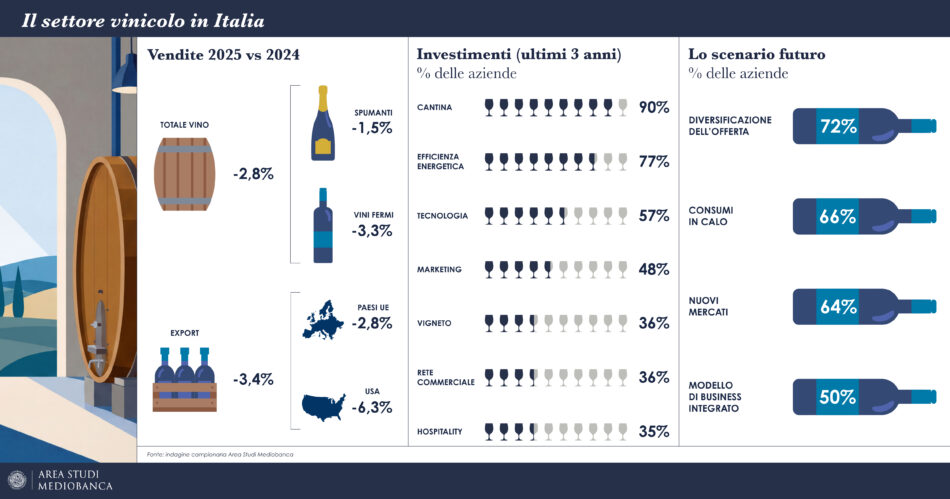
Over the past five years, 80% of Italian wine producers have reported a decline in wine consumption; two-thirds expect this trend to continue in the coming years. Despite this, 70% of producers still consider the sector attractive, believing it is headed toward a more rigorous selection process. However, 58% of major wine producers expect overall sales to grow by 2026. Diversifying the product offering is seen as the main strategy for addressing changing consumer trends (72% of companies agree), followed by entering or developing new markets (64%). Strengthening marketing and communication activities is essential for 60% of companies; this is followed by the development of new sales channels and a greater focus on sustainability (45% of responses). Overseeing the entire production and commercial supply chain is considered the most suitable organizational model (preferred by 50% of companies). Mergers and acquisitions are also moving in this direction, along with initiatives aimed at addressing local consolidation needs and generational transition issues. The focus remains on quality production, which half of the companies consider a key factor for consumers, second only to price (which is fundamental in two-thirds of cases). These challenges are being addressed through new investments: over the past three years, investments by major producers have primarily focused on winery facilities (in 90% of cases), energy efficiency (77%), and technology (57%). In 2025, total investments are projected to increase by 3.5% compared to 2024, while spending on advertising is expected to decline by 5.4%, settling at 2.6% of sales. This is the sentiment emerging from the survey of the Italian wine sector, conducted by the Mediobanca Research Department, which covers 255 leading Italian corporations with 2024 revenues exceeding 20 million euros and aggregate revenues of 12 billion euros, half of which come from abroad. The survey was presented yesterday in Milan in the presence of top executives from leading Italian wineries, including Federico Ceretto (Ceretto), Roberta Corrà (CEO of GIV - Gruppo Italiano Vini and President of the Italia del Vino Consortium), Renzo Cotarella (CEO of Marchesi Antinori), Lamberto Frescobaldi (President of Marchesi Frescobaldi), Riccardo Pasqua (CEO of Pasqua Vigneti e Cantine), Josè Rallo (CEO of Donnafugata), Massimo Romani (CEO of Argea), and Massimo Tuzzi (CEO of Holding Terra Moretti).
This report, based on 2025 figures, confirms the results of a WineNews survey conducted earlier this year. Last year, in fact, major Italian producers recorded a 2.8% decline in sales compared to 2024: the foreign market (-3.4%) was weaker than the domestic market (-2.2%). These figures are also reflected in national per-capita consumption, which fell from 38 liters in 2022 to 35.6 liters in 2025. The hardest-hit are smaller companies, with revenue under 30 million euros, which saw sales drop by 3.5%, and “capital-intensive” companies, i.e., those with tangible fixed assets exceeding 30% of total assets in 2024, with revenue down 3.7%. But profitability is declining most significantly in 2024, with EBITDA down 4.2%, EBIT down 9.5%, and net income down 7.5%. This decline in margins is also linked to the slowdown in “on-premise” sales, with the Horeca sector, which accounts for 17.2% of the wine market, down 2% compared to 2024, and wine shops and wine bars (which account for 5.5%) down 5.1%. Direct sales at wineries (which account for 7.8% of the wine market) are also down by 1%, and online sales are down as well, both on company websites (-2.4%) and on third-party platforms (-3.6%). Looking at individual product categories, Mediobanca notes that sparkling wines showed greater resilience in 2025 (with total sales down 1.5% compared to a 3.3% decline for other wines). Organic wines accounted for 6.2% of the market (sales down 0.8%), while low-alcohol and non-alcoholic wines accounted for less than 0.5%. The mid-price segment suffered the most, down 3.1%, while “basic wines” fell by 2.7% and premium wines by 2.2%. As is well known, exports also declined, with an overall drop of 3.4% for the companies in the survey, including a 2.7% decline in EU countries (which account for 37.2% of the total) and a 6.3% decline in the U.S. in particular, compared to a more stable performance in the United Kingdom (-0.7%), looking at the main markets for Italian wine.
Looking at the “top players” in the Italian wine industry by revenue, according to Mediobanca, the Cantine Riunite-Giv group will remain the sales leader in 2025 with revenue of €635.1 million (-4.6% compared to 2024). The Argea wine group remains in second place (€462.9 million, -0.3%), followed by Italian Wine Brands, with €395.9 million (-1.5% compared to 2024). Turnover in 2024 also exceeded 300 million euros for the Romagna-based cooperative Caviro (351.3 million), down 8.8% from 2024. According to Mediobanca, eight companies fall into the revenue bracket between 200 and 300 million euros: the Tuscan Antinori (2025 revenue of 259.7 million euros, down 0.7% from 2024), the Venetian Herita Marzotto Wine Estates (246.7 million euros, -0.6%), the Trentino-based cooperative Cavit (242.8 million euros, -4.1%), La Marca, specializing in sparkling wine production, with 2025 revenue of 234.7 million euros (-6.5%), the Terre Cevico cooperative (213.2 million, +3.4%), Trentino-based Mezzacorona (213 million, +0.3%), Mack & Schühle (€205.7 million, +0.1%), and the Collis Group (€202.7 million, -7.6%). Some companies, Mediobanca notes, have a very high export share, in some cases nearly 100%: Fantini Group reaches 95.7%, Argea 93.8%, and Ruffino and Fratelli Castellani exceed 90%.
These figures reflect an Italian wine sector that remains strongly rooted in family ownership: 66% of net assets are held by families, a share that rises to 82% when cooperatives are included. Financial investors hold 10.2% of equity: banks and insurance companies account for 4.8%, and private equity funds for 3.6% of net assets. The sector’s relationship with financial markets is negligible: only two companies have been listed on the stock exchange, on the AIM, since 2015 (Masi Agricola and Iwb).
And on boards: lean structures prevail (87.4% of boards have no more than five members) as do top-down structures (in 52% of cases, operational authority is concentrated in the hands of a single individual). The positions of Sole Director (average age 65) and Chairman (64), even when combined with operational authority (62), are held by relatively older individuals. The average age of a board member is 55. Few women hold top positions: they account for 13.6% of board members (25.2% in non-cooperative companies) and 9.4% of chairpersons (15.3% in non-cooperative companies).
All of this against a global backdrop in which, as Mediobanca notes, production in 2025 is estimated at 227 million hectoliters (+0.6% compared to 2024), while consumption stands at 208 million hectoliters, down 2.7%. Italy remains the world’s leading wine producer with 44.4 million hectoliters (19.7% of the total), not far from the 2024 level (+0.7%). Italy’s trade balance, however, remains in the black: over 20 years, it has grown at an average annual rate of 5%, rising from 2.7 billion euros in 2005 to 7.2 billion in 2025. Italy, Mediobanca notes, is the leading wine exporter by volume (21 million hectoliters in 2025) and the second-largest by value (7.8 billion euros, trailing only France’s 11.2 billion).
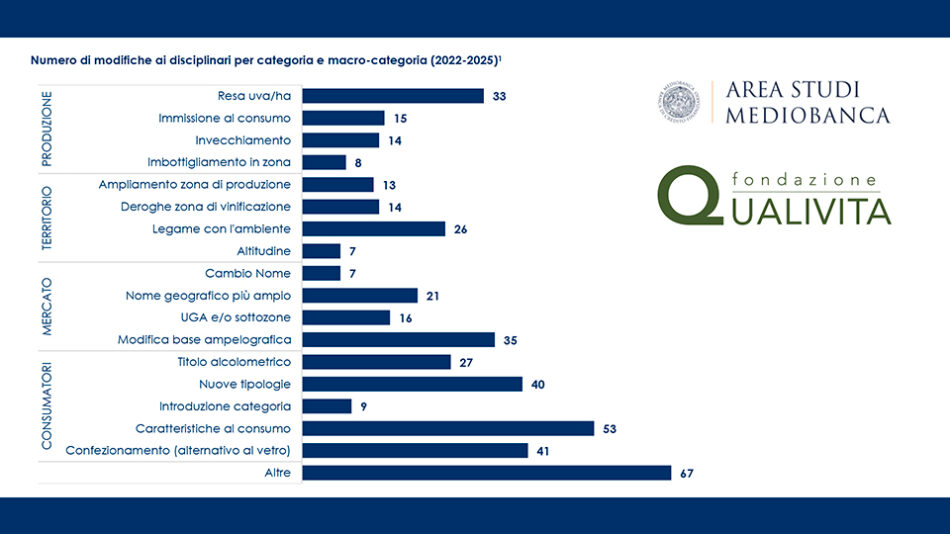
For the first time, the Mediobanca Report also includes a focus on the “DOP Economy” of wine, in collaboration with the Qualivita Foundation. This section analyzes the key economic data of the sector, which includes 522 DOP and IGP designations and accounts for 79% of the value of Italian wine, and examines the ongoing transformations in the sector and the market through a study of changes to production regulations over the 2022–2025 period. The analysis, based on official data from the Ministry of Agriculture and the European Commission, examines over 440 amendments to the regulations concerning more than 160 Italian appellations and interprets the sector’s main trends through four key areas: Production, Territory, Market, and Consumers. For example, it appears that, on the production side, most changes have focused on yield per hectare, while on the market side, changes have centered on the viticultural base; however, changes to alcohol content, consumer characteristics, the expansion of the geographical name, or modifications to UGA and subzones, among other things, remain very popular. These, too, are signs of a wine sector with protected designations working to keep pace with a rapidly changing world.
Copyright © 2000/2026
Contatti: info@winenews.it
Seguici anche su Twitter: @WineNewsIt
Seguici anche su Facebook: @winenewsit
Questo articolo è tratto dall'archivio di WineNews - Tutti i diritti riservati - Copyright © 2000/2026