






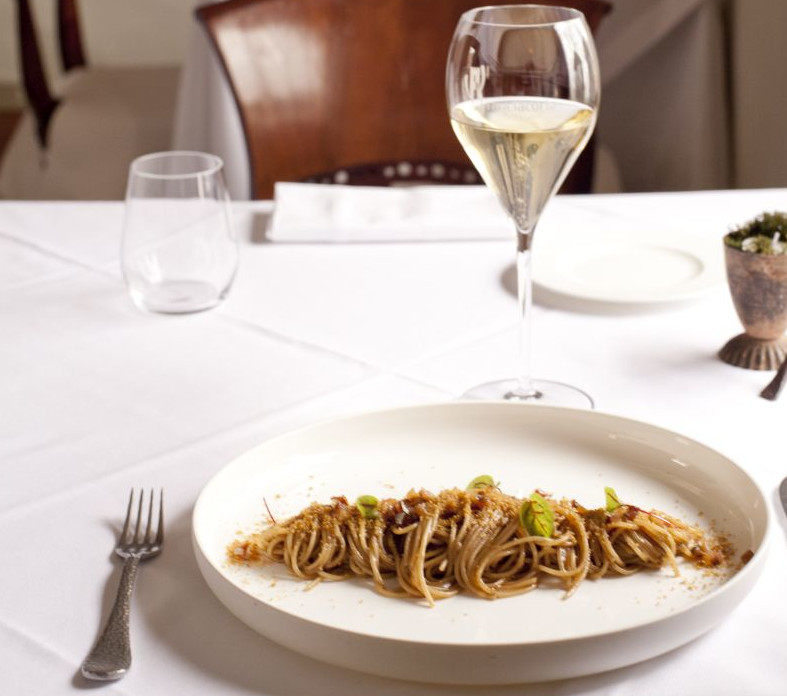
If for Italian cuisine, 2026, both in Italy and worldwide, where Italian restaurants are increasingly more, marks the first year as a World Heritage recognized by Unesco, for some of its greatest chefs, from Michelangelo Mammoliti to Norbert Niederkofler, from Enrico Cerea to Giancarlo Perbellini, from Giovanni Santini to Carlo Cracco - interviewed by WineNews at the end of 2025, when the Michelin Guide Italy 2026 unveiled its new stars in Parma - its future also calls for an even stronger focus on communicating the wine-food-territory mix, because wine is the most faithful companion at our table (as Josephine Di Chiara, Michelin Italy Communications Director, also emphasized). So much so that Michelin itself, in 2026, will debut for the first time in the wine world with its own “Wine Selection”, awarding from 1 to 3 “Michelin Grapes” to wineries, following the model of its stars, as the “Red Guide” explained to WineNews. Turning back to the plate, also Michelin, at the very start of the year, has lined up the “7 Big Food Trends of 2026”, the new trends “served” on tables worldwide to the Guide inspectors, united by one philosophy: eat well to live well, which means restoring food to its most genuine function as a natural source of well-being.
Starting with the return of slow cooking over embers, on the grill, or with wood fire - in Italian kitchens, truth be told, never really gone, quite the opposite, ed - but also using hot stones or “binchōtan”, the traditional Japanese charcoal, to cook meat or fish more naturally and serve them more simply. In dishes, that is, lighter and with bolder flavors, like those defining the new “contemporary” traditional cuisine, where chefs bring creativity, delicacy, and refinement to local recipes, rediscover forgotten local ingredients, and use innovative techniques to cook them.
This leads many chefs, though in different places, to highlight, among others, a flavor that has always held a privileged role in Italian taste, but which is now making a comeback in contemporary cuisine, a “revenge”, as one of the world leading food historians, as Massimo Montanari, has long argued: bitterness (to which the professor dedicated the essay “Amaro. Un gusto italiano”, Laterza, 2023), which, through fermentations, aging, and concentrated reductions, imparts the famous “umami” to dishes. Because time itself is an ingredient, so much so that, in some kitchens, flavors develop more thanks to technique than abundance, through marinades or fermentations which require time, precisely, to give more taste to ingredients.
Simplicity, even in haute cuisine, is making French “bistro” cooking increasingly more appreciated outside France, with dishes beloved by the French such as veal blanquette, oeufs mayonnaise, and île flottante: a success driven by Michelin-starred French chefs who, alongside their most famous restaurants, also run more “accessible” venues, following a trend that, in recent years, has also taken hold among Italian starred chefs, whose gourmet addresses are multiplying with this formula not only in Italy but worldwide, with a special focus on Asian countries. Likewise, it now seems obvious to say that, for Italian restaurants, table service is the other half of the hospitality culture, but globally, its importance is increasingly recognized in replacing the dining room to the center giving a restaurant a clear identity for a fully satisfying experience.
Finally, the future “hubs” of global gastronomy both as gourmet destinations and as places where every chef should train and gain experience, alongside historic countries like France, according to Michelin, include Thailand, with its wave of new openings by top chefs, especially in Bangkok - such as Cannubi, the restaurant of Umberto Bombana, the most Michelin-starred Italian chef abroad, based in Asia - China, where investments in a high-quality gastronomic scene are growing and on the rise, and Japan, which remains a “guiding light” for chefs seeking to refine their techniques.
The lesson? “There is no single path, only more ways for chefs to surprise us”. Words from the world most feared and authoritative “Red Guide”.
Copyright © 2000/2026
Contatti: info@winenews.it
Seguici anche su Twitter: @WineNewsIt
Seguici anche su Facebook: @winenewsit
Questo articolo è tratto dall'archivio di WineNews - Tutti i diritti riservati - Copyright © 2000/2026