


Monday 30th of March 2026 - Last Update: 16:26








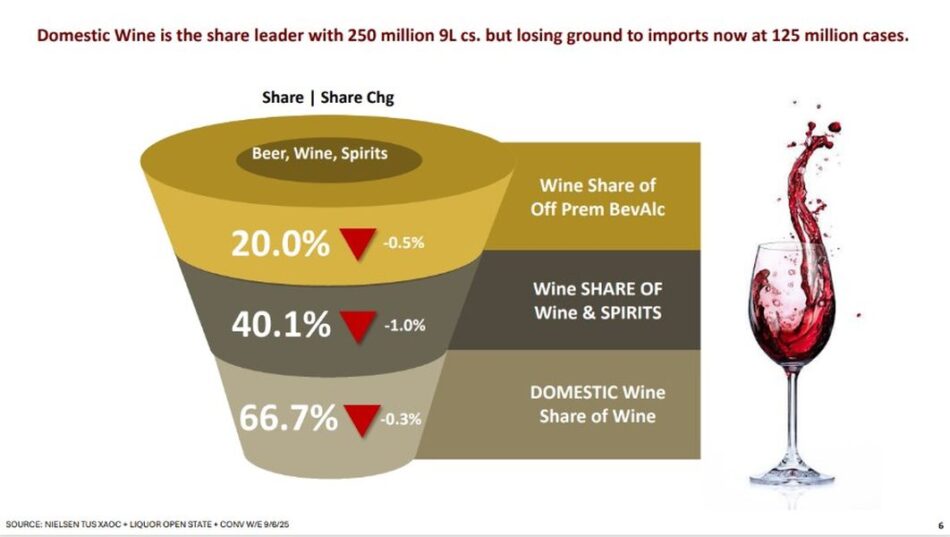
Data is undoubtedly intriguing because when a protectionist economic measure such as tariffs is introduced, the very last outcome one would want is for imported products to perform better (both in terms of consumption and price increases) than domestic ones. Yet, this is precisely the paradox currently unfolding in the United States regarding wine, as revealed by a NielsenIQ survey, analyzed and explored in depth by Paolo Battegazzore, ceo of Vinattieri 1385, the company handling direct imports into the U.S. for Marchesi Antinori. Battegazzore presented the findings at the Wine Market Forum promoted by the Chiasso-Cotarella Wine Consulting Firm for its client wineries, held in recent days at the Accademia Intrecci in Castiglione in Teverina.
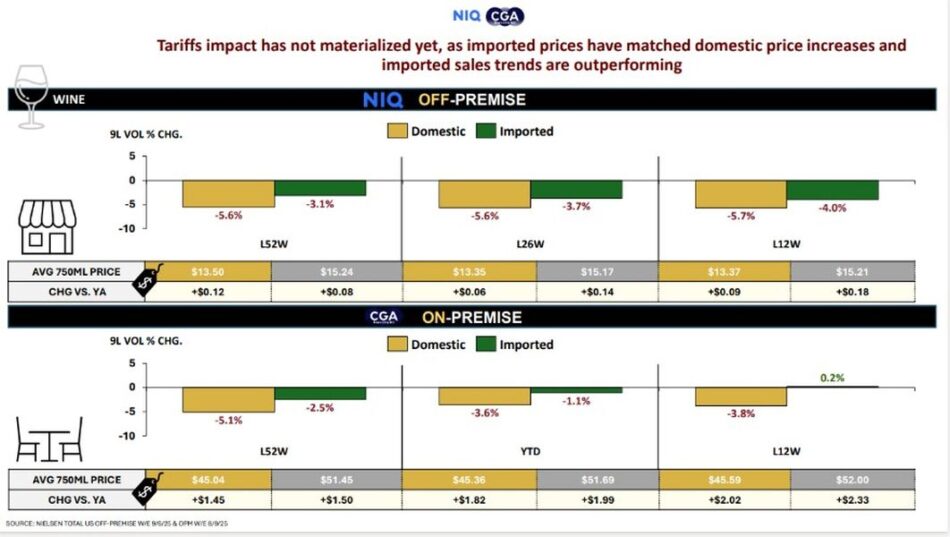
“The effect of the tariffs imposed by Trump in 2025 was barely noticeable, if at all - he explained - in fact, prices of imported European wines increased by only 1%. So, the tariffs were absorbed. Everyone says, however, that from 2026 onward they have increased, and we will only be able to assess their effects starting from the first quarter of the year”. This is because, according to the Nielsen study, prices of imported wine have matched the price increases of domestic wine (which are due, for example, also to higher costs for importing packaging materials), and wine imports from Europe have nonetheless posted solid performances. This is despite the fact that Italy, according to Istat data analyzed by WineNews, closed 2025 in the U.S. at 1.75 billion euros in value, -9.1% compared to 2024, and 339.5 million liters in volume, -6.2%, though still not among the worst performers). As a result, data shows that in terms of volume, in at-home consumption, American wine lost -5.6% over the past year, while imported wine recorded a smaller decline of -3.1%. At the same time, prices for American wine rose by +0.12 pennies, while European wine prices increased by +0.08. The same trends are reflected in the on-premise figures: in the on-trade channel, American wine saw a volume decline of -5.1% (compared to -2.5% for imported wine), while prices rose by +1.45 dollars (compared to +1.50 dollars for imported wine). In short, imported wine figures in the U.S. have indeed worsened (with Italy once again posting the best performance among them), but they have not performed as poorly as American wine.
In any case, explains Nielsen, U.S. wine is not losing market share at home to its “foreign competitor”, but rather to other beverages such as beer and spirits. Higher-priced wines are performing better than others. Overall volumes are down 7%: white wines, especially Pinot Grigio and Sauvignon Blanc, are growing relative to red wines (-10%) and rosé wine (which is losing share to Pinot Blanc). Prosecco continues to grow (+3%), while Champagne is also increasing, even if to a lesser extent.
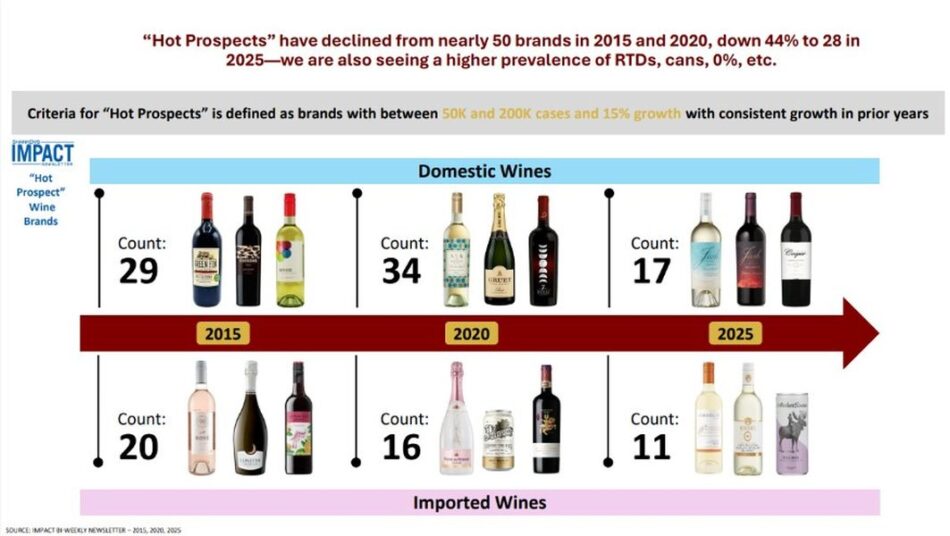
The figure showing a 44% decline over 10 years in “Hot Prospects” in the U.S further confirms the downward trend in consumption regards those companies selling between 50,000 and 200,000 wine cases in the States with at least 15% annual growth and similarly strong growth in previous years: there were 49 such companies in 2015 (29 American, 20 foreign); by 2025, they had fallen to 28 (17 American, 11 foreign).
In a country where 71% of Americans surveyed are aware of tariffs on imported goods (not only wine), 81% know this will impact prices, and 43% say they are opposed to tariffs. These were introduced at 10% in April 2025, then raised to 15% starting from August 1st, before being ruled unconstitutional by the U.S. Supreme Court in February and subsequently reintroduced again, currently at 10% until July 24th, 2026.
“But Nielsen survey tells us to be careful - concludes Battegazzore - wine is particularly sensitive to price increases and there is little brand loyalty. It is therefore very easy for a consumer to switch from one wine to another. So be cautious with price hikes. There is always a consequence, unless a brand has particularly strong recognition which allows it to absorb increases”.
Copyright © 2000/2026
Contatti: info@winenews.it
Seguici anche su Twitter: @WineNewsIt
Seguici anche su Facebook: @winenewsit
Questo articolo è tratto dall'archivio di WineNews - Tutti i diritti riservati - Copyright © 2000/2026