


Tuesday 15th of September 2026 - Last Update: 18:09







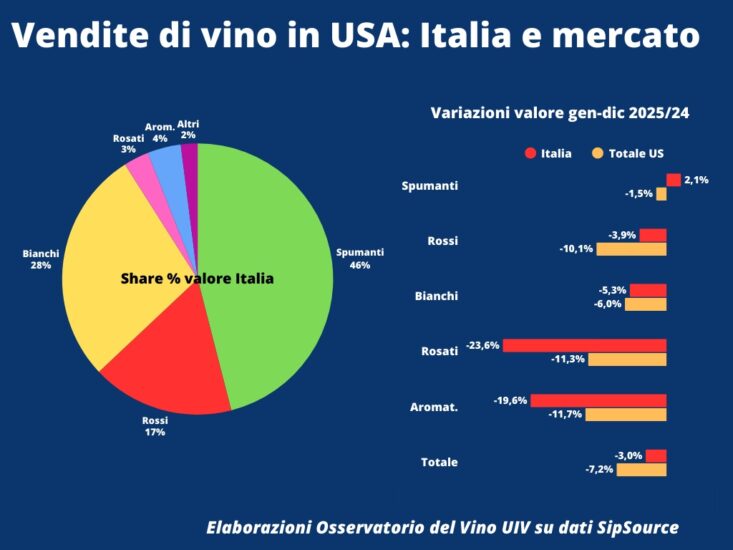
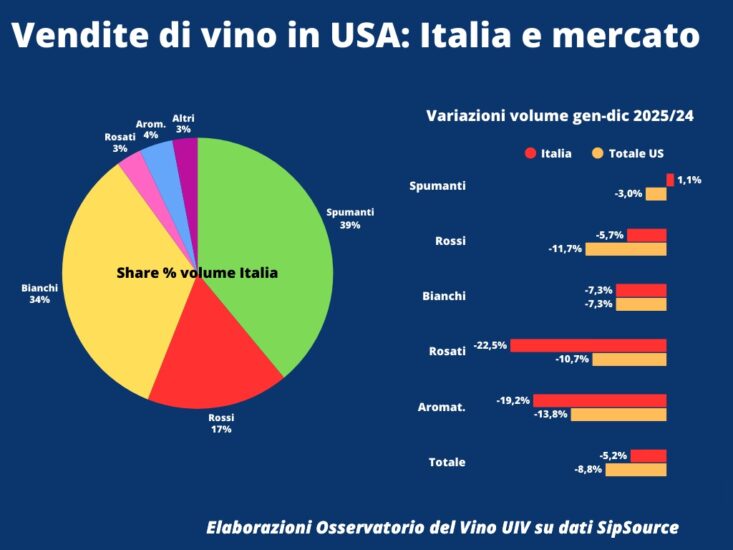
As some top U.S. buyers told WineNews during “Grandi Langhe e il Piemonte del Vino”, held in recent days in Turin, while it is true that the American wine market is struggling (and while new developments are awaited, though without much hope on the tariff front), it can’t be described as collapsing. Italian wines, thanks to their variety, quality, and price-to-quality ratio, are suffering slightly less than the average. This is confirmed by SipSource data - the platform of U.S. distributors which measures warehouse depletions of products destined for retail - released by Unione Italiana Vini - Uiv. According to which, “overall wine consumption in the United States, the world leading wine market with a retail value of about 60 billion dollars per year, 8 billion dollars of which spent on Italian products alone, has declined for the fifth consecutive year”. Specifically, according to Uiv analysis based on SipSource data, “distribution sales in supermarkets, wine shops, restaurants, and bars fell by 8.8% in volume and 7.2% in value. Italy also closes 2025 in the red, but with more contained declines (-5.2% in volume, -3% in value) compared to an average strongly affected by the crisis of U.S. products, which show contractions in volumes close to 10%”.
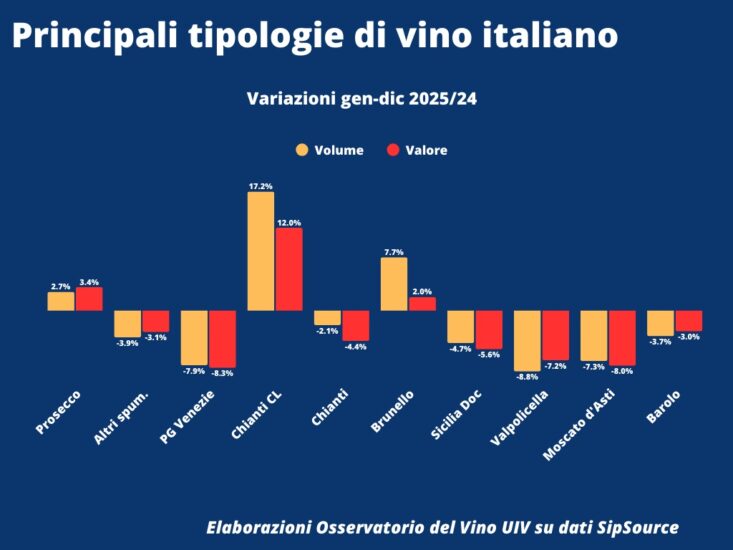
What has helped limit the decline of Italian wines - according to the Uiv Observatory - is “primarily Prosecco (+3.7% in value), a true star overseas, along with some timeless red denominations such as Chianti Classico and Brunello di Montalcino. All other major PDOs are struggling, despite Italy remaining firmly in the lead for imported wine consumption in a year which revealed a new sales leadership - also in value - in the sparkling category: Italian sparkling wines hold a 47.5% share, compared to 46% for French ones”.
“In the last four years, wine consumption volumes in the U.S. - says Uiv president Lamberto Frescobaldi - have contracted by about 20%; Italian wines have fared better, losing around 12% by our estimates. In this weakened market, also impacted by reduced purchasing power, the tariff situation becomes even more damaging, especially considering the first price increases on store shelves. In the month of December, we observed price growth of around 4%, despite Italian producers having cut their price lists by an average of 10% in the last semester. In such a difficult phase, it would be more appropriate for everyone to do their part to keep demand alive: we are doing ours, the American trade much less so, and this risks becoming a boomerang, above all for them. We must also acknowledge the need to accelerate new free trade agreements in response to U.S. protectionism, on which we have little hope of a change in direction. The U.S. - concluded Frescobaldi - remains an irreplaceable market for our wine, but with exports closing 2025 down 9% in value, every new partnership is an opportunity, and a duty, to seize, starting with Mercosur and India”.
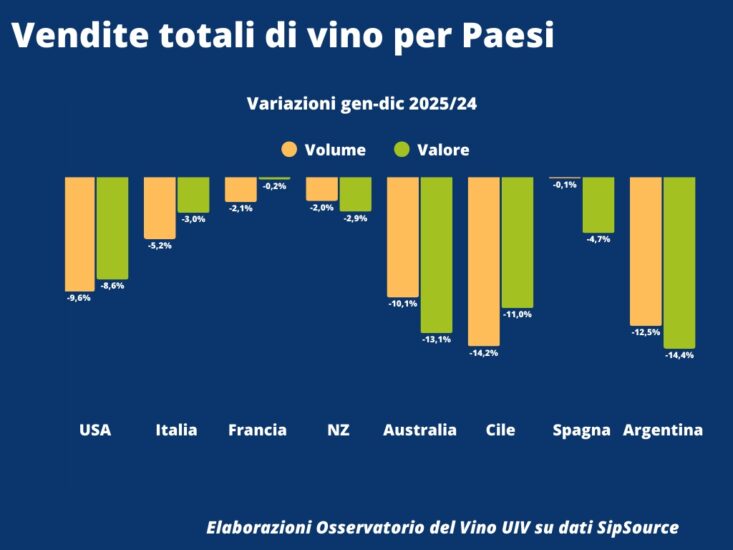
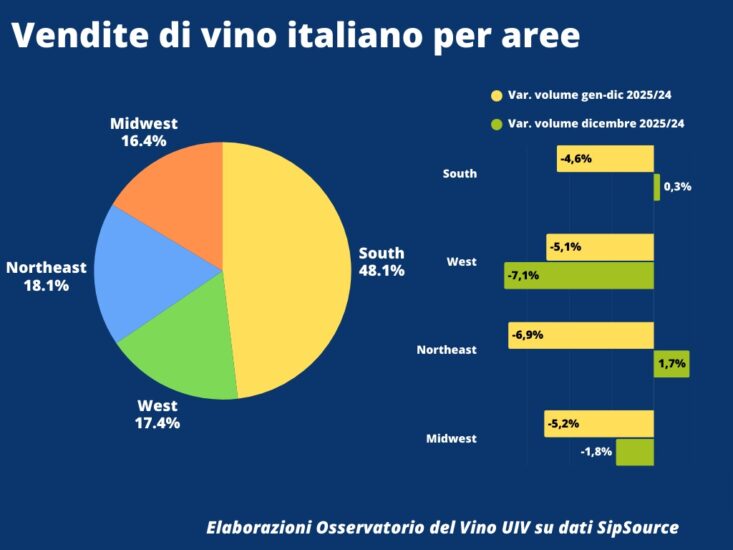
In Uiv observatory analysis based on SipSource, Italian sparkling wines are the only category recording growth in commercialized value (+2.1%). Red wines limit the losses (-3.9% compared to -10.1% for the overall category), while white wines fall by 5.3%. Rosé and flavored wines drop by about 20 percentage points. U.S. consumption shares by type show a further rise for sparkling wines: sparkling wines now account for 40% of American spending for Italian bottles, followed by white wines (28%), red wines (17%), aromatic wines (4%), and rosé wines (3%). In the geography of Italian wine consumption, the South dominates (48%), followed by the Northeast (18%), West (17%), and Midwest (16%). Among the competitors, France has managed to keep its annual sales value essentially unchanged (-0.2%), thanks mainly to white wines and the stable performance of Champagne. Spain is down (-4.7%). Among New World producers, New Zealand - the leader in white wines - keeps losses contained (-2.9%), while declines are in double digits for others (from Australia to Chile to Argentina), with U.S. Wines which account for 67% of total U.S. wine consumption by value, at -8.6%.
Copyright © 2000/2026
Contatti: info@winenews.it
Seguici anche su Twitter: @WineNewsIt
Seguici anche su Facebook: @winenewsit
Questo articolo è tratto dall'archivio di WineNews - Tutti i diritti riservati - Copyright © 2000/2026