








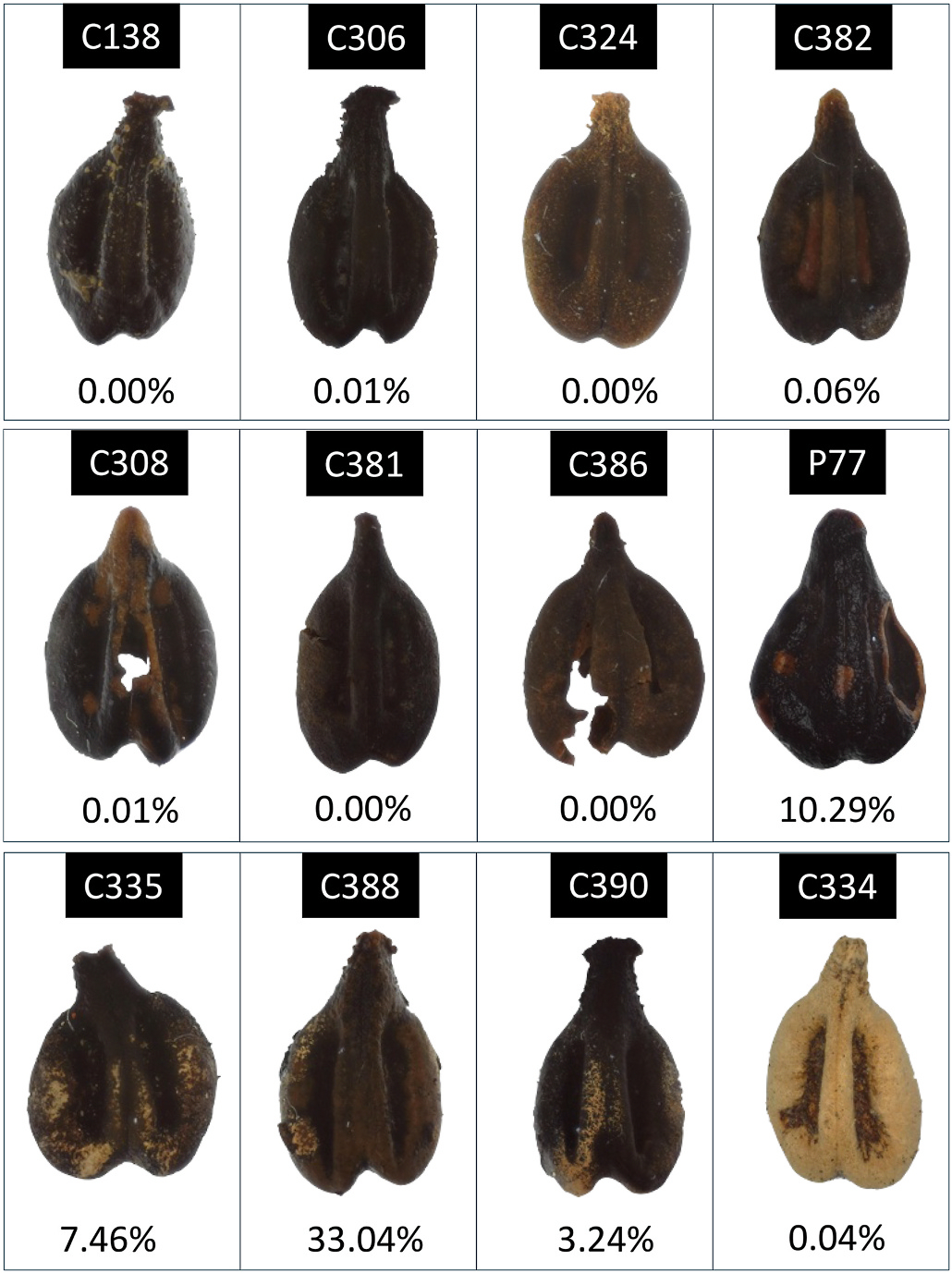
Part of the great appeal of wine as a “cultural beverage” and as a means through which to read the history of humankind lies in the ability of that very history to continually rewrite itself, sometimes revealing astonishing aspects. For example, by telling us that what is today one of the world most celebrated wine regions for its great red wines actually has ancient “white wine” origins. “In the anaerobic mud of deep wells, at Cetamura del Chianti (in the territory of Gaiole in Chianti, in the heart of Chianti Classico, ed), grape seeds capable of rewriting the prehistory of European wine had been lying dormant for two thousand years. They have been revived by researchers at the University of York, in a study published in the “Journal of Archaeological Science”. In terms of scope and consistency of the sample, it represents the most complete genetic reconstruction ever attempted on ancient vines from a single site. Eighty seeds were sequenced. A timeframe spanning from 300 BC to 300 AD. A settlement inhabited first by the Etruscans, then the Romans, and later medieval Italy. And a discovery which elegantly overturns the image Chianti has of itself: that land of Sangiovese and powerful red wines actually produced white grapes in classical times”, writes and comments historian Gianni Moriani to WineNews.
Who continues: “Dr. Oya Inanli, who carried out the work as part of her doctoral research, describes the most surprising finding with scientific understatement: the vast majority of the seeds analyzed belonged to a single identical variety, transmitted directly from the Etruscans to the Romans and maintained for centuries. A dominant clone, therefore, of extraordinary genetic stability. And the markers revealed that this grape variety produced white berries”. And if over more than 2,000 years it is understandable that things may have changed profoundly, “for those familiar with the territory, the news - explains Moriani - has the taste of historical vertigo. Chianti Classico, Sangiovese in purity or almost, a full-bodied red wine with a vocation for long macerations thus descends from a viticultural tradition that, in its documented origins, was of an entirely different chromatic and probably organoleptic nature”- Professor Nancy De Grummond of Florida State University, who has been carrying out excavations at Cetamura since 1973, as reported by Moriani, admits it with the delight of someone surprised by her own land: “how pleasant it is to learn that today world-famous red wine was actually preceded by a white wine cultivated and preserved for centuries in Etruscan and Roman times”.
But the research, the historian explains, doesn’t stop at the local dimension. “After the Roman conquest of the settlement, completely new grape varieties appeared at Cetamura, “imported vines”, one might say using a modern expression, suggesting the introduction of plant material from other provinces of the empire. The genetic kinship of Cetamura dominant clone with two ancient seeds previously analyzed and originating from southern France is even more revealing. This data - continues Moriani - transforms the discovery from a local fact into systemic evidence: the Roman Empire managed a long-distance agricultural network capable of standardizing wine production on a continental scale. It was not only a matter of trading amphorae and bottled wine, but of the circulation of propagative material, of exchanges of grafts and cuttings, of a true imperial viticultural policy, which Dr. Nathan Wales, co-author of the study, summarizes effectively: “it is incredible to think that the wine grapes appreciated by the ancient Romans are only a few steps away from the varieties we pour into our glasses today”.
But, according to Moriani, there is also “a third element brought to light by the research, one which possesses the evocative power typical of major scientific discoveries: among the eighty seeds analyzed, one belongs to a family of grape varieties still cultivated in Central and Eastern Europe. Its closest resemblance in the contemporary ampelographic panorama is a rare Hungarian variety, Baratcsuha szürke. But the most extraordinary connection is with the vine of Maribor, in Slovenia: officially recognized as the oldest living vine in the world still capable of producing fruit, with its four hundred years of history. The genetic thread that links a seed found in the mud of an Etruscan-Roman well to a plant still alive in a Central European city is more than an ampelographic fact. It is material proof that viticulture does not proceed through breaks and restarts, but through slow and widespread transmission, across centuries, conquests, wars, and the movements of peoples. The vine endures”.
What makes this research particularly valuable for the world of wine, and not only for archaeology, is the methodology adopted. “Ancient Dna analysis, already successfully used to reconstruct human genetic history, is now being applied with increasing precision to Vitis vinifera: not only to identify varieties, but to determine their color through molecular markers. A step which transforms fossil seeds from morphological remains into readable genetic documents. The wells of Cetamura, with their anoxic darkness - still explains Moriani - functioned better than any archive: oxygen-free mud halts bacterial degradation and preserves biological material intact. It is an unintentional form of cellar, more efficient than many modern ones. When you drink a Vernaccia di San Gimignano or a Greco di Tufo, Italian white wines with ancient roots, you may be sipping something not so distant, genetically and historically, from what was drunk at Cetamura two thousand years ago. And when today Chianti red - powerful, tannic, scented with violet and cherry - fills the glass, it carries with it the long shadow of a vanished white which is, in some way, its forgotten father”, concludes Moriani.
Copyright © 2000/2026
Contatti: info@winenews.it
Seguici anche su Twitter: @WineNewsIt
Seguici anche su Facebook: @winenewsit
Questo articolo è tratto dall'archivio di WineNews - Tutti i diritti riservati - Copyright © 2000/2026