


Tuesday 22nd of September 2026 - Last Update: 09:54







Trump tariffs, though deemed illegitimate, have largely (and within a regulatory framework for any potential reimbursements that is still far from clear) hit global economies hard, including the U.S. In the States, also due to ongoing wars, data from the Bureau of Labor Statistics (analyzed by the American Association of Wine Economists) shows that, in May 2026, fuel consumer prices were 40% higher than in May 2025. Many other goods, from tomatoes to air tickets, electronics to meat, rose between +10% and +32%. Overall, wine prices increased by 1.9% in out-of-home and even fell by -0.5% for domestic consumption purchases. Meanwhile, compared to 2024, the U.S. “wine trade balance” saw limited benefit: imports dropped by -8.3% to 6.2 billion euros, but exports collapsed by -33.5%, largely due to retaliatory tariffs from countries like Canada, bringing the deficit to -5.36 billion dollars, only slightly reduced (-2.5%). In short, there has been no strong positive effect, and Italian wine has not been spared: in 2025, compared to 2024, exports to the U.S. fell by -9.1% (1.75 billion euros), and in the first 3 months of 2026 they declined by .20.5% compared to the first quarter 2025 (407 million euros), according to Istat data analyzed by WineNews.
Yet,the loyalty of Americans to Italian wine (and to Italian agri-food products in general) gives hope that, when the economy starts growing again, consumption of Italian wine will also recover. Moreover, according to a survey of 1,200 U.S. wine consumers carried out by Nomisma for Federvini, “despite the price increases linked to tariffs being felt by the vast majority of buyers, less than 10% have substituted Italian products”. And “when faced with a potential 20% price increase, a significant share of consumers say they wouldn’t change their purchasing habits”.
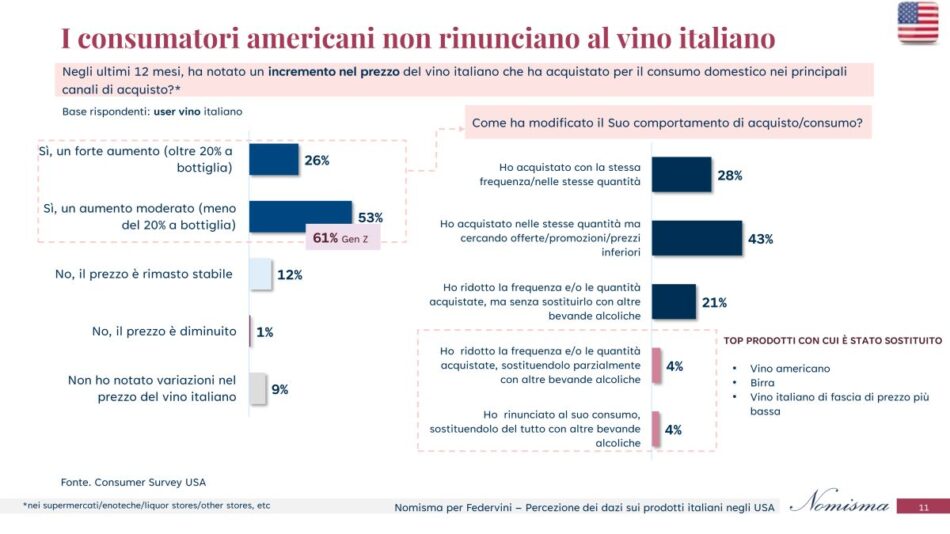
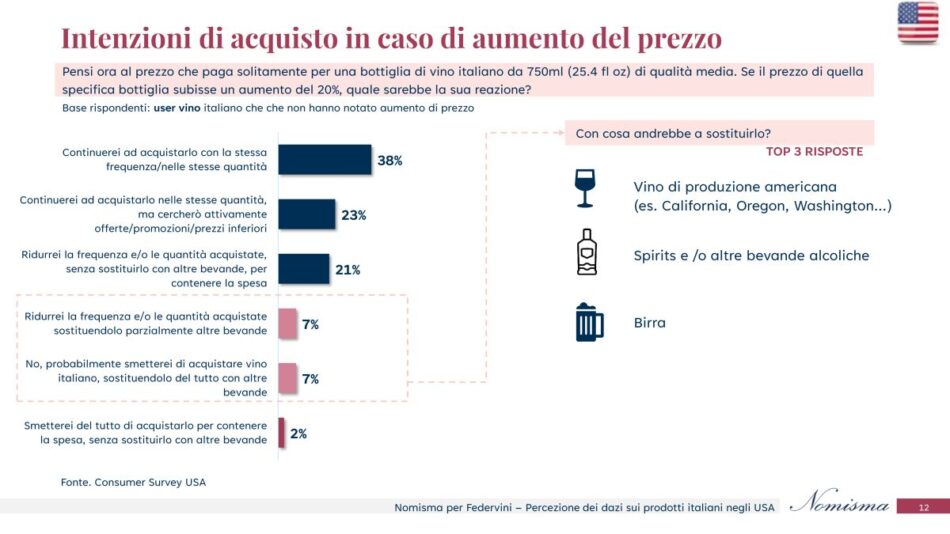
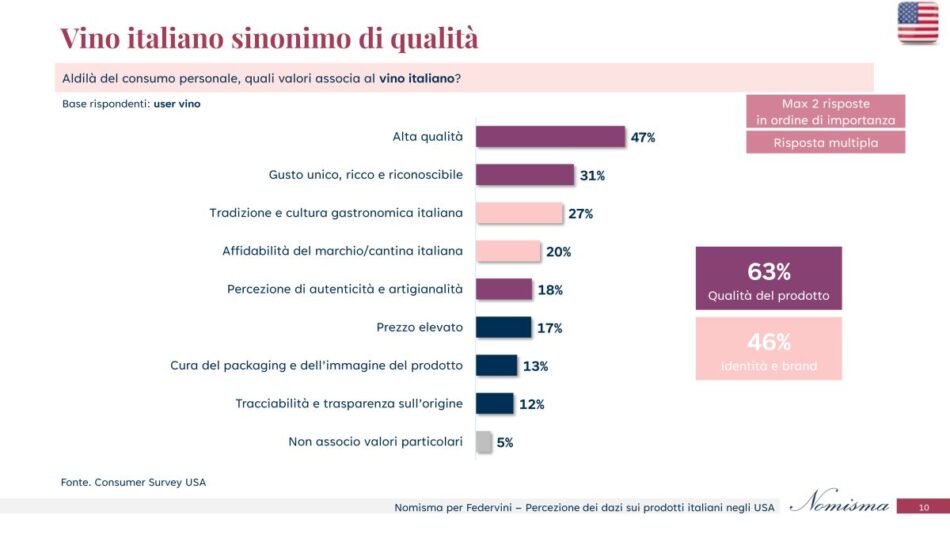
Looking at the data in detail, 68% of Americans who responded to the survey consume wine. While only 5% do so every day, about 40% is almost evenly split between those who enjoy a glass once a week and those who do so 2-3 times a month. And although consumption, as expected, is mainly concentrated on domestic wines (with “USA” indicated as the origin in 62% of cases, with multiple answers allowed), Italy follows immediately behind and ranks first among foreign countries (40%). Moreover, among foreign countries, Italy is perceived as offering the greatest guarantee of quality, both for food products (59%) and beverages in general (39%). Focusing more specifically on wine, whether Italian or not, the reputation and recognition of the winery brand is the main purchasing criterion (42%), followed at this stage by low price or the presence of a promotion (37%, rising to 49% among those earning less than 2,000 dollars per month), recommendations and word of mouth (34%), national origin (32%), grape variety (31%), packaging (22%), and foreign origin (22%). Italian wine, however, is synonymous with high quality (47%), a unique and recognizable taste (31%), and Italian tradition and culture (27%), although high price is indicated as the main obstacle to purchasing Italian labels (40%). Price increases, whether moderate or significant, are being noticed by consumers: more than one in four say they have observed a per-bottle price increase of over 20%, while half report moderate increases (below 20%). Nevertheless, 28% of Americans say they have continued buying Italian wine as before, 43% have maintained the same quantities while perhaps seeking deals or lower-priced products, and 21% have slightly reduced purchases without replacing Italian wine with other products. Among those who have not noticed price increases (12% of the sample), 38% say they would still continue buying as they do now even with a 20% increase in price per bottle, and 23% say they would keep purchasing the same number of bottles while looking for deals or more affordable options.
In a complex scenario, therefore, a certain degree of loyalty among American consumers toward Italian wine still emerges, which bodes well for the future. At the same time, there is an awareness that the U.S. market of tomorrow, once current challenges (a weak dollar, wars, and so on) are overcome, will likely be different from what we have known so far, as commented to WineNews by Albiera Antinori, head of Marchesi Antinori and the Wine Group of Federvini, who has a privileged perspective on the U.S. market, both as a producer (also active in the U.S., owning Stag’s Leap Wine Cellars, one of Napa Valley’s most important wineries in California) and as an importer through Vinattieri 1385. “The decline in wine consumption in the United States is not due only to tariffs, but to a series of factors, including geopolitical issues, which will certainly be resolved sooner or later. The market may not be exactly the same as we were used to, but I have no doubt that the situation will evolve positively: American consumers are great admirers of Italy, Italian products, and Italian wine. It is difficult to predict exactly how it will evolve - explains Albiera Antinori - tariffs came into play at a time when the market was already in crisis, accelerating it. There is also the issue of the three-tier system, the three steps required to bring wine from abroad to the shelf, which drives up final costs: it generates jobs but does not create added value. There are also difficulties in U.S. production, which, due in part to tariffs—has seen countries like Canada close their markets to certain products, meaning American producers will also need to reorganize beyond the current situation. Finally, there is the consumer - concludes Albiera Antinori - who is changing, in the U.S. and beyond: they are looking for more elegant, lower-alcohol wines, better suited to new types of cuisine. These are aspects that American viticulture will need to address, while Italy already has them somewhat in its DNA, and this gives reason to look to the future with optimism”.
Copyright © 2000/2026
Contatti: info@winenews.it
Seguici anche su Twitter: @WineNewsIt
Seguici anche su Facebook: @winenewsit
Questo articolo è tratto dall'archivio di WineNews - Tutti i diritti riservati - Copyright © 2000/2026