


Thursday 26th of March 2026 - Last Update: 18:18







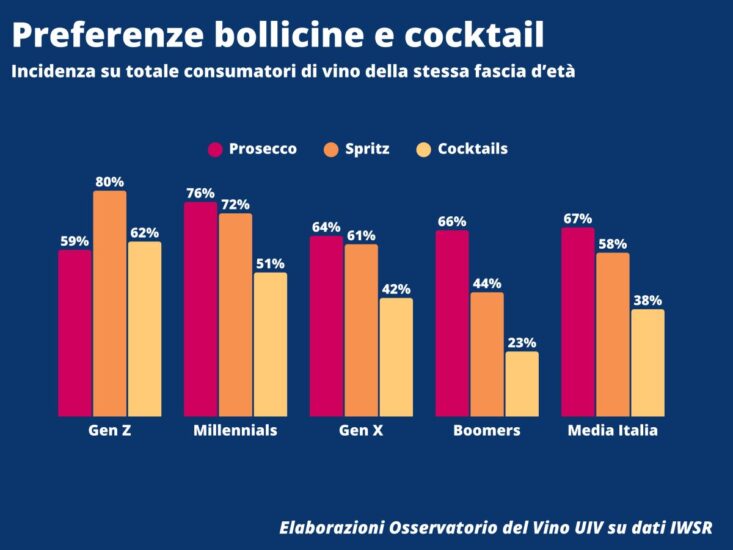
“It is all wrong, it all has to be done again”, said the great cycling champion Gino Bartali. A sentence which seems perfectly suited to what, until now, many analyses of consumption have largely been saying. Namely, that fewer and fewer people drink wine, that young people are no longer looking to the nectar of Bacchus, and that red wines, especially among the young, are now on the road to sunset. And yet, it now emerges that while it is true that less wine is being consumed, under the banner of “less but better” and moderation, it is also true that the pool of consumers is widening, especially thanks to the new generations, even if consumption is more occasional and less daily than in the past. And, if Prosecco is the favorite wine of Boomers, Gen X and Millennials, namely the more mature consumers, the great Italian red wines are the favorites of the very young of Gen Z, led by Amarone della Valpolicella, Barbaresco, Taurasi, Bolgheri and Chianti. This is a picture deeply different from the one drawn so far, captured by data from Unione Italiana Vini (Uiv) - Vinitaly Observatory, presented today in Rome at the Chamber of Deputies during the launch of the edition No. 58 of Vinitaly 2026, the flagship event of Italian wine, taking place from April 12th to 15th at Veronafiere in Verona.
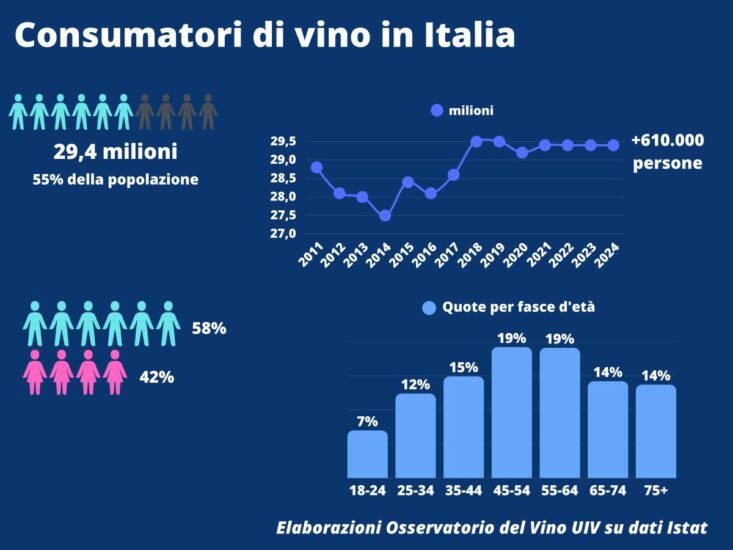
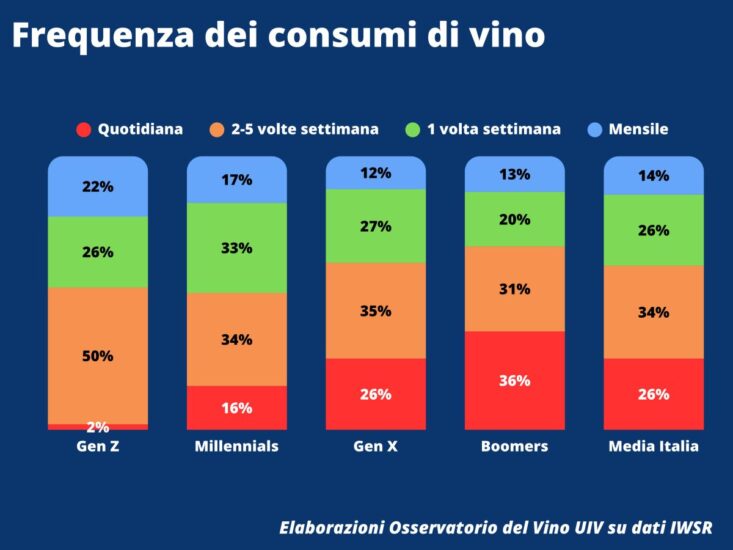
According to the Observatory, wine consumers in Italy currently number just under 30 million people, or 55% of the population. Over the last five years, the figures have therefore remained stable, while broadening the view to the first decade of the new millennium (2011) actually shows growth of more than 600,000 people. “People are drinking less, and this is true - notes the Observatory, which analyzed consumption over the past two decades based on Istat and Iwsr data - but this is because the share of daily users has declined, especially recently, among the more mature age groups. Today, the factors have reversed almost symmetrically: 61% of Italians consume wine occasionally, compared with 39% “daily” consumers: in 2006, the ratio was almost exactly the opposite”. People are therefore drinking less, but the consumer base is growing, in an evolution that, explains the Observatory, reflects the level of maturity in Italians relationship with wine: more aware, more moderate, and more aligned with an hedonistic and qualitative approach to consumption.
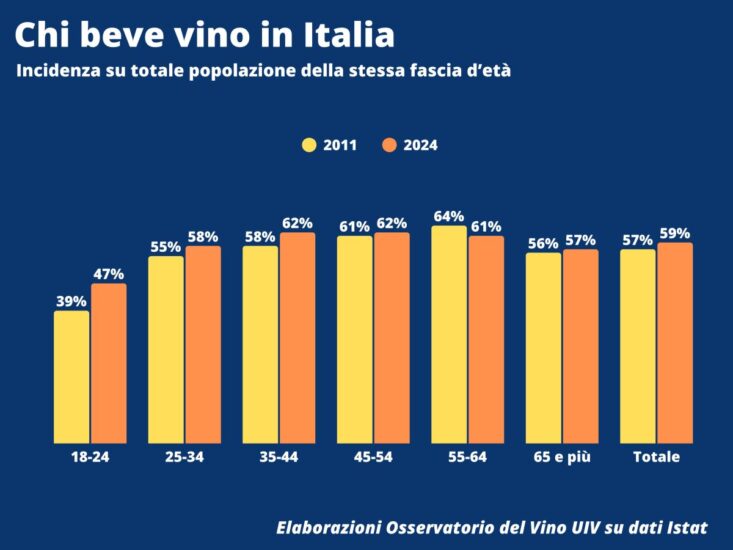
But surprise after surprise, exactly young people are expanding the base of wine consumers in Italy, even if they weigh less on total consumption, also because in numerical terms they are fewer than even 20 years ago. “It is true - affirms the analysis - that the most significant shares of wine consumers are found among the mature/elderly groups, with a 66% share among those over 45, but it is equally true that the small 18-24 age group (7% of consumers) is the only one to have seen a significant increase in its share: +8 percentage points (with very young wine consumers rising from 39% to 47% of their category), against stability in the more mature groups and a decline led by Millennials (ages 29-44)”. A positive sign for a cohort which stabilizes its consumption habits more gradually, as noted by Carlo Flamini, head of the Uiv-Vinitaly Observatory: “looking at generational movements, it can be said that wine gains a certain centrality in consumption habits as people grow older: if 18-24-year-olds surveyed by Istat in 2011 reported consuming wine in 39% of cases, 13 years later - when they were aged 31-37 - the share had risen to nearly 60%”.
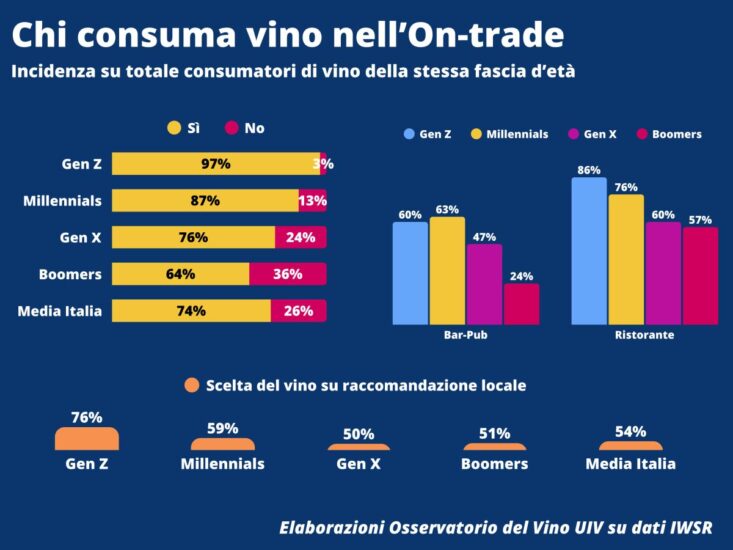
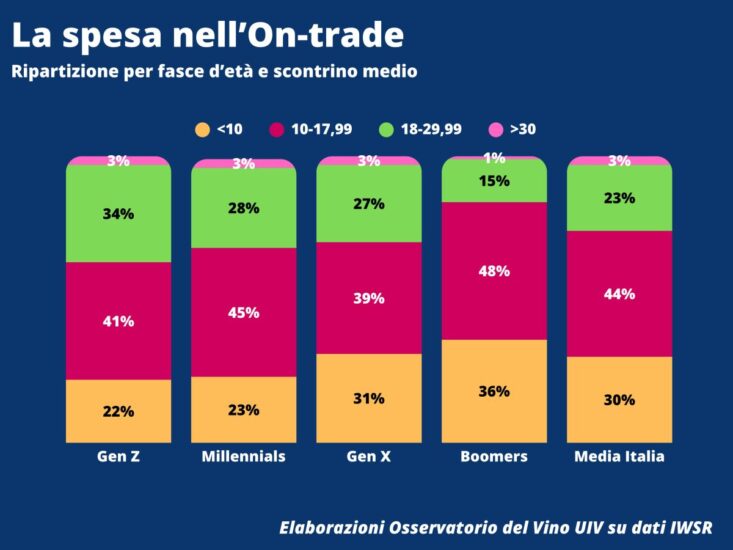
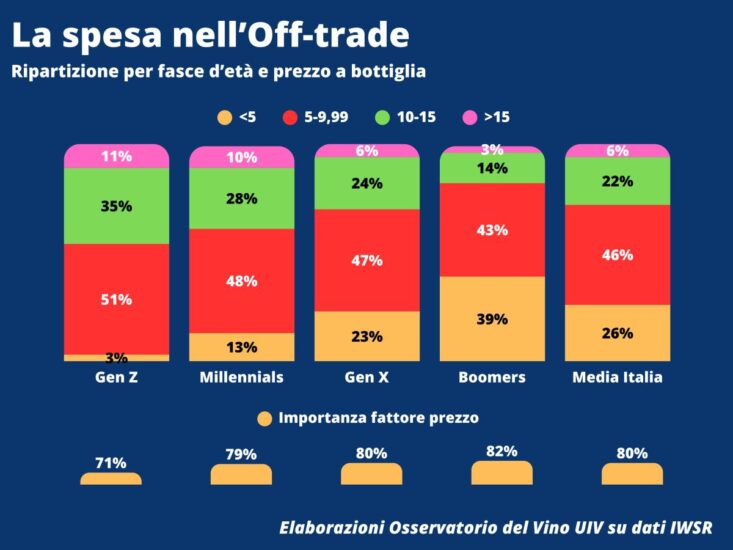
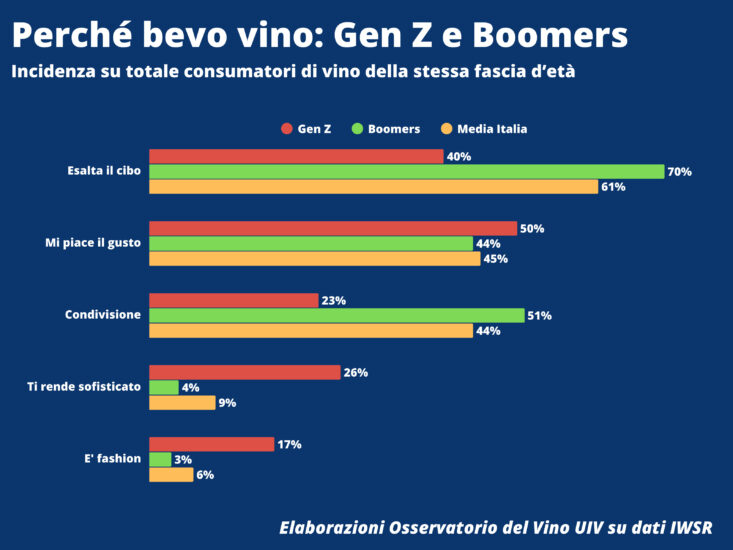
What is even more surprising, at a qualitative level, is the approach of young people. “Compared with more “tired” mature generations, where price is the dominant factor and out-of-home consumption is losing ground, young people relationship with wine - explains the Observatory - is driven by curiosity and self-affirmation, but above all by the simple fact that they like the drink”. In analyses based on Iwsr data, “I like the taste” is in fact the top criterion for Gen Z under 28 (50%), while for Boomers the main motivation is linked to eating at the table and therefore food pairing (70%). Another important factor in wine choice among Gen Z is related to the sphere of the self: “it makes you feel sophisticated” and “it is fashionable” together account for 43% of consumption motivations, compared with 7% among Boomers. This explains young people tendency to spend more on average (18 euros per check compared with an average of 10 euros out of home), and above all the fact that wine becomes a must outside the home. Here, the highest incidence percentages are found, unsurprisingly, among the youngest cohort: 97% for Gen Z, 87% for Millennials, while Boomers drop to 64%. Among the most popular venues, restaurants appear to be the preferred choice for the youngest consumers: 76% among Millennials and as high as 86% among Gen Z, compared with around 60% for Gen X and Boomers.
The decline in wine consumption in Italy, therefore, cannot be attributed to young people, or at least not solely to them. “The reductions we have seen in recent years are the result of the combined effect of two factors: the general shift toward occasional consumption, which today also affects more mature generations, and the significant reduction in the quantities of wine consumed on a daily basis, the so-called “moderation” which entails a progressive abandonment of excessive quantities (over half a liter) in favor of smaller amounts, 2-3 glasses a day. Moderation, like occasional consumption, is now more evident among mature generations”, explains the Observatory, which will further explore the topic at Vinitaly with the survey “Il consumatore al centro: la nuova alleanza tra vino e ristorazione” - “The consumer at the center: the new alliance between wine and foodservice”, in collaboration with Fipe, the Italian Federation of Public Establishments, based on a representative panel of restaurants and venues across Italy.
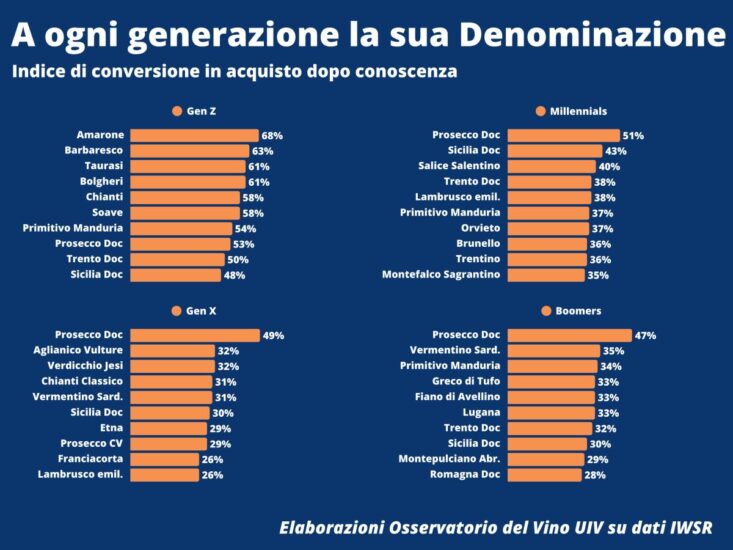
As mentioned, the Uiv -Vinitaly Observatory also seems to debunk another long-held assumption, namely the farewell to great red wines. Because “while it is true, and predictable, that Prosecco is the preferred product among Millennial consumers and older, it is rather surprising to see a shift toward reds among the very young of Gen Z, who draw up an all-red ranking through the fifth position. In first place - according to the Observatory Iwsr-based analysis - we find Amarone della Valpolicella, with a purchase conversion rate of 68%, followed by Barbaresco, Taurasi, Bolgheri and Chianti”. “There is a sort of revenge for red wines, which perhaps we had prematurely written off - still explains Carlo Flamini - they prove that any label can be the right one if it is offered to the right consumer. The very young are not only the most curious and inclined toward new experiences, but also the most open to advice”.
According to the survey data, Gen Z is in fact the generation most inclined to be guided in its choices both out of home and in online purchasing, where the youngest consumers (61%) read advice or reviews on websites and blogs, a habit which already drops sharply among Millennials (38%) and reaches its lowest levels among the most mature generation (24%). “The generational impact on attitudes toward experimentation - continues Flamini - is also reflected in the choice of formats. Four out of ten Gen Z consumers would buy wine in a can, and 17% would buy it in a pouch (soft plastic packaging, ed), figures which drop respectively to 4% and 0% among Boomers”.
In the under-30 ranking, white wines appear only in sixth place with Soave, then jump to ninth with the sparkling Trentodoc. The latter serves as a bridge to Millennials, who place it in fourth position. In second and third place on the podium (behind Prosecco, the “king” of Italian sparkling wines, chosen by three out of four consumers aged 30-44), there are Sicilia DOC and Salice Salentino, while Lambrusco from Emilia (in fifth position) forms a generational bridge toward Gen X. Among consumers aged 45 to 60, these mature drinkers include in their “Top 5” (again after Prosecco) Aglianico del Vulture, Verdicchio dei Castelli di Jesi, Chianti Classico and Vermentino di Sardegna, which also appeals to those over 60, who rank it second. In the wine kingdom of Boomers, the last step of the podium is occupied by Primitivo di Manduria (also sixth among Millennials and seventh among Gen Z), followed by Campanian white DOCGs (Greco di Tufo and Fiano di Avellino) and Lugana.
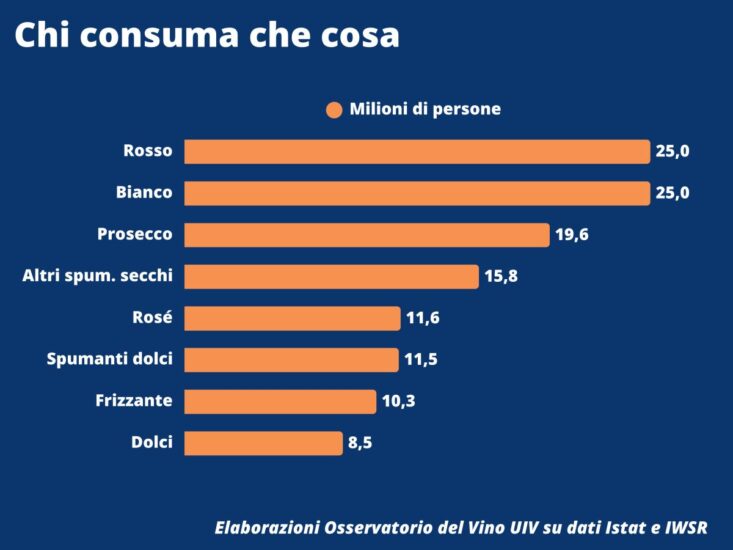
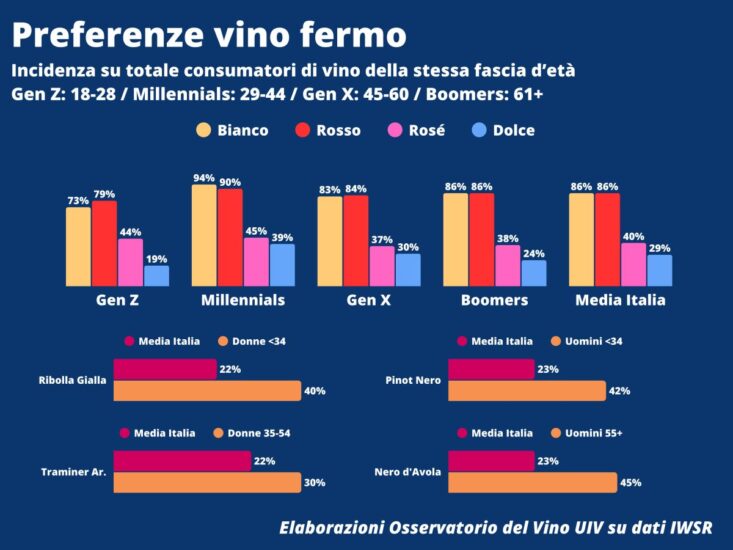
Looking at wine types, still wines are those with the highest penetration indices across all generations, with a total of 25 million consumers and peaks above 90% among Millennials for both white and red wines, well above the 70% mark even among Gen Z. As for sparkling wines, Prosecco fills the glasses of 20 million Italians, but nearly 16 million also choose other dry sparkling wines. Sweet sparkling wines stand at 11.5 million consumers, the same level as rosé wine.
Copyright © 2000/2026
Contatti: info@winenews.it
Seguici anche su Twitter: @WineNewsIt
Seguici anche su Facebook: @winenewsit
Questo articolo è tratto dall'archivio di WineNews - Tutti i diritti riservati - Copyright © 2000/2026