







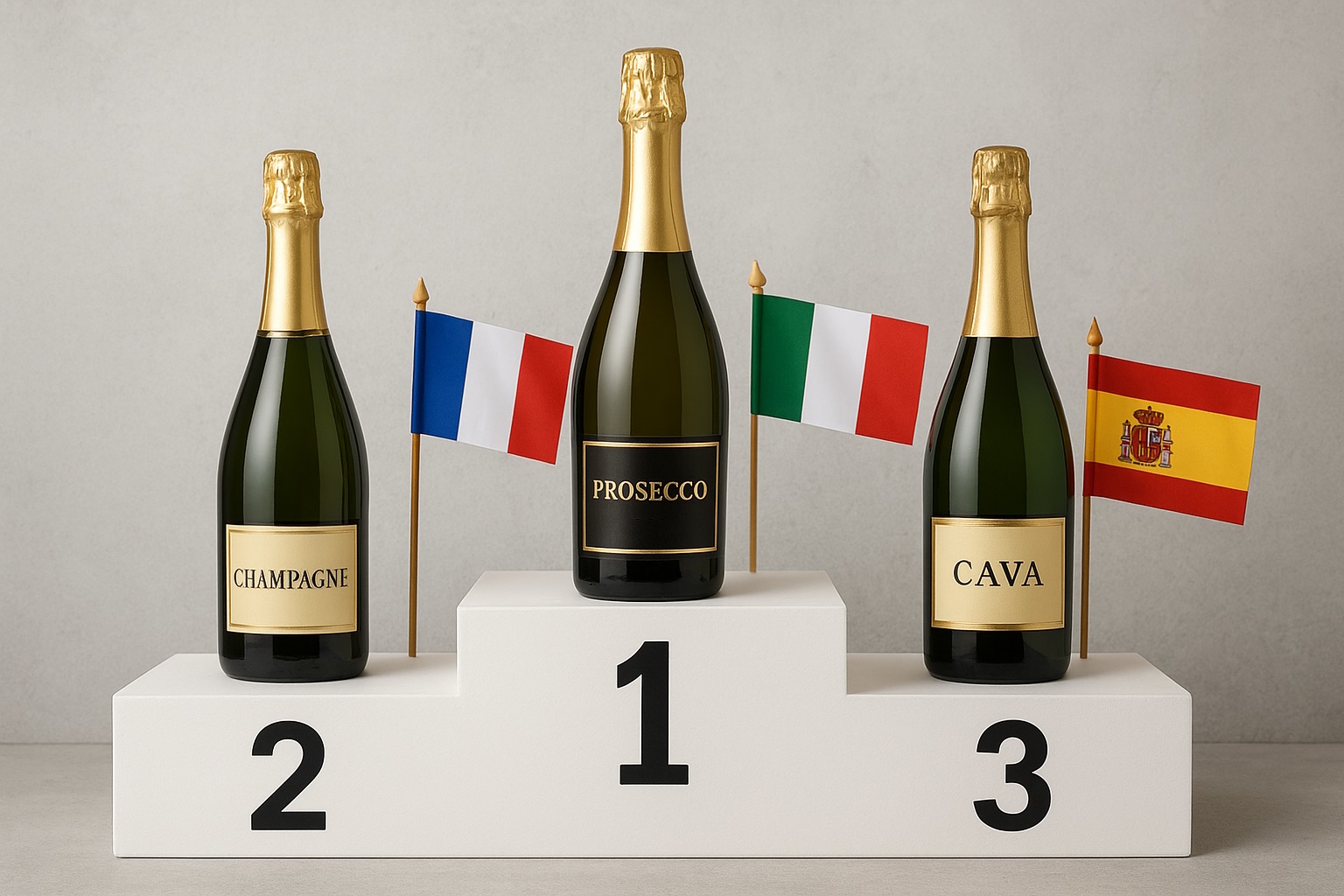
More than French Champagne and Spanish Cava, Prosecco is the sparkling wine that, in last years, has grown the most in percentage terms, both in value and volume, confirming itself as a phenomenon not only Italian (it is the driving force of wine exports) but also international. A snapshot of the sparkling wine market, dominated by Italy, France, and Spain, comes from figures analyzed by Del Ray Analysts of Wine Markets, published a few days ago. Overall, despite the positive trend of recent years, in July 2025 on an annual basis, sparkling wine exports have slowed, with global sales down by -0.6% in value (8.51 billion euros) and by +0.4% in volume surpassing 1 billion liters. Sparkling wine remains the wine category with the highest average price per liter (7.83 euros), although it is the only type to record a decrease over the past 12 months (-1%), despite the overall price of wine increasing by 1.2%. France, Italy, and Spain account for 85% of global revenue and 75% of sparkling wine volume, followed by Germany, which contributes 8% of value and 11% of volume.
However, the three leading sparkling wine countries show different trends and weights. France, with sales of 222 million liters for a value of over 4.3 billion euros represents half of global sparkling wine revenue mainly thanks to Champagne. Italy covers almost half of global export volume (519 million liters), although it accounts for 28% of value, just under 2.4 billion euros, largely thanks to Prosecco. Spain follows with 6% of total revenue (520 million euros), less than a quarter of Italy revenue, and is slightly closer to France in terms of volume, with 160 million liters, i.e. less than a third of Italy exported volume driven by Cava.
Looking at recent years, the boom of Prosecco, which represents 75% of Italian sparkling wine production, is evident. In 2020, the year of Covid-19, France lost 647 million euros, dropping from nearly 3.5 billion euros in sales to less than 2.8 billion euros. In 2021 and 2022, sales increased by over 1.8 billion euros reaching nearly 4.7 billion euros. In 2023, sales fell to 4.3 billion euros and remained stable with a slight increase of 1.3% in 2025 (from the beginning of the year to July). Italy revenue growth, driven by Prosecco, has been much more consistent. Until 2009, sparkling wine sales were very similar to Spain (388 million euros for Italy and 334 million euros for Spain). But, then the value of Italian sparkling wine increased six times reaching 2.4 billion euros, while Spanish sparkling wine sales grew only by 55% over the last 16 years to 520 million euros. While Italy increased its exports by 2 billion euros between 2009 and 2025, Spain grew by “only” 185 million euros.
In terms of export volume, the differences are striking. The three largest global producers and exporters sold similar volumes until 2009. That year, France exported 127 million liters, Italy and Spain 138 million liters. But, in 2020, Italy had already risen to 408 million liters, while France and Spain were competing even if at very different average prices at around 170 million liters. So, in just 11 years, Italy more than tripled its exported bottle volume, while France and Spain remained relatively stable. More recently, over the past four years, Italy has continued to grow, with some fluctuations and a projected decline in 2025, according to Del Ray Analysts of Wine Markets. France, also with fluctuations, rose to 222 million liters, while Spanish sparkling wine exports fell to about 160 million liters. Over the last 16 years, between 2009 and 2025 (annual reference is July), Italian sparkling wine exports increased by 276%, French by 74%, and Spanish by 22%.
An important aspect to be highlighted is that this surge was achieved at average prices which evolved better than competitors. Although French prices, thanks to Champagne, are unreachable averaging 19.43 euros per liter in 2025 compared to Italy 4.61 euros and Spain 3.24 euros per liter, Italian products have recorded the largest price increases since the turning point in 2009. In these 16 years, French prices rose by 41% (5.65 euros per liter more), Spanish by 34.1% (corresponding to 0.83 euros per liter more), and Italian by 64.1%, adding 1.80 euros to 2009 prices. Data shows that the superior performance of Italian sparkling wine sales, almost tripling Spain, was not due to lower prices but rather to higher unit prices compared to Spanish wines and faster growth.
So, the explanation for this greater growth is not price. In terms of value, on July 2025, Champagne accounts for 89% of France sparkling wine exports, Prosecco for 77% of Italy (where Asti is also important), and Cava for 74% of Spain total sparkling wine revenue. Champagne represents 54% of bottled French sparkling wines, Prosecco 75% of Italian sparkling wines, and Cava 70% of Spanish ones. Regarding market position, official data from these three main producers indicates average prices in July this year at 33.84 euros per liter for Champagne, 4.34 euros for Prosecco, and 3.69 euros for Cava. Since 2017, Champagne has grown by 36% in value, adding 1 billion euros in sales over the next eight years, for a total revenue of 3.8 billion euros over 12 months on July 2025. Prosecco, in the same period, more than doubled, with a 129% increase in value and profits even higher than Champagne, corresponding to about 1 billion euros reaching 1.8 billion euros in revenue in July 2025. Cava, on the other hand, grew by just 2.2% over eight years, adding 8.4 million euros to 2017 figures, for revenue of 382 million euros in July 2025.
Also in terms of volume, Prosecco shows even better performance compared to its main competitors, with even sharper differences. From 2017 to the referred yearly period of July 2025, Prosecco exports doubled (+107%), increasing by 219 million liters up to reaching 424 million liters, while Champagne exports rose by just over 1 million liters, +1.1% in 8 years, totaling 113.6 million liters. Cava exports fell by 13.1%, down 16 million liters in the same period, to 104 million liters.
“The difference in Prosecco evolution - explains the analysis - is therefore extraordinary compared to its two main competitors, both in value and volume. In last years, it has grown much faster than both, surpassing volumes, while Cava and Champagne have remained relatively stable, and it has recorded much greater value growth, although still far from Champagne revenues. However, average prices have increased slightly less rapidly than those of French and Spanish brands. In these same eight years, Prosecco average prices rose by 10.7%, while Champagne increased by 34.7%. Cava average prices rose by 17.6% in 8 years, yet it remains significantly cheaper than Prosecco”.
Despite being sold in a large number of markets (153 this year), sparkling wine exports from the main producers are concentrated and heavily dependent on a few countries. For France, the United States, the United Kingdom, and Germany, they account for 39.7% of total revenue and up to 41.8% of volume. For Italy, the United States, the United Kingdom, and France, they represent 48% of total value and 48.6% of volume. In the end, for Spain, with lower sales than its two competitors, the United States, Belgium, and Sweden account for 36.8% of turnover. Prosecco growth seems to have contributed to a slight price drop, especially in France, in recent months. Conversely, Spain is increasing the value of its sparkling wines, with average prices up 4.3% over the past year (since July 2024), almost double Italy (+2.1%) and more than France (+2.5%). If the strong growth in sparkling wine sales in recent years has occurred in some key markets, primarily the UK and the US, despite distribution in over 150 countries, this shows, according to the analysis, the weight of sales concentration, particularly high in Italy, and therefore that market diversification can’t be mentioned as the reason for Prosecco success.
So what are the reasons for this affirmation? According to Del Ray Analysts of Wine Markets, price, production method, and sales diversification do not explain Prosecco success. Rather, it is the taste of the product, which appeals to a wide range of consumers, also favored by cocktails like the spritz (now a global hit, ed). And still, an attractive image and the extensive distribution network on which sales are based. “These three elements - taste, image, and distribution - must be seriously considered fundamental for the success of any wine marketing strategy and, in any case, perhaps now more than ever, they stem from a deep understanding of market trends and consumer preferences”, concludes the analysis, which effectively rewards the work carried out over the years by the Prosecco universe, in its distinctive variations, from the historic Conegliano and Valdobbiadene DOCG to the younger and “ambitious” DOC and the dynamic Asolo DOCG.
Copyright © 2000/2026
Contatti: info@winenews.it
Seguici anche su Twitter: @WineNewsIt
Seguici anche su Facebook: @winenewsit
Questo articolo è tratto dall'archivio di WineNews - Tutti i diritti riservati - Copyright © 2000/2026