


Tuesday 25th of August 2026 - Last Update: 12:52








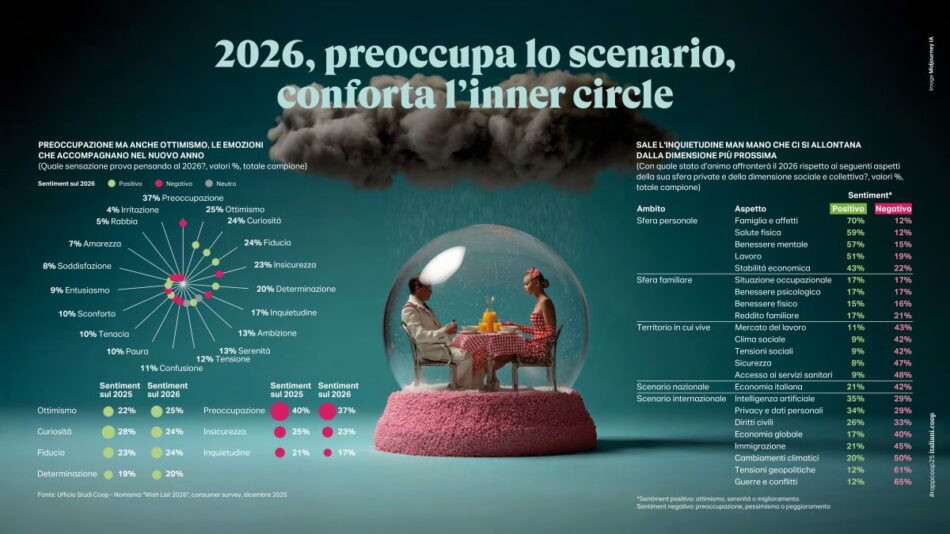
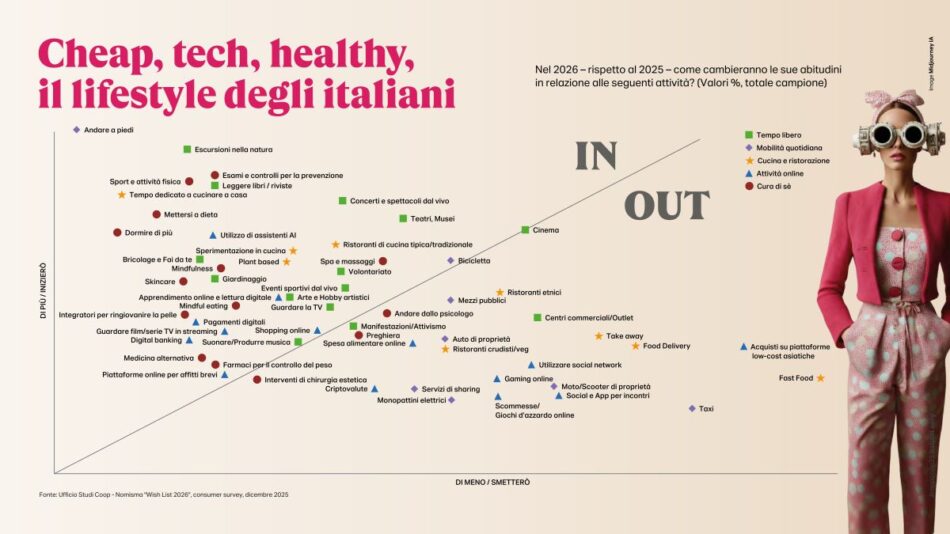
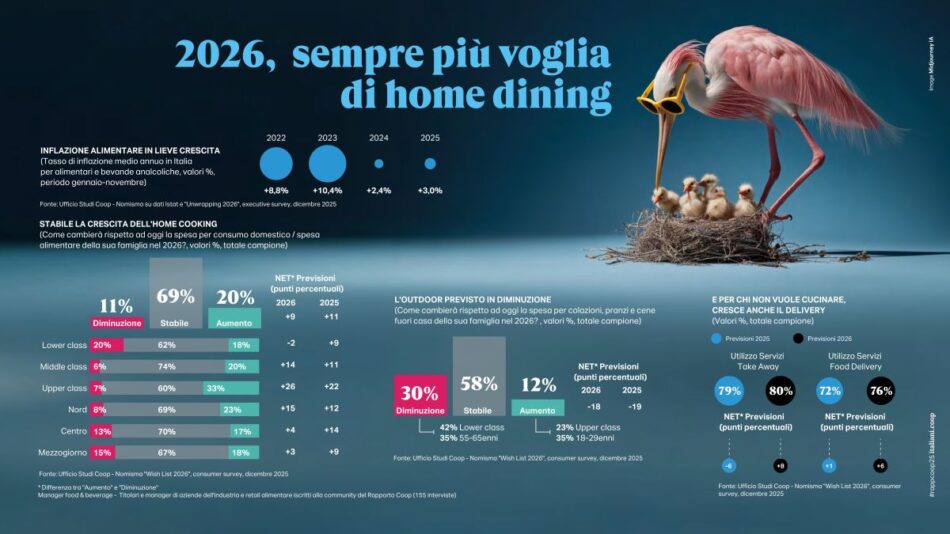
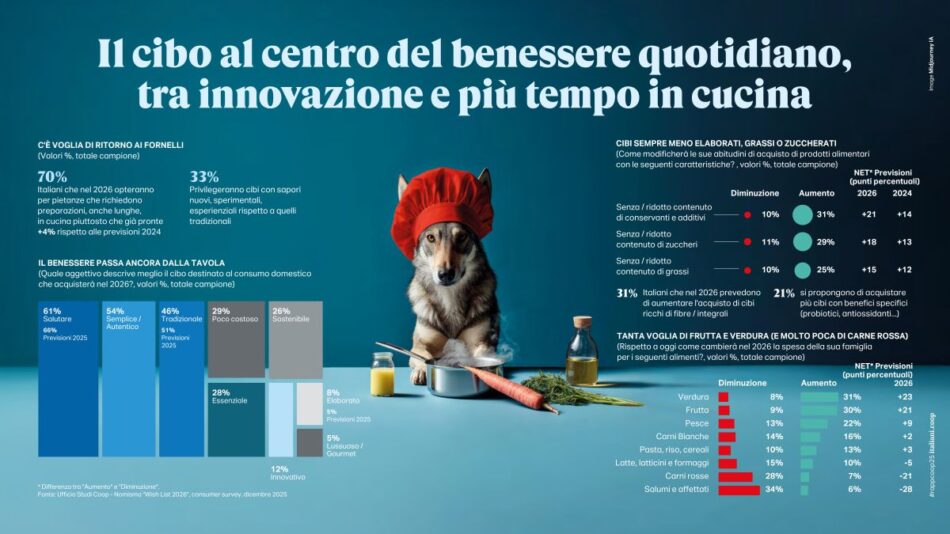
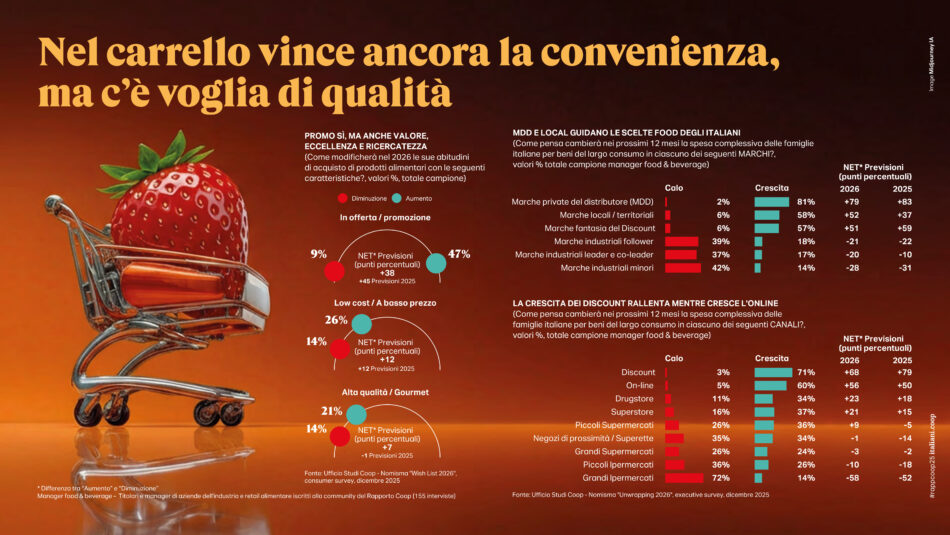
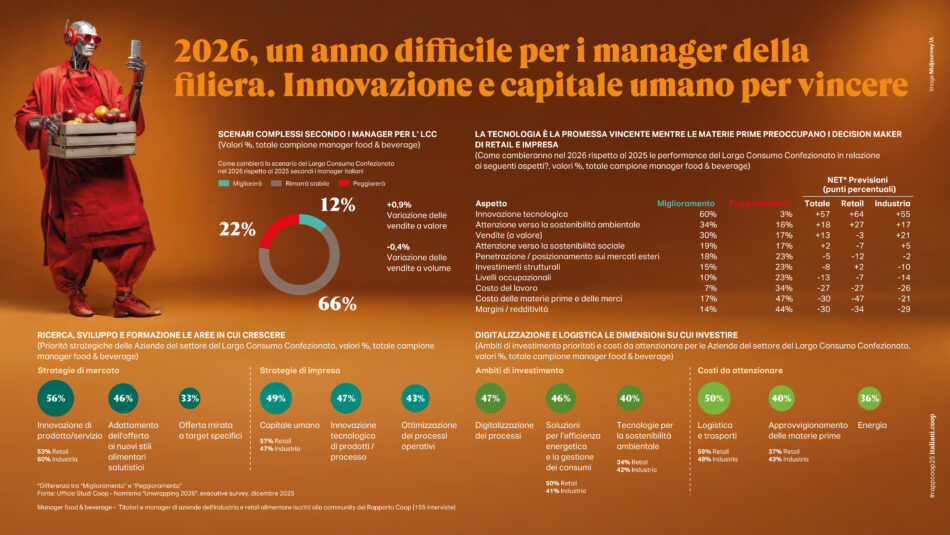
If the world is a “blender”, in 2026 Italians, “worried” (37%) and “insecure” (23%) in the face of the international scenario, take a break and seek refuge in their personal and family sphere, at home, the place of food for excellence. In such a context (with Gdp growth just above zero according to opinion leaders, and only +0.3% for household spending, as families know they will have to spend more but will prioritize necessities), it is difficult to imagine any dynamism in consumption. Meanwhile, home cooking continues to grow - 7 out of 10 don’t foresee changes in food spending for home consumption, 20% even expect an increase - and even food delivery is picking up again. More time in the kitchen and innovation are the key words of a table made of healthy, simple, and authentic foods (31% will buy more preservative- and additive-free products, 29% will choose products without or with reduced sugar content, and 25% without or with reduced fat content). In the purchasing intentions of Italians, vegetables, fruit, and fish are on the rise (up 31%, 30%, and 20% respectively), in contrast with expected spending declines for cured meats (-28%) and red meat (-34%), further reinforcing the mantra of wellness and prevention. There is also confirmation that shoppers still seek quality and affordability, as seen in the growth of private-label products embraced by Italians (with 81% of food & beverage managers predicting increased household spending on distributor brands), and the slowdown in discount stores. This snapshot comes from the “Coop Report 2025 . Winter Edition”, produced by the Coop Italia Research Office, one of the leaders of Italian large-scale retail - reporting a 2024 turnover of 16.6 billion euros (+1.2% compared to 2023), of which over 14.9 billion euros from retail alone (+1%), with wine & food accounting for about 90% of the total. Private-label products represent over 40% of sales, with a 2024 turnover of 3.5 billion euros - the 2026 forecasts stem from the “Wish List” survey, in partnership with Nomisma on a representative sample of 1,000 Italians aged 18-65, together with A21 Consulting of Mirko Veratti, and the “Unwrapping” survey of over 700 Italian opinion leaders, business owners, managers, public institution representatives, and analysts from top consulting firms. These forecasts depict an Italy focused on small things, where the “shopping list” is made of frugal sacrifices and many “I’d like to, but I can’t”. Starting with the fast moving consumer good (Fmcg), where the mood is more gray than black: 66% of food & beverage managers expect stability, 22% foresee deterioration, and 12% improvement. And even though food purchasing intentions are mildly positive, any growth will be +0.9% in value in 2026 compared to 2025, more than offset by price increases, resulting in a decline in volumes (-0.4%). Italians heading into 2026 seem immersed in a bath of reality which puts them face-to-face with a hostile world, where wars, social inequalities, and climate change are the norm and weigh heavily on the economy (safe-haven assets return to fashion, and the most profitable investments are raw materials, rare earths, defense stocks, and gold). Worry is the top word chosen by Italians to describe the coming year (37%), followed by insecurity (23%). Yet, at the end of the year, a desire to resist emerges: 1 in 4 tenaciously holds onto optimism (25%), and some even cite curiosity and trust (24%). However, positive emotions are strongly linked to personal and family life, the more Italians look at national and international events, the higher the tension rises, overshadowing expectations with negativity. The majority (43%) describe 2026 as “turbulent”, 34% choose “instability”, while only 1% expect a “stable” year. This instability also shapes negative expectations for financial markets in 2026, with 38% of opinion leaders predicting sharp declines or significant contractions. There is a sense of being in a confused, erratic context with sudden, unpredictable accelerations, a sort of global blender seemingly controlled by a few world leaders: Netanyahu, Putin, and Trump, all receiving highly negative evaluations from opinion leaders (all above 80%), while Xi Jinping is the only global leader to gather mostly positive assessments (43%). It is therefore understandable to expect another difficult year in 2026, with Italy once again the laggard of Europe, with Gdp growth barely above zero (+0.2%, compared to Istat forecast of +0.8%). In such a context, opinion leaders estimate household spending will grow by 0.3% in 2026, in front of Istat prediction of +0.9%. Italians know they will have to spend more, but almost exclusively on essential needs: those who expect higher utility and bill costs outnumber those expecting reductions by 22 percentage points. The same fear of higher spending applies to healthcare (+10 percentage point balance) and food at home (+9). It is a country curled up within itself, centered on family life, where any push toward greater dynamism is quickly dampened. Disillusion may rhyme with tranquility, but also with greater cynicism; reflected in a mirror, Italians are prepared to sacrifice behaviors inspired by integrity and ideals, as well as generosity and altruism (down 4 and 9 percentage points respectively in two years) in favor of a thinly veiled, disenchanted individual well-being. Meanwhile, the already mentioned “tranquility and harmony” rises by 5 points, and the pursuit of “achievement and success” rises by 10 (especially among young women). Expectations for improved performance in the Fmcg rely primarily on technological innovation, believed in most strongly by retail managers (balance of +64 percentage points between those expecting improvement and those expecting worsening compared to +55 in the food industry). Environmental sustainability remains a feasible compromise: 34% of food & beverage managers expect increased attention to it from companies compared to 16% who foresee reduced commitment (balance +18). Among the most critical concerns for food supply chain managers, there are employment levels (balance -13), labor costs (-27), that of raw material and goods costs (-30, and -47 among retail managers), and margins/profitability (-30). To succeed in a highly competitive market, Fmcg companies prioritize human capital (indicated by 49% of managers, rising to 57% in retail), followed by technological innovation (47%) and process optimization (43%). Among the priorities entrusted to the Government by opinion leaders, besides the ongoing request for tax cuts for families and businesses, there are strengthening labor policies centered on human capital, work-life balance, regularization measures, and new birth-rate policies. A positive attitude endures toward the contribution Ai can offer to business productivity (69% expect significant or moderate increases), while 37% believe it will also benefit employment rates.
Copyright © 2000/2026
Contatti: info@winenews.it
Seguici anche su Twitter: @WineNewsIt
Seguici anche su Facebook: @winenewsit
Questo articolo è tratto dall'archivio di WineNews - Tutti i diritti riservati - Copyright © 2000/2026