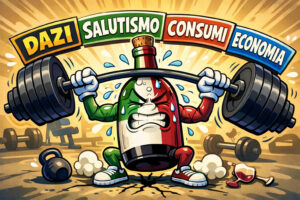







For some, they shouldn’t even be called wines; for others, they represent an opportunity for the supply chain and a phenomenon which is becoming a market segment of considerable importance: globally, it is already worth 2.4 billion dollars and is expected to reach 3.3 billion dollars by 2028, even though worldwide consumption still accounts for only 1%. Dealcoholized wine, which has been legally producible in Italy for about a year now, targets a group of consumers that includes teetotalers, pregnant women, drivers, people taking medications, and those who avoid alcohol for religious reasons. It is also appealing to people following low-calorie diets or athletes, fitting into a broader trend that can be summarized as “health-consciousness”. And while it is true that so-called “traditional” wine protects against depression and cognitive decline and, especially red wine, has antioxidant and anti-inflammatory properties (as shown in a recent study by professor Giovanni Scapagnini, an internationally renowned researcher), dealcoholized wines appear to be genuinely healthy in the broadest sense of the term. This is according to Smartfood, the nutrition and communication science program of Ieo, the European Institute of Oncology in Milan.
The premise is that only 0.0% dealcoholized wine can be considered truly healthy. The absence of ethanol, after all, is already a point in favor of the category: less ethanol also means fewer calories. As explained, a traditional glass contains between 90 and 130 calories, equivalent to 4 or more sugar cubes, while a glass of dealcoholized wine, which includes a natural amount of grape sugars, contains between 20 and 50 calories. However, there is an issue: the process of removing alcohol from wine to make it fully dealcoholized. Dealcoholization (generally carried out through reverse osmosis or vacuum distillation) results in a loss of beneficial phytochemicals (such as polyphenols), something producers are actively trying to minimize.
This point was also raised by Ananda Roy, senior vicepresident and industry advisor at Circana (in a forthcoming one-on-one video interview with WineNews, ed), who explained that “No-Lo drinks are, in fact, ultra-processed beverages. Removing alcohol requires an additional production step which increases costs and strips out aromas. To bring them back, more aromas must be added, so we are not talking about “clean labels”. In fact, these products often contain more additives and, in many cases, even more sugar, which is precisely what a calorie-conscious consumer does not want”. He also cautioned the industry to address this issue before dealcoholized wines shift from niche to mainstream: “when consumers will begin paying close attention to the caloric content of these bottles, they may question whether these beverages are truly healthier. And today, the answer is that they are not”.
Copyright © 2000/2026
Contatti: info@winenews.it
Seguici anche su Twitter: @WineNewsIt
Seguici anche su Facebook: @winenewsit
Questo articolo è tratto dall'archivio di WineNews - Tutti i diritti riservati - Copyright © 2000/2026