








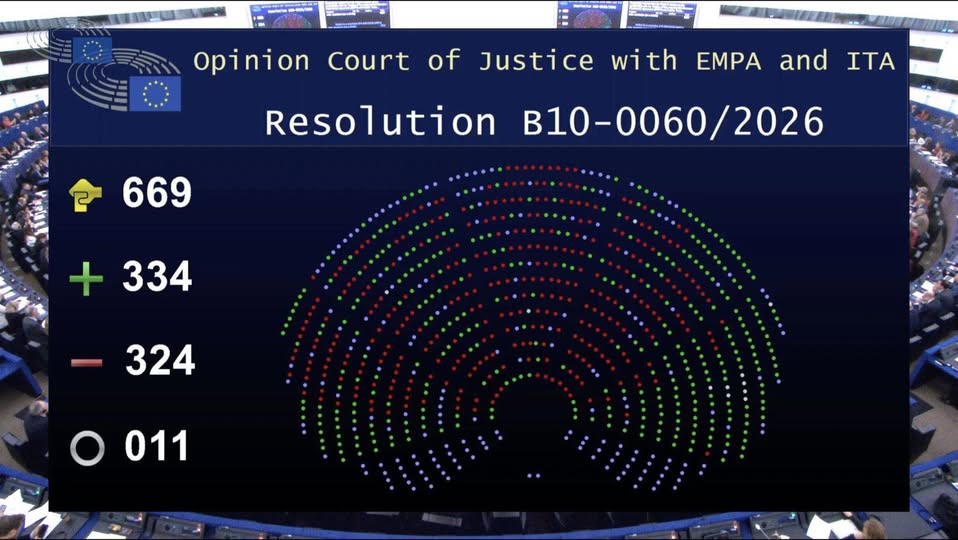
That the implementation process of the EU-Mercosur agreement, despite being signed in recent days after 26 years of negotiations, would be complex was evident. And now, a “stop” has already arrived which risks delaying its actual entry into force by almost another two years, causing disappointment among those who supported it as a great opportunity (namely, much of the Italian and European wine industry) and satisfaction among those who opposed it, highlighting above all the risks (i.e., the overwhelming majority of agricultural associations). Today, the EU Parliament has referred the matter to the Court of Justice of the European Union to assess whether the EU-Mercosur agreement complies with EU Treaties. “With 334 votes in favor, 324 against, and 11 abstentions, MEPs adopted a resolution requesting a legal opinion from the Court of Justice (Cjeu) on the agreement. A second resolution, which also requested a legal assessment, was rejected with 225 votes in favor, 402 against, and 13 abstentions”, explains an official note from the European Parliament. It clarifies that “the legal basis of the EU-Mercosur Partnership Agreement (Empa) and the provisional trade agreement (Ita) will now be examined by the Court of Justice, according to the indications contained in the adopted text. While awaiting the Court opinion, the European Parliament may continue reviewing the texts but must wait for its publication before approving or rejecting the Ita. The Ita, which concerns an exclusive competence of the EU - recalls the Parliament - is subject only to ratification at the Union level; this will require the consent of the European Parliament and the formal final approval of the Council, after which it can enter into force. The Ita will cease to apply once the Empa enters into force”.
As said, reactions from the wine sector and those from the strictly agricultural sector are completely opposite. The European Committee of Wine Companies - Ceev, headed by Marzia Varvaglione (which also includes Unione Italiana Vini - Uiv and Federvini, ed), expressed disappointment. “In recent months, the European Commission has provided detailed explanations confirming the full compatibility of the Agreement with EU Treaties. In this context, Ceev deplores the European Parliament decision to request the Court of Justice opinion on the compatibility of the EU-Mercosur Agreement with EU Treaties. This referral will cause an 18-20 month delay in the ratification process, creating unnecessary uncertainty for businesses. The disappointment is even greater because time is money. Just last year, EU wine companies exporting to Mercosur markets faced over 43 million euros in tariffs. This figure doesn’t include additional costs generated by bureaucracy, complex import procedures, and other non-tariff barriers, which continue to hinder access to the highly promising Brazilian market. At a time marked by growing geopolitical and economic challenges, it is more important than ever for the European Union to secure and diversify its trade relations with reliable partners without delay. The EU-Mercosur Agreement has the potential not only to strengthen the competitiveness of European wines in foreign markets but also to consolidate the EU role as a global leader in promoting stability and open, rules-based trade. Ceev considers this vote a missed opportunity to move quickly toward ratifying an Agreement urgently needed by both the European Union and EU wine companies”.
Today’s vote in the European Parliament doesn’t only harm businesses; it harms all of Europe. Voting is sacred, and Unione Italiana Vini fully respects the democratic outcome, but we can’t ignore how this decision portrays a divided EU at a historical moment marked by trade tensions which would instead require maximum cohesion”, adds Lamberto Frescobaldi, president of Unione Italiana Vini (Uiv), who underlines that “the ten-vote margin in favor of the referral, without provisional approval, would amount to freezing the agreement for up to 18-20 months. A delay we can’t afford, even less so for Italian wine, which will close 2025 in the United States with a decline of around 9%. As Agriculture Minister Francesco Lollobrigida rightly pointed out, Mercosur is an advantageous agreement not only for industry but also for agriculture, capable of strengthening Italy agri-food system both in terms of market access and protection of our branded products”. According to Uiv, for historical and cultural reasons, the South American area, which counts over 250 million consumers, represents a potentially receptive context for European and Italian wines. Today, for example, European wines destined for Brazil face price increases of up to 27% for still wines and 35% for sparkling wines due to import tariffs: the gradual elimination of tariffs provided for by the Partnership Agreement could impact the competitiveness of companies in a market that currently - also because of tariffs - operates at low levels. Wine imports in Brazil nearly reach 500 million euros per year, while Italy share stops at just 40 million euros, about 8% of the total. On the other hand, agricultural sector representatives are celebrating, having been present yesterday in Strasbourg to demonstrate their opposition and concern over the signing of the agreement.
“The major mobilizations of the primary sector on December 18th, in Brussels, and yesterday, in Strasbourg, led the European Parliament to vote in favor of referring the EU-Mercosur free trade agreement to the Court of Justice for a legal opinion. The referral could block the entry into force of the trade deal for several months. The vote aligns with the position Confagricoltura has always defended - explains the organization headed by Massimiliano Giansanti - and clearly shows how divisive this agreement is and how it is not advantageous for Italian and European agriculture. International trade policies can’t ignore the principle of reciprocity, which must be the basis of bilateral agreements. We can’t afford deals which reward lower production standards while European farmers are asked to do more with less. In a period of major geopolitical uncertainties - concludes Confagricoltura - it is important to protect the primary sector which inspired Europe from its origins and today contributes decisively to its economic stability, as well as to its food security with healthy, quality food”. “Finally, there is a European Parliament which demonstrates it has listened to our concerns and demands on Mercosur. Our demonstration yesterday in Strasbourg was decisive and will continue, in the most appropriate forms, so that the suspension of ratification now represents a useful time to enforce our conditions in this and all future trade negotiations”, says Cristiano Fini, national president of Cia-Agricoltori Italiani. “Although not by a wide majority, today’s vote postpones everything to the verification of compatibility with EU treaties and, above all - specifies Fini - provides an important space for pressure to ensure true reciprocity, strict controls, and automatic safeguard clauses. We are ready to engage on these key issues to protect farmers and European citizens, in terms of production competitiveness and health and environmental standards which must be the same as those imposed on European producers and breeders. Our protests with thousands of farmers, and this latest act by the EU Parliament - concludes Fini - are a clear message on the direction to take: international trade agreements only under equal rules and conditions, to ensure healthy, safe, and transparent food for our citizens”. “The vote of the European Parliament referring the Mercosur agreement to the Court of Justice represents a political response to the follies of President Ursula von der Leyen and her narrow circle of Brussels technocrats who tried to impose an agreement by erasing the role, dignity, and power of the European Parliament, still comments Coldiretti. Which adds: “now the European Parliament must advance reciprocity rules which prevent the entry into Europe of products which don’t respect the same standards, regardless of their country of origin. If this blitz had succeeded, as Coldiretti repeatedly stressed even yesterday during the mobilization in Strasbourg - underlines the organization - it would have created a very serious precedent with a bypassed Parliament, stripped of its prerogatives, reduced to a mere formality and unable to exercise democratic control over decisions which affect consumer food safety, European agriculture, and EU policies, starting with the Cap. With today’s vote, an important first step achieved thanks to the many mobilizations of Coldiretti farmers, the European Parliament prevents a very dangerous shortcut and reaffirms its constitutional role, stopping a project by von der Leyen that would have sanctioned the definitive marginalization of the only institution directly elected by European citizens”.
Copyright © 2000/2026
Contatti: info@winenews.it
Seguici anche su Twitter: @WineNewsIt
Seguici anche su Facebook: @winenewsit
Questo articolo è tratto dall'archivio di WineNews - Tutti i diritti riservati - Copyright © 2000/2026