


Monday 13th of April 2026 - Last Update: 15:57








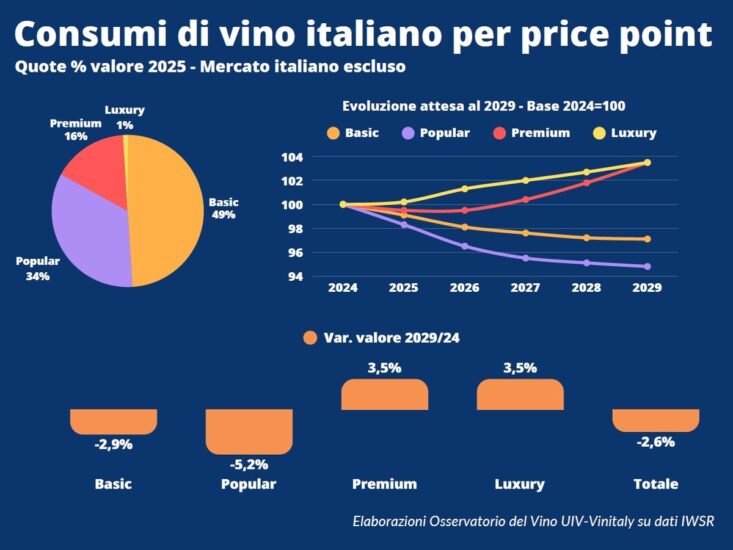
Premium wines (which leave the winery at a minimum price of 8 euros and retail, depending on the market, between 25 and 50 euros) are expected to continue growing over the coming years, despite the overall global decline in wine imports. Together with Luxury wines, they will at least partially offset the downturn of products in the mid-to-lower end of the shelf. The growth in value won’t be spectacular - +1% between now and 2029, rising to +3.5% for made in Italy products - but which - according to the analysis carried out by the Uiv - Vinitaly Observatory basing on Iwsr data - Italy could experience even more positive outcomes if it were to focus on certain strategic areas, both established and not. There are twelve countries with the highest potential growth rates: Japan, Mexico, South Korea, Brazil, Vietnam, China, Thailand, Indonesia, Australia and India, joined by two “out of range” and top non-EU buyers, the United States and the United Kingdom. According to Unione Italiana Vini and Vinitaly, these are the areas where presence should be strengthened in order to expand the commercial base of a sector that is still overly concentrated on the top 5 destination markets, which alone account for 60% of total export value.
The goal is to consolidate quality production, mitigate difficulties and raise the bar in terms of market positioning; a strategic priority for the export performance of a wine superpower such as Italy, with wine - according to Prometeia - which ranks second among traditional made in Italy sectors for trade balance, according to Prometeia, with a 7.2 billion euros surplus in 2025. “Export value in 2025 declined by almost 4% - said Carlo Flamini, head of the Observatory - but, according to our estimates, if Premium wines had accounted for 20% of exports instead of the current 17%, the negative balance would have softened to -0.7%. Moreover, if Italy were to set the goal of increasing the weight of Premium wines in its offer by 1 percentage point per year (+11% in value over 5 years), overall exports would benefit, arresting the decline that - assuming constant factors - is expected to continue through at least 2029, accumulating a -12% balance between 2024 and 2029”.
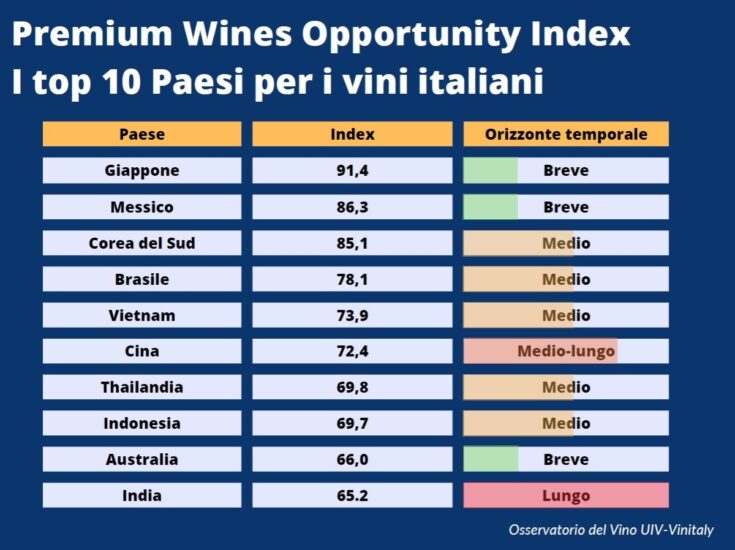
The Uiv-Vinitaly ranking provides a Premium Wines Opportunity Index identifying the 10 most attractive destinations, built by combining, among other factors, Italian export data by price point, consumption dynamics and market-specific competitive factors. The ranking ranges from Japan (index 91.4) to Mexico (86.3), from Brazil (78.1) to South Korea (85.1) and to China (72.4), and extends to smaller destinations that may seem marginal within the broader Italian wine landscape but become highly attractive when viewed through a “Premium lens”. Thailand, Vietnam, Indonesia and India all score above 60.
Naturally, established markets such as the United States, the United Kingdom and Japan can’t be excluded. In the first case, the recessionary phase will generally affect the Premium segment, but not Italian wines, which are bucking the trend (+4%) thanks to the continued strength of sparkling wines, starting with Prosecco, which is set for an important evolutionary step both in terms of younger consumer targets and upgraded positioning. In the UK, there is room to strengthen what has so far been the lightweight presence of Italian Premium wines, with growth expected also for still red and rosé wines (+3%) from Tuscany, Piedmont, Puglia and Abruzzo. In Japan (at the top of the promise ranking), the focus should aim even higher than the Premium segment, targeting Luxury wines, expected to reach a 20% share at their peak.
Then, there is a group of markets poised for a second phase of growth, starting with China (score 72.4). While wine consumption by volume has been declining sharply for over five years, demand is shifting toward the mid-to-upper shelf. Between now and 2029, Premium wine value is expected to increase by 10%, with Italy at +2.5%, driven mainly by sparkling wines (+9%) and aromatic wines such as Moscato d’Asti. Similar dynamics can be observed in South Korea, while on the other side of the world Mexico and Brazil (the latter benefiting from gradually reduced tariffs) appear to offer Italian wineries new opportunities beyond the traditional products like Lambrusco, which originally opened these markets. In South Korea, Italy aim can be medium-term: today Premium wines account for 27% of the total market, but only 6% for Italian wines. In Mexico, Premium wines represent 16% of total consumption, while Italy share is still below half of that, but with growth rates thanks to Italian red wines which are expected to exceed the market average by 2029 (+15% against +12%).
Next-generation markets are still relatively small and carry limited weight in Italy export portfolio, but they show steady growth rates. Thailand (+27% the estimated Premium growth), Vietnam (+25%), the Philippines (+30%) and India (+76%), differently from Japan and South Korea, share a strongly youth-driven consumption profile, which follows two seemingly diverging paths: on the one hand, the strong presence of cocktails, including wine-based ones; on the other hand, a growing interest in wine as a standalone product, reflected in very high penetration rates of Wset courses among younger consumers, particularly women. The common thread linking cocktails and wine will clearly be sparkling wines, with positive expectations also for still wines, especially white wines.
At Vinitaly 2026 (April 12th - 15th ), more than 30,000 international operators from 130 countries are expected, along with over 1,000 top buyers selected, invited and hosted jointly by Veronafiere and Ita - Italian Trade Agency. Significant non-EU delegations are expected from North America, as well as from Asia, with increased arrivals from China, India, Japan and Thailand, in addition to Vietnam, South Korea, Singapore, Malaysia and the Philippines. A strong turnout is also expected from South America, led by Brazil and Mexico, while Africa is seeing a sharp increase in incoming operators, with participation expanding this year to 10 countries.
Copyright © 2000/2026
Contatti: info@winenews.it
Seguici anche su Twitter: @WineNewsIt
Seguici anche su Facebook: @winenewsit
Questo articolo è tratto dall'archivio di WineNews - Tutti i diritti riservati - Copyright © 2000/2026