







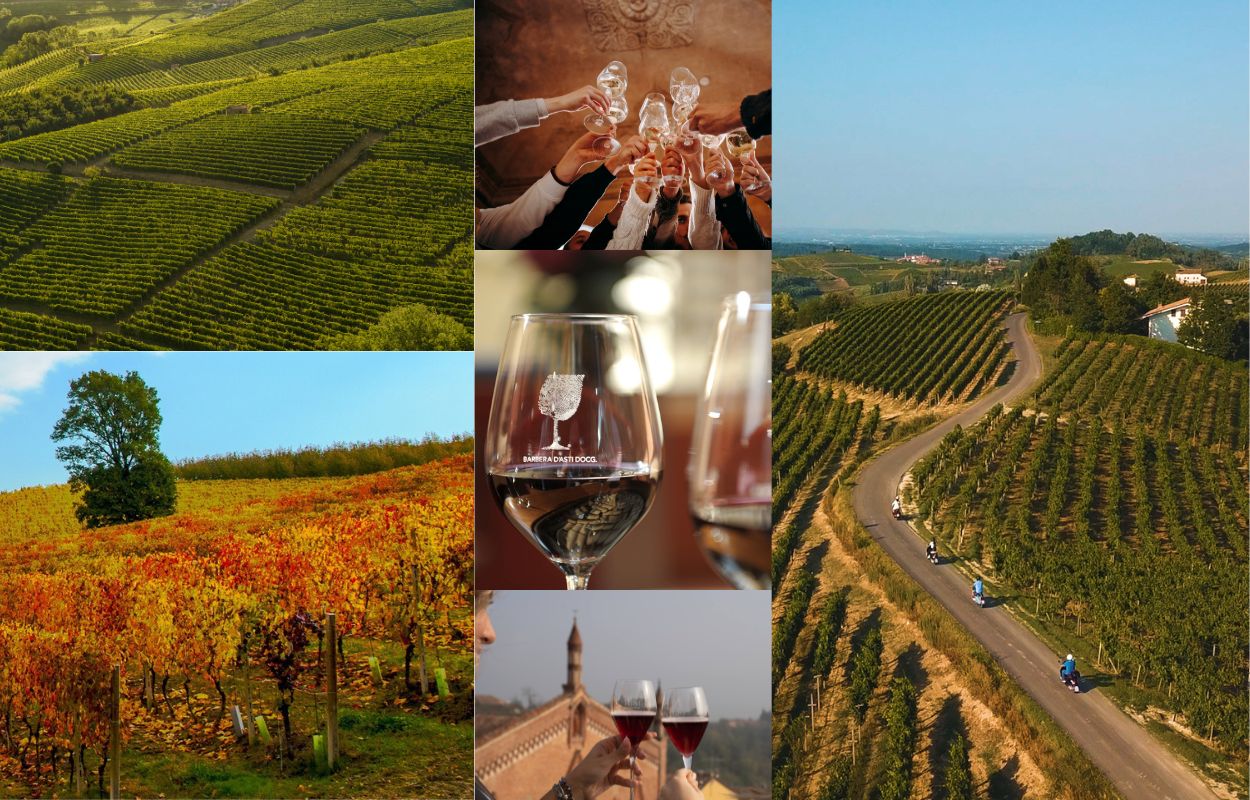
The Monferrato region chooses to join forces and entrusts wine with the role of directing its future. A clear message of unity and shared purpose comes from one of Piedmont Unesco wine territories (together with Langhe and Roero, ed), emphasized yesterday in Acqui Terme during the forum “Il futuro del Monferrato nasce dal vino - Economia, società, paesaggio” - “The future of Monferrato arises from wine - Economy, society, landscape”. The event marked the foundational moment of a strategic path shared by the three main consortia of the area - Consorzio dei Vini d’Acqui, Consorzio Barbera d’Asti and Vini del Monferrato and Consorzio dell’Asti Spumante and of Moscato d’Asti Docg - which presented “a three-year plan to relaunch Monferrato wine ecosystem, moving beyond individual denominations to adopt an integrated, systemic and territorial vision”.
The project aims to recognize the wine supply chain as the economic, social, and cultural backbone of the hills designated as a UNESCOterme World Heritage Site since 2014. The presidents of the three consortia, Paolo Ricagno (Acqui), Vitaliano Maccario (Barbera d’Asti e Vini del Monferrato), and Stefano Ricagno (Asti), explained its purpose: “it is time to bring the supply chain - stated Stefano Ricagno, president of Consorzio dell’Asti Spumante e del Moscato d’Asti Docg - back to the center of the wine system. Behind every bottle, there is not just a product, but an entire world which begins with the grape grower and involves every social and economic actor. In recent years, we have oversimplified communication; now our mission is to explain and enhance the unique features of this supply chain, working concretely so that it once again becomes the real driving force behind Monferrato future”.
“Piedmont wine heritage is a mosaic of diversity which must be safeguarded in its entirety. From large cooperatives to small producers, each is a crucial piece in addressing complex markets and geopolitical instability - continued Vitaliano Maccario, president of Consorzio Barbera d’Asti e Vini del Monferrato - we have a heritage of native grape varieties which is unique in the world. The unification of these three consortia stems from the desire to transform this variety into a single, powerful shared vision for the protection and promotion of the territory”.
“Joining forces among consortia is an act of courage and vision: alone, we can’t win the challenges of global markets. We represent a territory which produces five prestigious denominations and 150 million bottles: we have nothing to envy in other areas - concluded Paolo Ricagno, president of the Consorzio dei Vini d’Acqui - and we must be the first proud ambassadors of our land, ensuring that every tourist arriving in these hills finds in our wines the true soul of Monferrato”.
Francesco Billari, Rector of Bocconi University and professor of Demography, highlighted how demographic trends are key to understanding the future: from the global records of 2024-2025 to Italian data and figures from the Provinces of Alessandria and Asti, it is clear that declining birth rates and the shrinking weight of younger generations call for new strategies to safeguard human capital. In this context, Italy emerges as a laboratory of innovation aimed at ensuring the resilience of the productive system.
Magda Antonioli, senior professor of Tourism Economics and Policy, director of the Master in Economics of Tourism, and head of the Tourism Lab (Cleacc) at Bocconi University (and considered one of the “ideologists and philosophers” of Italian wine tourism in the 1990s, ed), underlined that experiential tourism and food and wine culture are decisive drivers of development. An increasingly aware international demand must be met with an integrated offer and communication capable of speaking to Gen Z as well. Compared with Langhe and Roero, Monferrato - though also a Unesco territory - needs to build its own brand by enhancing identity, landscape, and community engagement.
Matteo Casagrande Paladino, dg of Colline and Oltre Spa, a company co-owned by Intesa Sanpaolo, Fondazione Banca del Monte di Lombardia, and Fondazione Social Venture Giordano Dell’Amore, presented the case history of Oltrepò Pavese. Based in Pavia, also home to Intesa Sanpaolo Agribusiness Division dedicated to Italian agri-food companies, Colline e Oltre has worked since 2021 to show how coordinated action among finance, institutions, and local operators can deliver concrete initiatives for revitalizing and upgrading the hospitality, restaurant, and food and wine sectors, offering a reference model for Monferrato.
The guidelines of the three-year plan were illustrated by Andrea Pirola, ceo of WhiteMC and marketing and strategic advisor for the project. He outlined an operational roadmap for 2026-2028 based on a long-term vision aimed at regenerating the territory competitiveness. The plan seeks to transform Monferrato into a strong territorial brand through three phases: rebuilding, expansion, and consolidation. Among its macro-objectives are supporting the average price to protect supply chain margins and capturing new consumption trends such as mixology, moderation, and informal conviviality. Defined by Pirola as “systemic, measurable, and replicable”, the project aims to lay a solid foundation for a future export phase, using a mix of traditional channels (TV, media, large-scale retail, trade) and modern ones (social media, ambassadors, and on-site experiences) to communicate authenticity and sustainability to a global audience.
The message which emerged is therefore clear: “wine is not only an excellent product, but an economic and social infrastructure capable of generating income, employment, cohesion, and attractiveness. March 3rd marked an important moment for Monferrato, signaling the beginning of a new season of collaboration among the Consortia, with the goal of restoring economic centrality and long-term development prospects to one of Italy most identity-rich wine territories”.
Copyright © 2000/2026
Contatti: info@winenews.it
Seguici anche su Twitter: @WineNewsIt
Seguici anche su Facebook: @winenewsit
Questo articolo è tratto dall'archivio di WineNews - Tutti i diritti riservati - Copyright © 2000/2026