


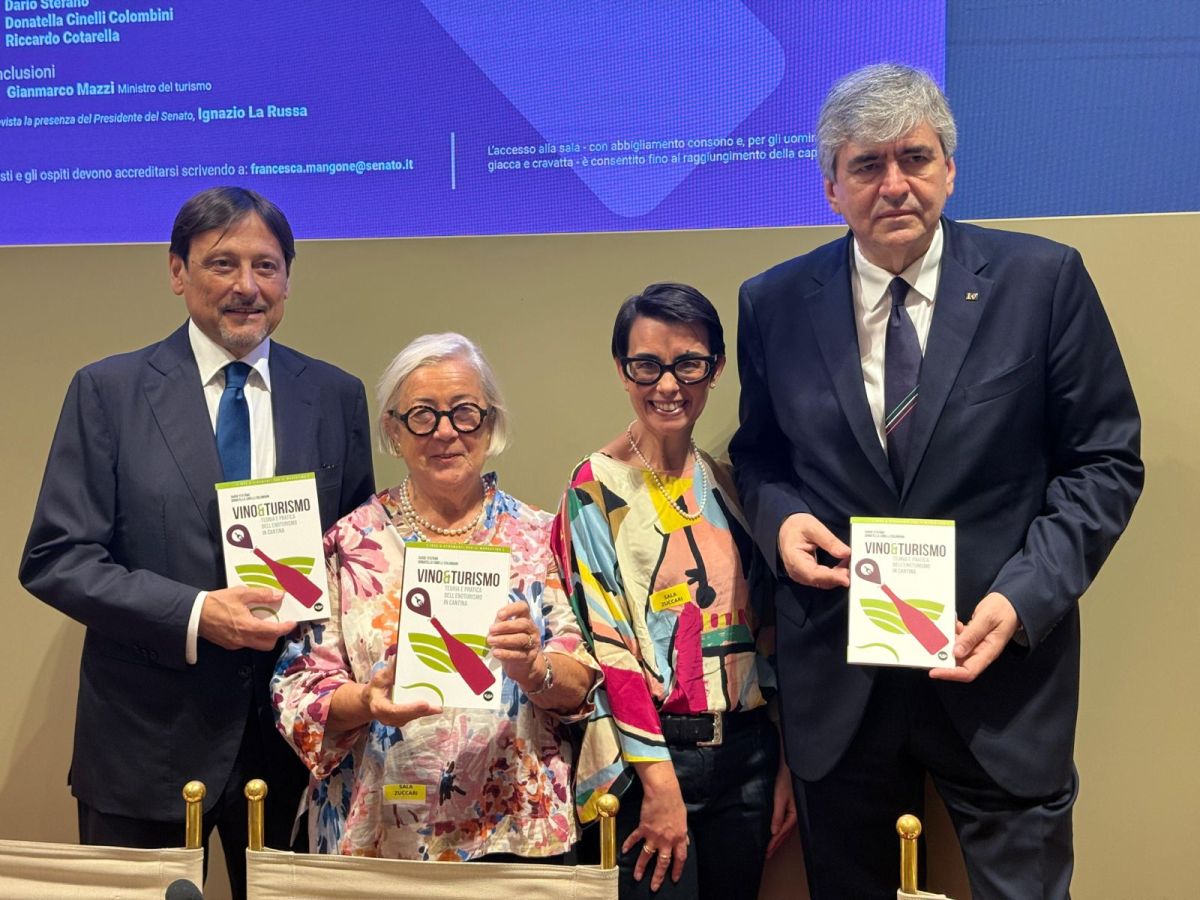
In Italy, where wine is increasingly seen as an experience as well as a product, wine tourism is emerging as one of the most dynamic drivers of the national tourism offering, as well as a strategic asset for business development. However, vision, expertise, and strategies are needed to manage its growth. These are the points outlined in “Vino & Turismo. Teoria e pratica dell’enoturismo in cantina” -“Wine & Tourism. Theory and practice of wine tourism in wineries”, a true manual for the sector authored by Dario Stefàno and Donatella Cinelli Colombini, respectively president and director of the Center for Wine and Oil Tourism Studies at Lumsa University (Ceseo). The book was recently presented at the Senate in Rome, with Tourism Minister Gianmarco Mazzi and a video message from Agriculture Minister Francesco Lollobrigida.
The new volume dedicated to the sector (Agra Editrice, 2026, 120 pages, cover price 24 euros) proposes itself as a guide for the new generation of wine tourism, combining analysis and operational tools in a sector which today in Italy involves 20,000 wineries open to the public and over 20 million visitors, with steady growth of around +9% per year.
Minister of Tourism Gianmarco Mazzi highlighted “the role of wine tourism as a fundamental lever for expanding Italy tourism offering, a powerful attractor for international tourism which brings with it the added value of combining key elements such as a diverse landscape, a unique artistic and cultural heritage, and a broad, locally rooted gastronomic offering”. Minister of Agriculture Francesco Lollobrigida emphasized that “the new publication by Stefàno and Cinelli Colombini celebrates the inseparable link between land, culture, hospitality, and identity through an exceptional product such as wine. I have often pointed out how the agri-food sector, with wine at the forefront, and tourism in Italy don’t travel on parallel tracks but represent two sides of the same coin, a single, large value chain that defines our uniqueness in the world. The title of the book “Wine & Tourism” encloses a fundamental formula for the future of our heritage”.
The manual originates from the activities of Ceseo, the observatory developed in synergy with the Movimento Turismo del Vino - Wine Tourism Movement, and addresses the crucial issues of a rapidly evolving sector: from hospitality guidelines to staff training, from the launch of new wine tourism businesses to comparisons with international wine hospitality models, such as those developed by wine communication expert Paul Wagner.
Among the priorities, the issue of accessibility stands out strongly, not only physical but also digital, considering the growing share of international demand, which for 30% of the wineries in the Movimento Turismo del Vino exceeds half of total visitors. If attracting visitors is no longer the main challenge, the focus now is to ensure meaningful and informed access to the experiences offered by wineries, making them usable, inclusive, and capable of generating long-term value. At the same time, the required skills are changing: foreign languages, communication, marketing, and event organization are becoming essential tools to engage an increasingly demanding and international audience, while the relationship with visitors extends beyond the visit through wine clubs and e-commerce. Wine tourism is thus evolving from simple tasting into a complex and immersive experience, capable of combining well-being, sustainability, and a connection with the territory. Comparisons with other countries, finally, provide insight into an increasingly competitive global market, where Italy starts from a position of strength but must continue to innovate to maintain its leadership.
“With this volume, we aimed to fill a gap in the training landscape dedicated to wine tourism - declared Dario Stefàno, professor of Tourism Management and Marketing at Lumsa University - today, wine is an extraordinary driver of territorial enhancement, capable of generating economic value, employment, and attractiveness. At the same time, it helps qualify the tourism offering and represents a concrete opportunity for wineries to diversify and optimize revenue. To turn this potential into stable and sustainable development, skills, professionalism, and innovation capacity are required. This manual was created to support students, operators, and producers in this challenge, offering practical tools to build increasingly high-quality hospitality and transform a winery visit into a true cultural and identity-driven experience. Today, in fact, wine is not only consumed, it is told, shared, and experienced”. “I focused on the practical management of tourist wineries, providing more up-to-date and different information compared to previous books on wine tourism - explained producer Donatella Cinelli Colombini - emphasizing the speed of change in a sector that is growing in Italy by +9% per year and globally by as much as +13%. Wine tourism is not just a new way of traveling: it is a driver for enhancing territories that transforms wine into experience and storytelling, creating a bridge between producers and travelers, between the beauty of landscapes and the most authentic identity of the country. It is also a tool to diversify the sale channels of wineries through direct producer-consumer relationships”. “The tourist - underlined Violante Gardini Cinelli Colombini, president of Movimento Turismo del Vino - looks for direct contact with nature, and in this sense the vineyard becomes a space where people can slow down and reconnect with themselves and the environment through outdoor and regenerative tourism experiences”.
The offering must therefore be diversified and made authentic by placing the enhancement of the country wine-growing and landscape heritage back at the center. “Wine & Tourism. Theory and practice of wine tourism in wineries” thus presents itself as a solid compass to guide this evolution, offering wineries, and especially students and new generations of sector professionals, a new perspective, with guidelines for transforming hospitality into a strategic development asset. Investing in professional skills and breaking down accessibility barriers become the key factors in shaping the future of the sector.
Copyright © 2000/2026
Contatti: info@winenews.it
Seguici anche su Twitter: @WineNewsIt
Seguici anche su Facebook: @winenewsit
Questo articolo è tratto dall'archivio di WineNews - Tutti i diritti riservati - Copyright © 2000/2026