







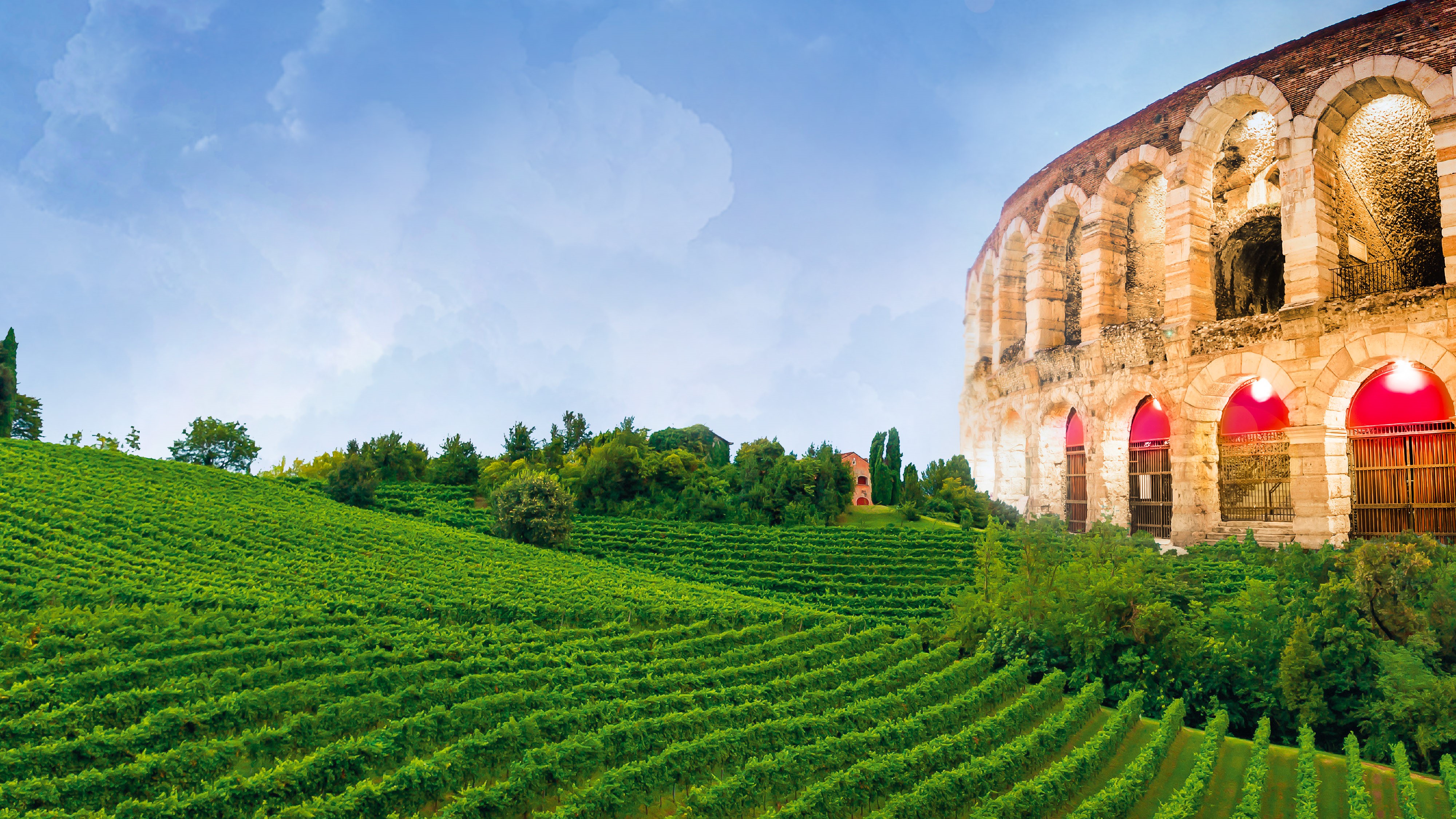
“The capital of Valpolicella”, yet also overlooking other major wine-producing districts such as Soave and Lake Garda, and the “capital of Italian wine” thanks to Vinitaly, the leading international event for the wine sector, Verona, one of Italy most visited art cities and a Unesco World Heritage Site, is deeply connected to wine through its history, culture, and economy. This is because it is home to Italy largest urban vineyard and its territory ranks first in the country for both wine export value and wine production, while also viewing wine tourism as a strategic asset for the future. In both good times and bad. While the expansion of the wine economy has enriched the city and its surrounding area, the challenging period currently facing the wine market is affecting more than just winery balance sheets. In fact, with a hypothetical -5% decline in exports, the economic damage to Verona and its territory would amount to 261 million euros, while a decline of around -7% (as it has been occurring during the first half of 2026) would result in losses of 366 million euros. This scenario emerges from a study carried out by the Economics Living Lab, a spin-off of the University of Verona (Department of Economics), presented yesterday at the Verona Chamber of Commerce, which commissioned the research (and which, in the most extreme scenarios, forecasts economic losses of up to -1.3 billion euros). A case history, that of Verona - a city which, nevertheless, also relies on other important industries such as logistics and manufacturing, and is additionally recognized as the capital of Italian opera thanks to the Arena - which should prompt serious reflection on the potential consequences of a further contraction in the wine business in regions where it represents the primary, if not the sole, economic driver.
This picture was outlined yesterday by Professor Francesco Pecci during the “Forum on the wine future”, which featured speakers including Pierluigi Guarise, ceo of Collis Veneto Wine, Roberta Corrà, dg of Gruppo Italiano Vini-Giv, Michele Tessari of the Ca’ Rugate winery, Giangiacomo Gallarati Scotti Bonaldi, president of Federdoc, Alessandro Rossi, National Category Manager Wine at Partesa, and Paolo Artelio, vicepresident and executive director of Fipe). The analysis takes into account not only the potential losses of wine companies, but also those affecting suppliers and the broader community that works in and benefits from a sector historically characterized by high added value. “A contraction in demand - said Pecci - generates significant impacts not only directly, but above all indirectly and through induced effects, with substantial consequences for GDP and repercussions on household incomes and tax revenues”.
The impact analysis is based on the social accounting matrix of the provincial economy; a 5% decline in exports corresponds to a reduction in wine sales of 53 million euros, which in turn leads to a decrease of more than 186 million euros across sectors directly and indirectly involved, along with lower labor and capital incomes. These effects translate into a 75.5 million euros reduction in wealth creation (GDP), for a total economic loss exceeding 261 million euros. Applying a -7% reduction in exports, a figure very close to the 7.4% decline recorded in Verona beverage exports during the first quarter of 2026, where wine accounts for more than 90% of the sector, the total loss for the Veronese economy would exceed 366 million euros.
“Verona - commented Paolo Arena, president of the Chamber of Commerce - holds the leading position among Italian provinces in terms of export value and production value. Added to this, there is the wine tourism phenomenon, which generates additional benefits and employment, further enhancing the value of an indispensable asset for our territory. The structural challenges currently facing the sector at global, national, and local levels compel us, each within our own areas of responsibility, to analyze and develop solutions capable of safeguarding one of Verona key industries. This is the call to action that the Chamber of Commerce is addressing to institutions and industry stakeholders”. According to the Chamber Research and Studies Department, Verona, one of the most important cities in the Veneto Region, which is currently finalizing its regional wine tourism law, as recalled by Regional Councillor for Agriculture Dario Bond, represents one of Italy leading wine-producing hubs, with more than 7,000 winegrowers, over 24,000 hectares of vineyards, 15 DOC denominations, and 5 DOCG appellations. Verona wine sector generates 7.9% of provincial exports and accounts for more than 10% of Italy total wine exports. However, Veronese wine producers are also operating within a challenging global wine market. Between 2019 and 2025, wine consumption declined by 16%, reaching 2.2 billion nine-liter cases, and is expected to fall by a further -3% by 2029, with only slight growth projected in the premium and ultra-premium segments, which nonetheless represent only about 20% of total consumption, according to data presented by Carlo Flamini of Unione Italiana Vini-Uiv Wine Observatory.
“The Veneto Region is working on a new wine tourism law, which is expected to be submitted to the Regional Council between September and October, with the aim of providing clearer regulations and supporting the growth of businesses and wine tourism hospitality - said Dario Bond, Regional Councillor for Agriculture of Veneto - we must work to enhance the value of our wineries by reducing bureaucracy and giving them the opportunity to offer increasingly more comprehensive experiences to visitors. Wine tourism represents a major opportunity for the territory and must be supported with appropriate tools. At the same time, we must ask ourselves how to bring younger generations closer to the world of wine, because consumption habits have changed and a new approach is needed. As institutions, we are ready to listen to the territory and do our part”.
The discussion on the wine sector priorities also featured remarks from Giangiacomo Gallarati Scotti Bonaldi, president of Federdoc: “Verona is a wine capital and a benchmark for the industry, but not all of Italy can rely on the same conditions. For this reason, the challenges facing the sector must be addressed with a national perspective. Among the priorities, there is the issue of authorizations for new vineyard plantings: we need to ask ourselves whether it is still sustainable to continue increasing vineyard potential by 1% every year, or whether the time has come to suspend this mechanism in order to restore balance between supply and demand. The issue of vine extirpations must also be approached pragmatically. In the past, extirpations have already been carried out with significant public funding, without definitively resolving the problem. Where removals are necessary, consistency is essential: if a decision is made to uproot vineyards, it can’t be followed by replanting just a few years later. If the State invests financial resources, it must do so to solve the problem structurally, not simply postpone it. Furthermore, if we allocate resources to vineyard removals and take them away from international market promotion, we risk making a serious mistake. Today, new opportunities are emerging, from Mercosur to Australia, the Far East, and other growing markets, all of which require investment. If we spread our resources too thinly, we risk undermining the sector growth potential”.
“Wine is not merely an agricultural sector; it is an economic engine that generates employment, tourism, services, trade, and value for the entire Verona area. For this reason, its protection - concluded Alex Vantini, member of the Executive Board of the Verona Chamber of Commerce and president of Coldiretti Verona - can’t be regarded as the concern of a single category, but rather as a shared responsibility. Faced with declining consumption and increasingly more compressed profitability for wine-growing businesses, bold choices are needed throughout the entire supply chain. In this regard, we believe it is essential to freeze the annual 1% increase in authorizations for new vineyard plantings: if Verona denominations are already demonstrating a sense of responsibility by containing their production potential, it is unacceptable that in other areas of the country vineyard acreage continues to expand, further exacerbating market imbalances. At the same time, it is necessary to strengthen dialogue among all participants in the supply chain, including the restaurant sector, where in some cases markups on bottles exceed 400%, risking the alienation of consumers from wine. Only by working together as a system and distributing value more evenly will we be able to guarantee competitiveness, profitability, and a future for Verona wine industry”.
These are issues and reflections coming in Verona, but they apply to the entire Italian wine sector.
Copyright © 2000/2026
Contatti: info@winenews.it
Seguici anche su Twitter: @WineNewsIt
Seguici anche su Facebook: @winenewsit
Questo articolo è tratto dall'archivio di WineNews - Tutti i diritti riservati - Copyright © 2000/2026