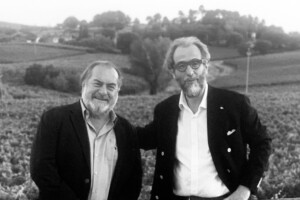







Germany is one of the main wine markets in the world and has long been the second most important foreign market for Italian wine. In 2025, imports from Italy reached 1.14 billion euros, according to Istat data. But it is not an easy market, as explained today by René Sorrentino, ceo of Ges Sorrentino, one of the leading and historic importers and distributors of Italian wine in Germany, run together with his father, Francesco Sorrentino (13 million bottles per year, with a turnover of 47 million euros). His remarks were delivered during a talk for the Forum on the Wine Market, held today at the Intrecci Academy in Castiglione in Teverina, organized by the Cotarella family and promoted by the Chiasso-Cotarella Wine Consulting Firm “Rethinking wine: moments and strategies for growth in a changing market”.
The German wine market in 2026: figures, reality, and outlook for Italian wines
By René Sorrentino, Gruppo Sorrentino
What is Germany
One of the world largest wine import markets. At the same time, one of the most price-sensitive import markets globally. For years, it has been declining in volume. Emotionally, it is open to Italy, the leading country for imported wines. The key question is not “Is Germany a good market for Italian wine?”, but rather “How can we assert Italian wine in a market which has undergone structural changes?” Those who fail to make this distinction work with the wrong strategy.
A new era - not a temporary crisis
The old wine world as we knew it ended on 31.12.2019.
2019 - End of the old normal in wine trade.
2020 - 2021 - Covid changed consumption and dining habits: boom in at-home consumption; online channels became essential; wineries aimed to position themselves in the premium segment.
2022 - War, energy shock, inflation, and growing uncertainty ended the sales boom.
Today - Health debates, geopolitical tensions, new consumer behaviors, and a race to the bottom.
The market has not disappeared. It has changed its rules three times in six years.
Size of the German market: concrete data
A total wine market of 10–20 million hectoliters, with more than 50% tied to imports. Italy accounts for one-third of Germany wine imports. Germany is the world No. 3 wine-importing country. 64% of wine goes through organized retail.
The special relationship between Germany and Italy, leader of market with emotion
Pizza, pasta, mozzarella are now everyday household items in Germany, nothing exotic. The idea of “my Italian restaurant” is deeply rooted, and cappuccino is a daily ritual. “La Dolce Vita” is beloved as a lifestyle. Italy is part of everyday life. This emotional closeness is a strategic advantage, something France, Spain, and the USA can’t replicate. Emotion doesn’t replace price strategy, but it is a unique lever when used correctly.
Per-capita consumption - trend
What data says (source: Analysis on wine consumption by DWI 2024/2025):
2019: 23 liters per capita.
2020: increase to 24.3 liters (Covid effect).
Starting from 2020/2021: continuous decline from 24.3 to 21.5 liters in 2025, clearly below 2019
2024/2025: another decline equivalent to about one bottle per person
Main causes: inflation, rising health consciousness, anti-alcohol campaigns. But the decline is structural, driven by demographics, costs, and changing consumption habits.
German consumer loyalty
“I spend 6.99 euros for my favorite wine. If the price goes up, I will look for a new favorite wine at€6.99 euros”, it is a statement which reflects high substitutability. Emotional attachment is not present; brand loyalty is weak, and price thresholds prevail. Shelf price strategy matters more than image communication. Germany is rational, not romantic. Ignoring this means losing shelf space. This logic, although less extreme, also applies across all wine trade channels in Germany.
Current market trends
White wine is growing faster than red wine: 45% white, 39% red, 16% rosé (source: Dwi data and market analysis).
Growing demand for lower-alcohol products.
Aware consumption, fewer impulse purchases, higher quality expectations.
No particular “buzz” from Italy, but the market seeks reliable partners: collaboration, support, communication are fundamental!
The 3 Big Ps (Primitivo, Prosecco, Pinot Grigio) are no longer a fad, they are established categories.
Tradition, innovation, or what?
Today, there is no single answer, as tradition requires innovative communication, and both need a clear “reason to exist”. Success of German market now depends on combining multiple aspects.
Low & No Alcohol - A structural challenge for Italian wine
A problem for Italy: dealcoholized wines can be marketed only as table wines, and grape variety can’t be indicated. Italian dealcoholized products are practically absent due to regulatory disadvantages, leading to distorted competition. Producers in Germany and Spain can label dealcoholized wines with grape varieties, an obvious competitive advantage. It is a growing segment and a real trend, not a niche. Italy risks losing this market.
Is it still possible to build successful business in Germany?
Yes, but not with old recipes. The market has changed. Those who continue with old methods will lose.
What the German market really wants today
The supplier becomes a strategic partner: product alone is no longer enough.
Communication and assistance - presence, service, concepts, ideas.
Flexibility - quick reactions, customized solutions, out-of-the-box ideas.
Usp - distinctive features and selling points; quality alone is no longer enough.
Therefore, our answer is
service and multichannel. Not as a slogan but as a system. A strategic approach to manage complexity, protect brand logic, and build sustainable business in Germany based on each winery needs. Respect for the different sales channels, each with its own rules. Not every winery fits every channel, but some fit more than one. Dedicated communication and structures for each channel; precise adaptation of portfolio, pricing, and messaging.
Long-term partnerships, avoiding short-term opportunism, building sustainable relationships, this is part of our Dna. Both with companies and our clients.
Peculiarity in the offer: customers now expect a complete offering. From everyday wines to top-awarded labels. We aim to provide the service which allows partners to focus on selling. Multichannel is not only a growth strategy but also a risk-management strategy in an evolving market.
Conclusion - Clear thesis, Germany is not an easy market; therefore, we have to:
1 - understand market logic: respect psychological thresholds; price strategy, service, and continuity as foundations;
2 - master multichannel: specialty retailers, wholesalers, retail stores, online shops, restaurants;
3 - combine emotion and structure: leverage Italy cultural strength as a tool, not a self-sustaining phenomenon;
4 - take partnership seriously: those who collaborate, not merely deliver products, earn lasting customer space.
The question is not whether Italian wine has a future in Germany. The question is: with what strategy do we intend to manage that future?
Germany remains a strong market for those who adapt.
René Sorrentino
Copyright © 2000/2026
Contatti: info@winenews.it
Seguici anche su Twitter: @WineNewsIt
Seguici anche su Facebook: @winenewsit
Questo articolo è tratto dall'archivio di WineNews - Tutti i diritti riservati - Copyright © 2000/2026