


Thursday 19th of March 2026 - Last Update: 14:59







The issue of rising inflation and the decline in the purchasing power of consumers, in Italy as elsewhere, has recently become central for every sector. And even in the wine world, faced with a drop in consumption which appears particularly significant in the out-of-home segment, where markups are higher, it is a much-debated topic. We at WineNews have addressed it multiple times, also asking some of the most important Italian distributors for their views, from Gruppo Meregalli to Cuzziol Grandivini, from Sagna to Sarzi-Amadè, from Pellegrini to Partesa, to Heres. And the issue of wine prices, perhaps too high even “ex-cellar” in some cases, was recently raised again (in this interview) by Oscar Farinetti, founder of Eataly and wine producer in Piedmont, and not only.
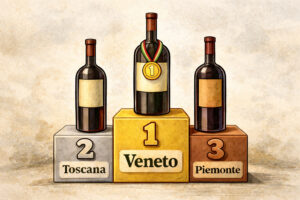
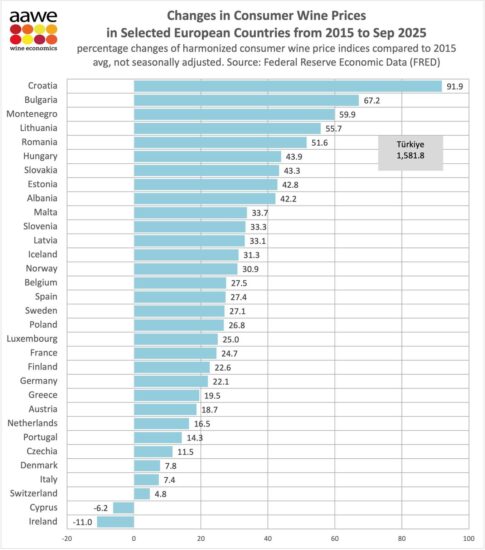
But when taking a closer look, compared with consumer prices of many goods which have increased sharply and substantially over the past 10 years, from energy to food (+25% from 2021 to 2025 alone, according to Istat data), wine, at least in Italy, is among the products that have seen the lowest growth. According to Eurostat data processed by the Federal Reserve Economic Data (Fred) and analyzed by the American Association of Wine Economics, looking at changes in the harmonized index of consumer prices for wine from 2015 to 2025, Italy recorded a +7.4% increase, the lowest among the selected European countries, with only Switzerland showing a smaller increase (+4.8%). Looking at other major European wine markets included in the comparison, Germany marked +22.6%, France +25.7%, Spain +27.4%, as well as Belgium.
“Wine inflation” has been strong in Northern Europe as well, ranging from Finland +22.6% to Norway +30.9%, with Sweden at +27.1%, for example, while Denmark stands out as an exception (+7.8%). But consumer price growth has been even higher across much of Eastern Europe: while Poland marks +25%, increases range from +33% in Latvia and Slovenia to +91% in Croatia, with many countries above +40% such as Albania, Estonia, Slovakia, and Hungary, and others between +50% and +60% like Romania, Lithuania, and Montenegro, up to +67% in Bulgaria. Meanwhile, Turkey shows a standout statistical figure of +1,581%, though in a market with extremely low consumption today and virtually nonexistent volumes 10 years ago.
In many countries, the increase in price indexes appears, at first glance, to go hand in hand with growing wine imports in those markets. But more generally, one might think it is also linked to a cultural shift: wine moving from an everyday consumer good to a discretionary, luxury-leaning product. And it reflects, in practice, the phenomenon of “premiumisation” which has emerged as a macro-trend in the wine market over the past decade.
Copyright © 2000/2026
Contatti: info@winenews.it
Seguici anche su Twitter: @WineNewsIt
Seguici anche su Facebook: @winenewsit
Questo articolo è tratto dall'archivio di WineNews - Tutti i diritti riservati - Copyright © 2000/2026