


Monday 14th of September 2026 - Last Update: 12:00







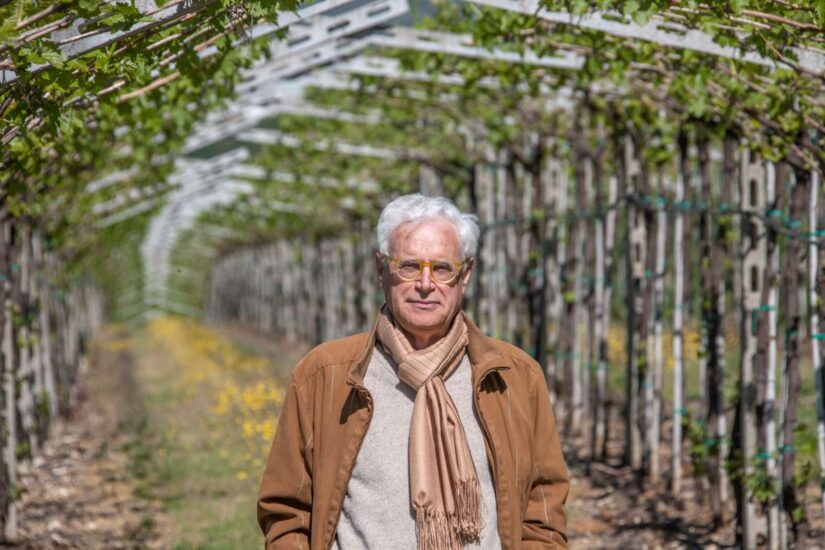
Between the fact that people drink less, and differently, and that cellars are full while markets less; between a fragmented system which seems unable to withstand the impact of global markets and the need to produce less and even better; between restaurant price markups which represent a “silent wound”, and the idea that if we talk about light wines we must also have the courage to use light words; and finally, between the realization that the time has come to stop calling both an international business event and a local wine tourism gathering a “fair”, Gianni Moriani, historian of Italian cuisine and agrarian landscapes and a sociologist with whom we often engage in dialogue, outlines a state of the art of the Italian wine world. We receive his reflections and are pleased to publish them on WineNews. Because, the professor argues, “there is one dimension that all the reasoning conducted so far - on markets, yields, markups, trade fairs - risks forgetting: wine arose to be shared. It is not a commodity category nor a financial asset; it is a ritual of mutual recognition”.
Beyond the ritual of trade fairs. Italian wine in search of a new compass
We drink less, and differently
Global wine consumption is in structural decline: not a cyclical downturn, but a deep transformation. New generations approach alcohol with greater caution; road safety regulations weigh heavily on evening choices; the culture of wellness is reshaping consumption; and the no-alcohol category is advancing at a pace unimaginable until a few years ago. The season of mixed drinks has become established - spritz has legitimized a light, convivial style of drinking - and demand is shifting toward low-alcohol wines: light, easy, uncommitted. This is not a fad; it is a paradigm shift.
Cellars are full. Markets, less so
Italy produces more wine than it consumes: for decades, exports have been the system safety valve. But, today, that valve is creaking. Geopolitical shocks - tariffs, conflicts, instability in trade corridors - are putting pressure on companies that lack a solid and diversified international network. The result is plain to see: around 58 million hectoliters in storage, immobilized value and a concrete financial risk for thousands of producers.
A fragmented system can’t withstand market pressure
There is a structural element that the sector continues to treat as a neutral given, when in fact it is one of its most serious limitations: the fragmentation of the production system. Italian wine is made up of a multitude of small-scale producers, often excellent from an agricultural standpoint, but too weak on the commercial side. In a market that requires continuity of supply, negotiating power, and logistical presence, size matters - and moving in scattered order duplicates costs, disperses resources, and leaves room for more compact competitors. If this knot is not addressed - by encouraging real aggregation, strengthening consortia in their commercial functions, and fostering effective business networks, every other measure risks having only limited impact. Because a divided system, even when it produces quality, remains structurally fragile.
Produce less, produce even better
If markets absorb less and cellars are overflowing, the response can’t be only commercial: it must also be agronomic and political. Serious policies are needed to reduce yields per hectare, including the use of green harvesting, along with concrete incentives both for distillation and for the uprooting of unsustainable vineyards, those in marginal areas, with production costs out of line with the market, or with varieties that no longer have an outlet. The principle is simple, and it should become a supply-chain priority: less quantity, more quality, not as a slogan, but as a structural choice. A rarer, more identity-driven, harder-to-replicate Italian wine is worth more, both on foreign markets and at home.
Light wines, light words
When talking about light wines, however, one must also have the courage to say something else: that the wine bottle must be lightened of the weight of words as well. In recent decades, Italian wine has been buried under a blanket of redundant descriptions, cloying metaphors, geographical and historical evocations repeated to the point of exhaustion, a building of empty rhetoric built by marketing departments which have mistaken complexity for value. The result is an overloaded, bewildered, and at times even alienated consumer. And yet the answer is disarmingly simple: a good wine doesn’t need to be described with ten adjectives. It needs to speak for itself. When it does, it already says everything the consumer wants to hear, because wine is listened to with the palate, not with the ears. It is time to free consumers from all the clutter that has been piled onto them: encrustations of unnecessary storytelling, usurping words which have occupied the space that should have belonged to experience. The light wine the market is asking for is not only a matter of alcohol content: it is also, and perhaps above all, a matter of communicative lightness.
Restaurant price markups: a silent wound
There is, however, a contradiction that plays out every day in restaurants: unsustainable markups. The price at which wine is offered has reached levels that often bear no relation to the product real value, nor to the spending capacity of those seated at the table. Bottles disappear from tables, replaced by glasses, not by choice, but out of economic necessity. When wine at the table becomes an exception rather than a habit, something deeper than a simple sale is lost: the natural context in which wine lives, is told, and is passed on is eroded.
Mending this tear requires courageous choices and a supply chain agreement which involves all three actors: producers, by selecting partners who respect wine identity and accessibility; distributors, by betting on volume rotation rather than rent-seeking positions; and restaurateurs, by abandoning fixed and anachronistic multipliers in favor of fairer markup models. A transparent, binding agreement, built together, that establishes shared criteria for pricing and restores wine to the place it deserves on Italian tables.
The trade fair is not the answer. Or at least, not that answer
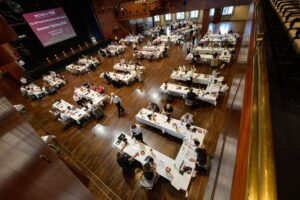
In this scenario, investing in undifferentiated trade fairs, where everything accumulates and nothing stands out, is a strategy from the last century. Italian wine doesn’t need more generic visibility; it needs qualified presence in the right places and at the right times. Major industry events shouldn’t be shelved, but honestly rethought, starting from a question the system continues to avoid: who are they really for? Are they for producers seeking concrete commercial relationships with selected importers, or do they serve to reassure a sector that needs to see itself as numerous in order to feel strong? The two things do not coincide, and confusing them is costly. A mature system should be able to distinguish between two functions that are currently blended together: on the one hand, vertical and selective events, working tables with qualified importers, meetings built around precise objectives and clearly identified markets; on the other hands, events rooted in their territories, capable of telling the story of wine as an expression of landscape and identity, transforming tasting into experience and experience into wine tourism. These are two different tools, with different audiences and different logics. Treating them as if they were the same thing - and calling them both “trade fairs” - is one of the most serious wastes in the Italian wine system: unforgivable at any time, intolerable in a period when resources are scarce, cellars are full, and markets are tightening. Their existence is not in question; their meaning is. The Italian wine system must look beyond the trade-fair calendar and ask itself which tools are truly needed to compete in a market that is shedding its skin. Before asking how to sell wine, it would be worth remembering why it has always been drunk.
Wine and care for the other
There is one dimension that all the reasoning conducted so far - on markets, yields, markups, trade fairs - risks forgetting: wine arose to be shared. It is not a commodity category nor a financial asset; it is a ritual of mutual recognition, the gesture by which we say to one another: I am here, I am here with you. In an era in which loneliness has become one of the silent emergencies of our time - affecting young and old alike, cities and provinces, families and individuals - the shared glass rises to the status of a common good. Luigi Meneghello knew this, and wrote it in 1975 with a precision no technical data sheet could ever match: midday in the sun, the small square, white wine, a father with his son, friends arriving. “Supreme and perfect joy, abstracted from time, in the middle of the village, as if beyond the reach of death”. This is the territory Italian wine must once again claim, not score rankings (or at least not only those, ed), not international awards, not redesigned labels. The territory of the meeting. Producing less, communicating better, pricing honestly: all of this only makes sense if wine returns to doing what it does better than any other beverage breaking the silence between two people, stretching out an afternoon, making a table something more than a surface transforming it into a space of meeting, because first and foremost we are social animals.
Gianni Moriani
Copyright © 2000/2026
Contatti: info@winenews.it
Seguici anche su Twitter: @WineNewsIt
Seguici anche su Facebook: @winenewsit
Questo articolo è tratto dall'archivio di WineNews - Tutti i diritti riservati - Copyright © 2000/2026