








The global wine sector continues to undergo a phase of structural transformation. In 2025, the global vineyard area declined for the sixth consecutive year, while production, consumption, and international trade remain under pressure in a context marked by climate change, economic uncertainty, and shifting consumer habits. Italy and France, however, remain leaders in production, exports, and consumption (although in the latter case they have been surpassed by the United States, while Spain retains the primacy of having the largest vineyard area: see focus). This was reported in the “Global Wine Market Report” 2025 presented today in Lyon by the International Organization of Vine and Wine (Oiv).
“In recent years, the wine sector has adapted to ongoing climatic, economic, and social challenges. In 2025, disruptions in international trade caused by tariff policies represented an additional external factor that producers, exporters, and the supply chain must manage. Overall, the sector is demonstrating resilience, both by seeking new market opportunities and by adjusting production capacity to demand. Trade and product value remain solid, and recent bilateral or multilateral trade agreements will help create favorable conditions for market evolution. The International Organization of Vine and Wine will continue to support its members and the sector by sharing key data, developing science-based standards and recommendations, and promoting international cooperation to advance common interests”, said Oiv dg John Barker.
Looking at the key figures, according to the latest estimates, the global vineyard area stopped at 7 million hectares, declining by 0.8% compared to 2024. The contraction reflects the gradual adjustment of production capacity by the main wine producing countries in both hemispheres, which are facing weaker demand and increasingly unstable markets. Also global wine production remains at historically low levels. In 2025, it is estimated at 227 million hectoliters, just 0.6% higher than the minimum recorded in 2024. Climatic conditions continue to have a heavy impact on harvests: drought, extreme events, and high weather variability have limited productivity in many wine-growing regions. To this, the choices of some territories to voluntarily reduce production in order to contain surpluses and support the market must be added. However, there are also signs of recovery in some areas. Brazil, New Zealand, South Africa, and Moldova recorded a rebound after the difficulties of the 2024 harvest, helping to limit the global decline.
On the demand side, global wine consumption is estimated at 208 million hectoliters, with a decrease of 2.7% compared to the previous year. This trend confirms an ongoing evolution in mature markets, where lifestyles, social habits, and the preferences of younger generations are changing. Inflation and the economic slowdown have also weighed heavily, reducing the purchasing power of consumers.
In this scenario, however, some markets stand out for their dynamism. Portugal, Brazil, and Japan are among the countries that recorded consumption growth in 2025, along with some areas of Central and Eastern Europe.
International trade is also struggling. Global wine exports fell to 94.8 million hectoliters (-4.7%), while the total value of trade decreased to 33.8 billion euros (-6.7%). Despite the contraction, values remain above pre-pandemic levels. Trade has been held back mainly by the slowdown in global demand, trade tensions, and uncertainties linked to tariff policies, particularly in the U.S. market. The United States, the world leading market in terms of import value, saw its purchases of foreign wine drop to 5.5 billion euros, a 12% decrease compared to 2024.
Despite the complex picture, the global wine market appears to be broadly in balance today. For the third consecutive year, global production has remained relatively low, helping to limit stock accumulation. The gap between production and consumption in 2025 is estimated at around 18.7 million hectoliters, but this figure must be interpreted in light of the industrial uses of wine, ranging from distillation to vinegar production, as well as derived products and spirits, which on average absorb around 30 million hectoliters per year. It is therefore a fragile balance, but for now it allows the sector to avoid deeper imbalances in an international context still marked by high volatility.
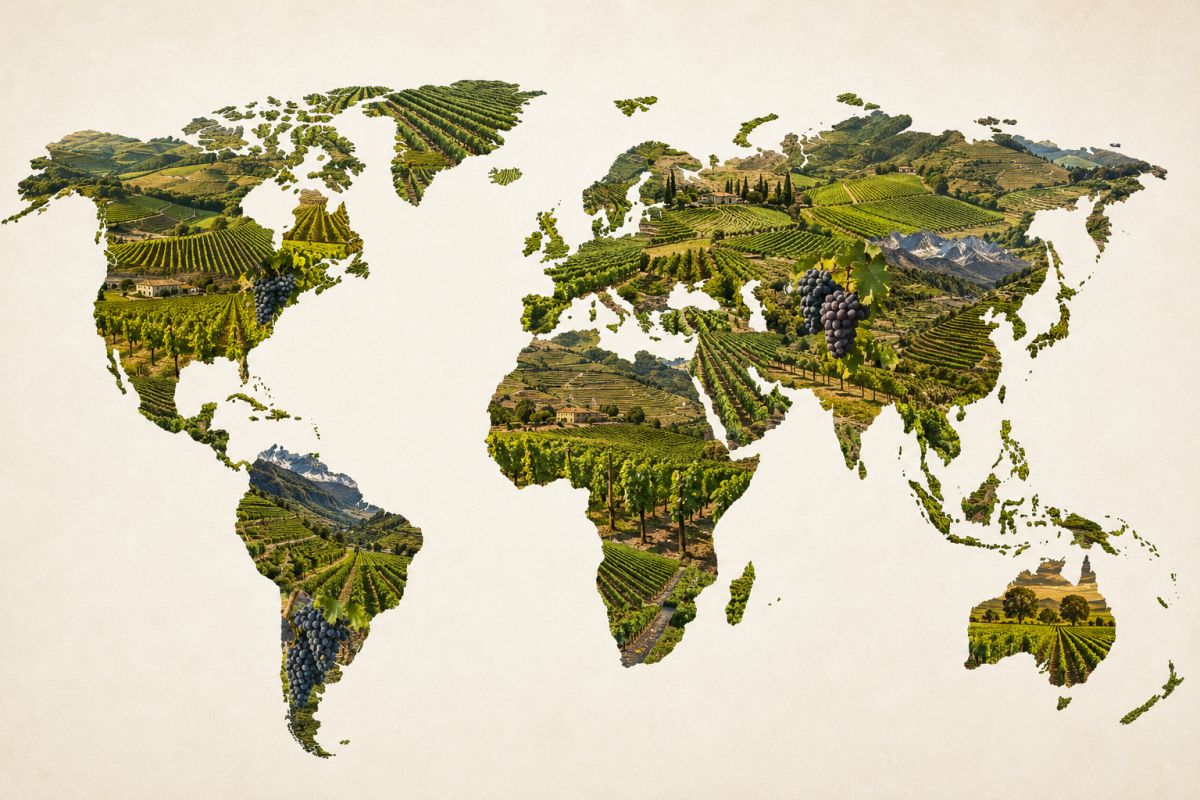
Focus - Oiv: the global vineyard in 2025
The vineyard area of the European Union decreased by 1.6% in 2025, reaching a total of 3.2 million hectares, equal to 45% of the global total. This decline was mainly driven by significant vineyard uprooting in France and, to a lesser extent, in Spain, while vineyard areas in other major producing countries remained largely stable.
At the national level, Spain, which has the largest vineyard in the world, counts 919,000 hectares in 2025 and recorded a 1.3% decrease (corresponding to 12,000 hectares) compared to 2024. Similarly, France, which has the second-largest vineyard area in the EU, recorded a decline for the third consecutive year. In 2025, the adjustment accelerated, with a 4.4% decrease in vineyard area compared to 2024 - corresponding to around 34,000 hectares less - bringing the total vineyard area to 740,000 hectares. Italy, after a significant expansion of its vineyard area recorded in 2024, saw a slight contraction of 0.3% in 2025, bringing the total to 726,000 hectares. The other major EU vineyards remained largely stable compared to 2024, showing only very minor downward adjustments. This is the case of Romania (187,000 hectares), Portugal (171,000 hectares), Germany (102,000 hectares), Greece (93,000 hectares), Bulgaria (58,000 hectares), and Hungary (58,000 hectares). In Eastern Europe, Russia and Moldova remain the countries with the largest vineyard areas, both estimated at 110,000 hectares. However, their recent trends diverge sharply. Moldova vineyard area continues to shrink, reflecting an ongoing restructuring process in the sector, while Russia has recorded strong growth, having actively promoted the development of its wine sector over the last decade.
In Asia, after a period of expansion from 2000 to 2015 (from 300,000 to 770,000 hectares), China vineyard, the third largest in the world, has stabilized in recent years and is estimated at 733,000 hectares in 2025. Turkey hosts the sixth-largest vineyard area in the world in 2025, with an estimated 395,000 hectares, mainly devoted to table grapes and raisins. The country continues to record a long-term decline in vineyard area which began in the 1980s, when its vineyard was roughly double its current size. By contrast, India vineyard area has grown in recent years, with an average annual growth rate of 4.6% since 2019. In 2025, the total surface is estimated to reach 197,000 hectares, making India vineyard the seventh largest in the world. Other large Asian vineyards, mainly specialized in table grapes and raisins, are found in Iran (128,000 hectares), Uzbekistan (125,000 hectares), and Afghanistan (104,000 hectares).
In North America, the United States, the fifth-largest vineyard in the world, is estimated at 415,000 hectares (-0.9% compared to 2024). This marks the seventh consecutive year of decline in vineyard area, largely due to the ongoing uprooting of wine vineyards in California. In South America, Argentina vineyard area continues the downward trend which began in 2015 and decreased by 1.9% in 2025, reaching 196,000 hectares. Similarly, Chile continues the negative trend which began in 2020, with a further 3.7% reduction in 2025, bringing the total to 154,000 hectares. Since 2019, Chile vineyard has contracted by 27%. Brazil, by contrast, has significantly expanded its vineyard for the fifth consecutive year, reaching 91,000 hectares (+9.6% compared to 2024).
Africa largest vineyard area is located in South Africa. After several consecutive years of decline - partly due to the lasting effects of drought episodes between 2015 and 2017 - the vineyard area is estimated at 109,000 hectares in 2025. For the first time since 2020, it has remained essentially stable, with only a marginal decrease of 0.1% compared to 2024. Other important African vineyards are found in Egypt (86,000 hectares) and Algeria (68,000 hectares).
Finally, Australia vineyard area is estimated at 159,000 hectares, broadly in line with the average observed in recent years.
Copyright © 2000/2026
Contatti: info@winenews.it
Seguici anche su Twitter: @WineNewsIt
Seguici anche su Facebook: @winenewsit
Questo articolo è tratto dall'archivio di WineNews - Tutti i diritti riservati - Copyright © 2000/2026