


Friday 10th of April 2026 - Last Update: 13:38






2025 was a complex and selective year for listed wine groups as well, at a global level. This is according to an analysis by Pambianco, which explains that it was “the combination of structural and cyclical factors” which had a significant impact on the sector performance, “while prospects for 2026 remain characterized by a high level of uncertainty”. The current year is burdened by “the worsening economic and geopolitical environment” which “continues to influence investor expectations. More than economic results, it is the overall scenario that determines market sentiment, keeping caution towards listed wine companies at a high level”.
Looking back at 2025, company balance sheets, and consequently stock performance on financial markets, were affected by well-known factors that have been analyzed several times by WineNews, such as the contraction in global wine consumption, geopolitical tensions culminating in the introduction of U.S. tariffs, and inflationary pressure that reduced purchasing power in key markets. According to Pambianco, “the sector has progressively lost attractiveness in the eyes of investors. If in the past the limited number of listed players and expectations of consolidation operations had supported valuations, the slowdown in merger & acquisitions activity and the deterioration of the macroeconomic environment have cooled interest. The stock exchange remains a relevant tool to support long-term growth projects, but the main unlisted Italian groups show no signs of opening up to a listing in the short term”.
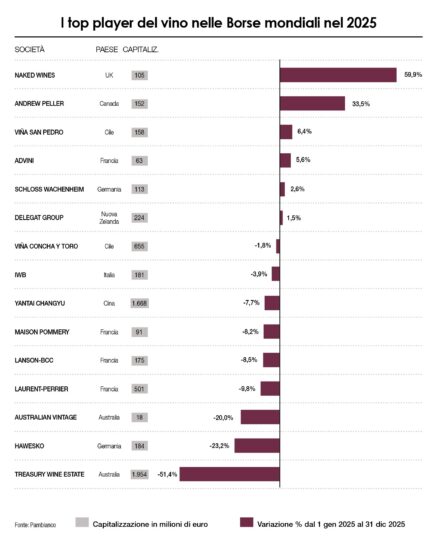
Even the “giants” have struggled. Pambianco mentions the case of Treasury Wine Estates (an Australian player and one of the world largest wine groups, with brands such as Penfold’s, Daou, 19 Crimes, Blossom Hill, and Beringer, as well as Castello di Gabbiano in Chianti Classico, ed), “whose share price lost more than half its value in 2025, falling from 10.78 to 5.24 Australian dollars, with market capitalization dropping to 3.2 billion Australian dollars (equal to 1.95 billion euros). The group was penalized by weak demand for premium wines in the United States and China. Starting from October, the appointment of new ceo Sam Fischer marked a change of course, with the launch of a multi-year cost-cutting plan, the suspension of the dividend, and the cancellation of the share buyback planned for 2026. At the same time, the company recorded a write-down of U.S. assets amounting to 988 million Australian dollars, closing the half-year with a net loss of 649 million”.
There was also “a negative performance for Australian Vintage which recorded a 20% decline in share value. German distributor Hawesko saw a drop of 23.2%, affected by weak domestic consumption and the contraction of e-commerce compared to pandemic peaks”. Pambianco also mentions “declining performances for Champagne houses as well: Laurent-Perrier (-9.8%), Lanson-Bcc (-8.5%), and Maison Pommery Associé (-8.2%), penalized by the slowdown in demand for premium sparkling wines after years of strong growth”.
And Italy? “The only Italian presence among the world’s leading groups”, affirms Pambianco, “is Italian Wine Brands (Iwb) (listed on the Euronext Growth Milan index, as well as Masi Agricola, a historic Valpolicella winery, although it was not analyzed in the Pambianco report, ed), which in 2025 recorded a decline of -3.9%, falling from 22.27 to 21.40 euros per share, with a market capitalization of 181 million euros at the end of the year. Revenues amounted to 395.9 million euros, essentially stable despite a challenging environment and volume growth. The resilience of the UK and Canadian markets partly offset the decline in the United States, but the market continues to maintain a cautious stance”.
Moving countertrend, “Naked Wines stands out, having recorded a rise of 59.9%. The performance is linked to the turnaround plan presented in spring 2025, which included the liquidation of 40 million pounds worth of excess inventory and an upward revision of profitability targets. Positive results were also posted by the Canadian group Andrew Peller, with an increase of 33.5% and a market capitalization of 152 million euros. Also in positive territory, there are AdVini (+5.6%), thanks to prudent management in a difficult context for high-end French wines, and German group Schloss Wachenheim (+2.6%)”.
Copyright © 2000/2026
Contatti: info@winenews.it
Seguici anche su Twitter: @WineNewsIt
Seguici anche su Facebook: @winenewsit
Questo articolo è tratto dall'archivio di WineNews - Tutti i diritti riservati - Copyright © 2000/2026