


Monday 14th of September 2026 - Last Update: 18:09







The wine world, with the harvest now just around the corner although the first grape clusters have already arrived at wineries, is facing a difficult 2026. However, the situation must be analyzed case by case and month by month. It is certainly performing worse than 2025, a year which had already posted losses compared to 2024. This is also highlighted by export data that WineNews analyzes monthly for the Italian market, and which, despite showing some slight recovery compared to the beginning of the year, still faces significant challenges.
Market stagnation, weighed down by the sharp slowdown in the United States due to tariffs, is affecting all the major players in the PDO (Protected Designation of Origin) landscape, the highest expression of certified quality and territorial identity. France, Spain, and Italy are all experiencing export declines compared to 2025. However, the main factor dragging the balance into negative territory is red wine, a category which has been suffering from a long-term shift in consumer preferences. At the international level, there are still positive examples, but these seem largely confined to certain white wine and sparkling wine denominations (especially in France, although Italian sparkling wines are also proving more resilient than still wines), while success stories among red wines, such as those from Burgundy, are much rarer.
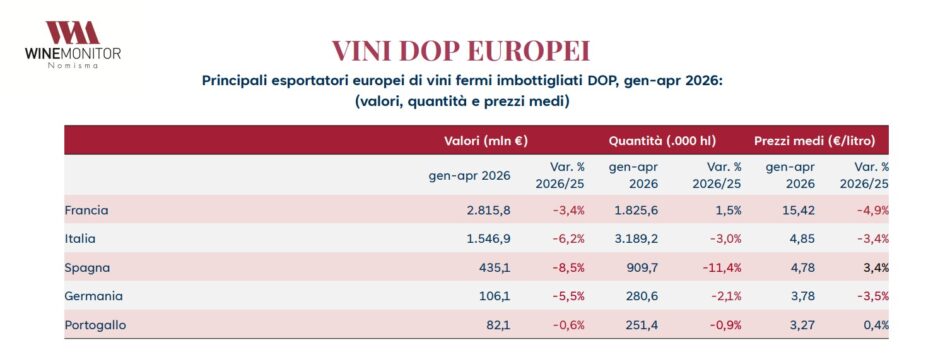
It is therefore unsurprising that the latest Nomisma Wine Monitor report on European PDO wine exports paints a picture of decline during the first four months of 2026. Among the leading European exporters, not a single country recorded growth in overall PDO wine exports. Compared with the same period of the previous year, Italy declined by 6.2%, France by 3.4%, and Germany by 5.5%. Spain performed worst of all, posting a decline of 8.5%. During the first four months of 2026, Italian PDO wine exports reached a total value of 1.5 billion euros, down 6.2% from the same period in 2025, while export volumes totaled 318.9 million liters, a drop of -3%.
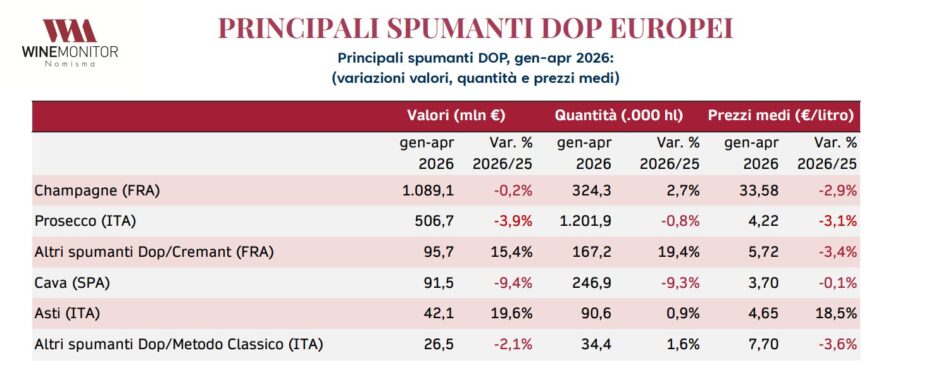
Prosecco remains Italy most exported PDO wine, reaching 506.7 million euros and 120 million liters (an average price of 4.22 euros per liter, -3.1%), with export value declining by 3.9% and volumes slipping by -0.8%. It is followed by Tuscan still red wines, with exports worth 202.9 million euros (-10.2% in value and -5.1% in volume), and Piedmont still red wines, which generated 123.9 million euros (-2.5% in value but +8.8% in volume). Among white wines, Veneto still whites reached 103.2 million euros (-4.7% in value and -3.5% in volume), while still whites from South Tyrol and Friuli-Venezia Giulia totaled 86.4 million euros (-16.5%) and 16.7 million liters (-5.2%). Exports of PDO semi-sparkling wines amounted to 65.1 million euros, -8.3% in value and -4.6% in volume. Meanwhile, Asti Spumante export rebounded to 42.1 million euros in exports (+19.6% in value and +0.9% in volume) after a difficult 2025. This recovery was also driven by Chinese demand, where sparkling wines, although still a niche category, are experiencing growing consumption trends. Asti can also celebrate an 18.5% increase in its average price per liter during the first four months of the year, reaching 4.65 euros per liter. Other noteworthy trends include Sicilian still red wines, whose exports fell to 20.6 million euros (-9.2%) and 5.1 million liters (-11.8%), while white wines from the same region continued to grow, reaching 15.4 million euros (+2.8% in value and +0.4% in volume). Tuscan whites also performed positively, reaching 7.8 million euros (+3.3% in value), despite a -4.9% decline in volume.
France PDO wine exports reached 2.8 billion euros in value (-3.4%) and 182.5 million liters (+1.5%), making it the only major exporting nation to post volume growth, although its average price declined by -4.9% to 15.4 euros per liter. Champagne exceeded 1 billion euros in exports during the first four months of 2026 (-0.2%), while volumes increased to 32.4 million liters (+2.7%). Its average export price fell by -2.9% to 33.58 euros per liter but remained exceptionally high. French Crémant exports also performed well in value terms, rising +19.4% to 95.7 million euros despite lower volumes. Regarding red wines, Burgundy recorded a +2.7% increase in export value for PDO red wines (230.9 million euros), although export volumes declined by -2.9%. In contrast, the negative trend continued for Bordeaux reds, whose export value dropped -18.9% to 545.1 million euros, accompanied by an 8.1% decline in export volumes and an average price of 16.40 euros per liter, down 11.7%.
Performance was stronger for Burgundy white wines (+5% in value to 271 million euros and 5.8% in volume), Loire white wines (+4.5% in value and +6.2% in volume), and especially Bordeaux whites (+10.8% in value to 43.9 million euros and +15.6% in volume). Spain recorded PDO wine exports of 435.1 million euros during the first four months of the year (-8.5%) and 90.9 million liters (-11.4%), despite an average price increase to 4.78 euros per liter (+3.4%). Even Cava, Spain flagship sparkling wine, saw its export value decline by -9.4% to 91.5 million euros.
“The data highlighted in the latest Wine Monitor Report - declares Denis Pantini, head of Nomisma Wine Monitor - shows a two-speed PDO wine export market. In an overall recessionary market environment, white wines and sparkling wines are limiting losses, while many red wines continue to decline, although some denomination within the category are still achieving export growth. While market trends appear fairly well defined depending on the wine category considered, the export performance of individual denominations suggests that generalizations should be avoided, demonstrating that both cyclical and structural factors are driving market performance, with the latter unfortunately prevailing over the former in many cases”.
Copyright © 2000/2026
Contatti: info@winenews.it
Seguici anche su Twitter: @WineNewsIt
Seguici anche su Facebook: @winenewsit
Questo articolo è tratto dall'archivio di WineNews - Tutti i diritti riservati - Copyright © 2000/2026