

Wednesday 8th of April 2026 - Last Update: 11:46





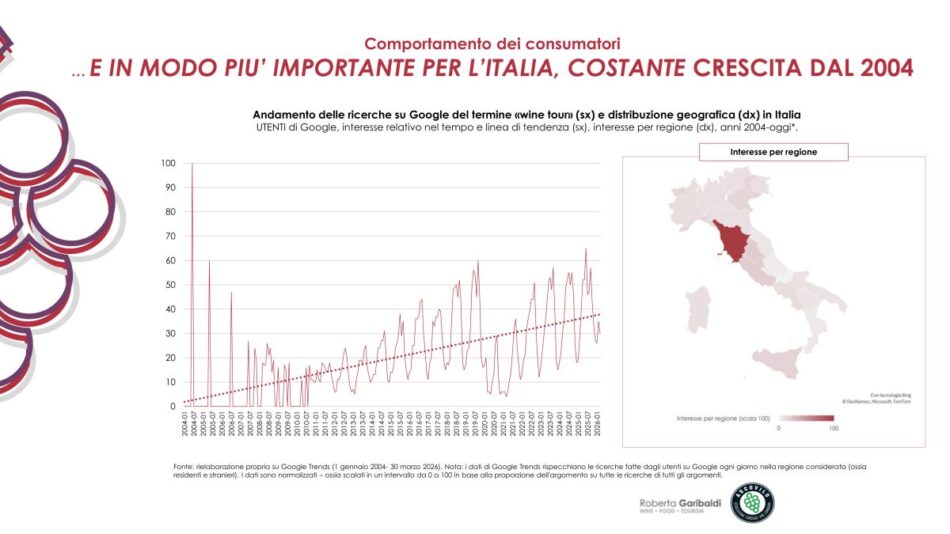
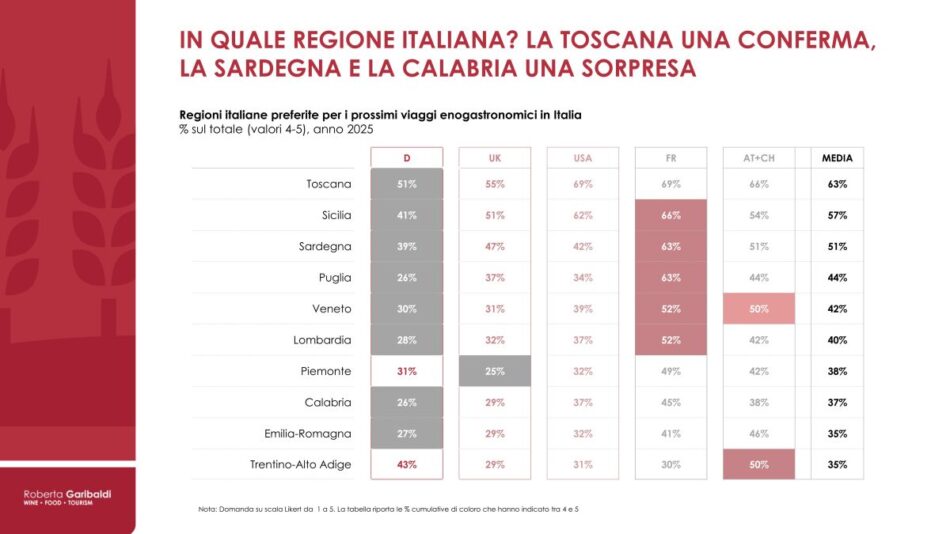
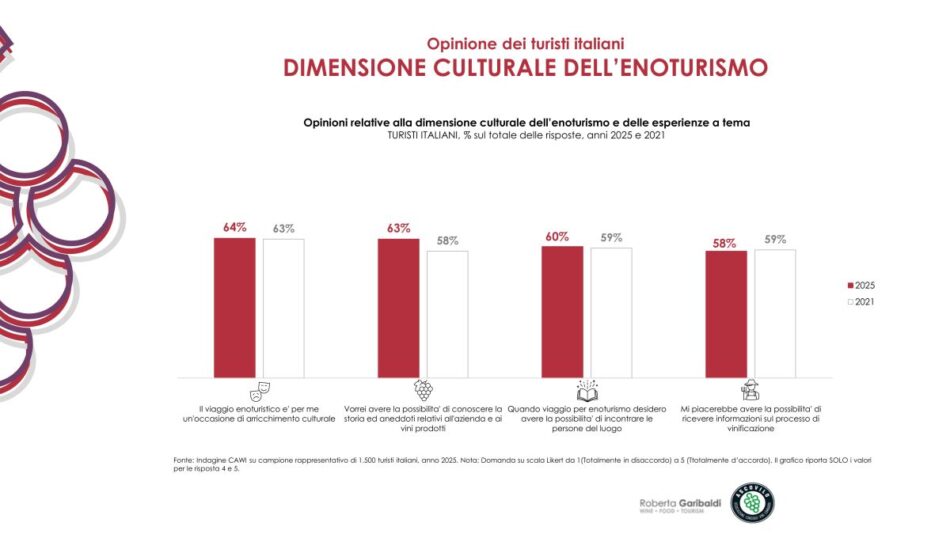
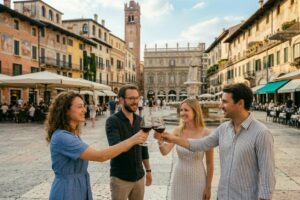
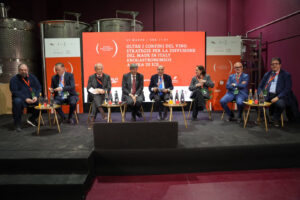
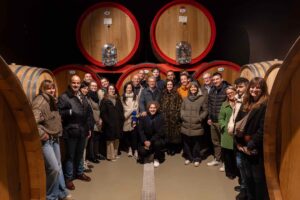
In 2026, 18 million Italians are estimated to be involved in wine-related experiences, an increase of even 4.5 million compared to 2024. There is also growing interest in meeting producers directly at their wineries, as participation by Italian tourists in visits has risen over the past three years from 60% in 2021 to 77% in 2025, once again placing experiences at production sites at the center, sites which are not only wineries, but also dairies, olive mills, or pasta factories. This is according to data presented today in Milan at the Lombardy Regional Government by Roberta Garibaldi, president of Aite - the Italian Association of Wine and food Tourism, in collaboration with Ascovilo - the Association of Wine Consortia of Lombardy, headed by producer Giovanna Prandini (Perla del Garda). Ascovilo brings together, among others, the Garda DOC, Lugana DOC, Valtellina Wines, Valtenèsi, and Valcalepio Consortia, and more (and which has recently launched the new wine tourism portal “Italian Cellar Door”). The data were presented just days ahead of Vinitaly 2026 in Verona, where the sector will take center stage at Vinitaly Tourism. These figures show how Italian wine tourism is entering a new evolutionary phase, marked by strong growth in demand and a deep transformation in traveler behavior.
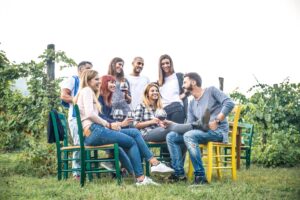
The analysis of the behavior of Italian tourists highlights a particularly significant element: for the first time, the most widespread wine tourism experience is a visit to a family-run winery, followed by the opportunity to purchase wine at convenient prices. This shift points to a major transformation in demand, increasingly focused on relationships and personal encounters, even within a highly digitalized context. Alongside winery visits, there is also growing interest in more complete and articulated experiences. Winery tastings are increasing (+15%), with demand increasingly oriented toward wine and food pairings rather than simple tastings. At the same time, consumption patterns are changing: the number of wineries visited during wine tourism trips is declining (3 or more in 2026, -12% compared to 2024), and the winery is increasingly becoming a stop along the journey, regardless of the main destination or travel motivation, rather than the exclusive focus of a dedicated vacation.
The human dimension is also a decisive factor in building loyalty: among the main reasons for returning to a winery already visited, Italian tourists identify hospitality and staff professionalism as central elements, mentioned by 68% of visitors. Alongside these, two additional strategic drivers for repeat visits are the ease of booking and organizing the experience, relevant for 66% of tourists, and the possibility of enjoying wine tourism offerings that differ from the previous visit, cited by 64% of tourists. This highlights how process simplification and the ability to renew offerings are now the main levers of competitiveness for businesses.
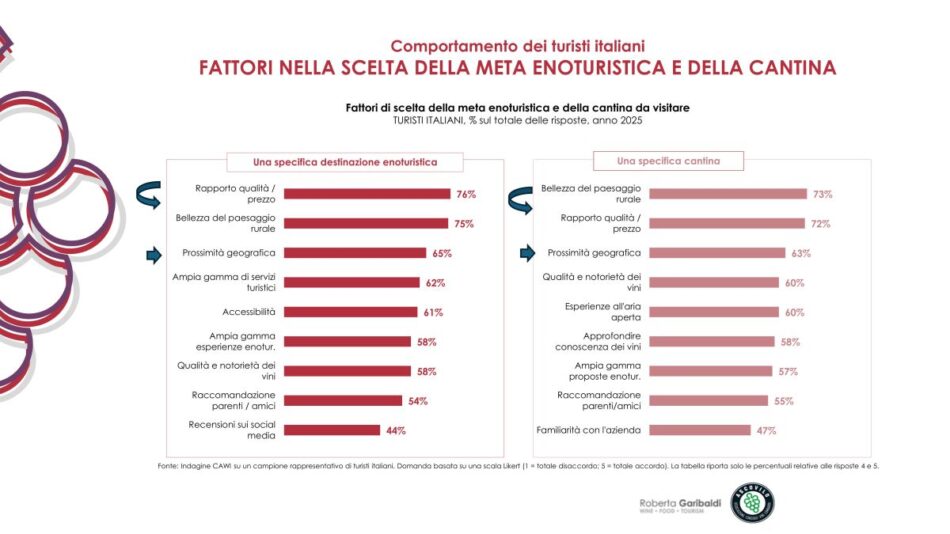
At the same time, consistent selection criteria are emerging for both wine tourism destinations and the wineries themselves: the beauty of the rural landscape, value for money, and geographic proximity guide the decisions of tourists in both cases. This last factor, mentioned by 65% of tourists in choosing a destination and by 63% when choosing a winery, opens up significant opportunities for the development of proximity-based wine tourism, capable of attracting not only overnight visitors but also local audiences.
In parallel, a structural transformation of the customer journey is taking shape, driven by technological innovation. Artificial Intelligence is one of the tools set to redefine how tourists discover, choose, and experience wine tourism. Interest in Ai is focused in particular on key functions such as personalized experiences based on tourist preferences, support for more sustainable choices, and operational tools like content and menu translation. Recently published data from Phocuswright shows that this change is already underway: 56% of American tourists say they have found travel inspiration through Artificial Intelligence tools, despite still-limited availability of skills in the sector, with only 2.8% of tourism operators possessing specific expertise in this area.
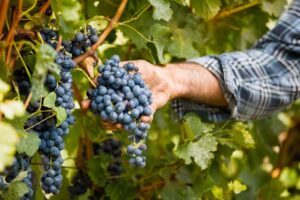
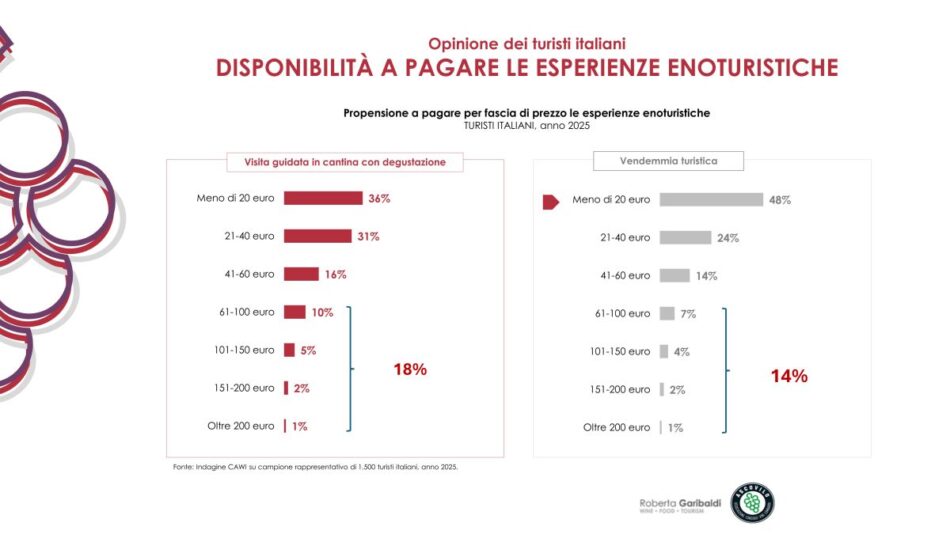
In terms of spending, demand is segmented by price range: 36% of tourists prefer experiences under 20 euros, 31% between 21 and 40 euros, 16% between 41 and 60 euros, while the premium segment above 60 euros stands at around 18%. Perceptions differ for more complex experiences: tourist grape harvesting is still undervalued economically, with only 14% of tourists willing to spend between 40 and 60 euros, indicating still untapped potential. In this scenario, wine tourism confirms itself as a strategic lever for the development of Italian tourism, with ample room for growth linked to the enhancement of experiences, territorial proximity, and the integration of technological innovation with the human dimension. The challenge for the coming years will be to support this evolution with supply and governance models capable of meeting an increasingly sophisticated, aware, and quality-oriented demand.
“Wine tourism today is at the center of a dual transformation: on the one hand, demand for authenticity, relationship, and human contact is growing; on the other hand, Artificial Intelligence is deeply reshaping the customer journey. Businesses must organize themselves to respond to both dynamics, investing in skills, hospitality quality, and the ability to interpret the new needs of visitors”, concludes Roberta Garibaldi. According to her, “wineries must avoid strategies based solely on increasing experience prices when these are applied without offering more than adequate qualitative compensation. Such an approach would betray the trust of wine tourists, who already consider high prices the main limitation to visiting wine and food production sites (63%). Hospitality at the winery must certainly represent a sustainable business for the wine sector and, at the same time, serve as the company most effective advertising page toward its audience, which, if satisfied, becomes its best brand ambassador”.
Copyright © 2000/2026
Contatti: info@winenews.it
Seguici anche su Twitter: @WineNewsIt
Seguici anche su Facebook: @winenewsit
Questo articolo è tratto dall'archivio di WineNews - Tutti i diritti riservati - Copyright © 2000/2026