






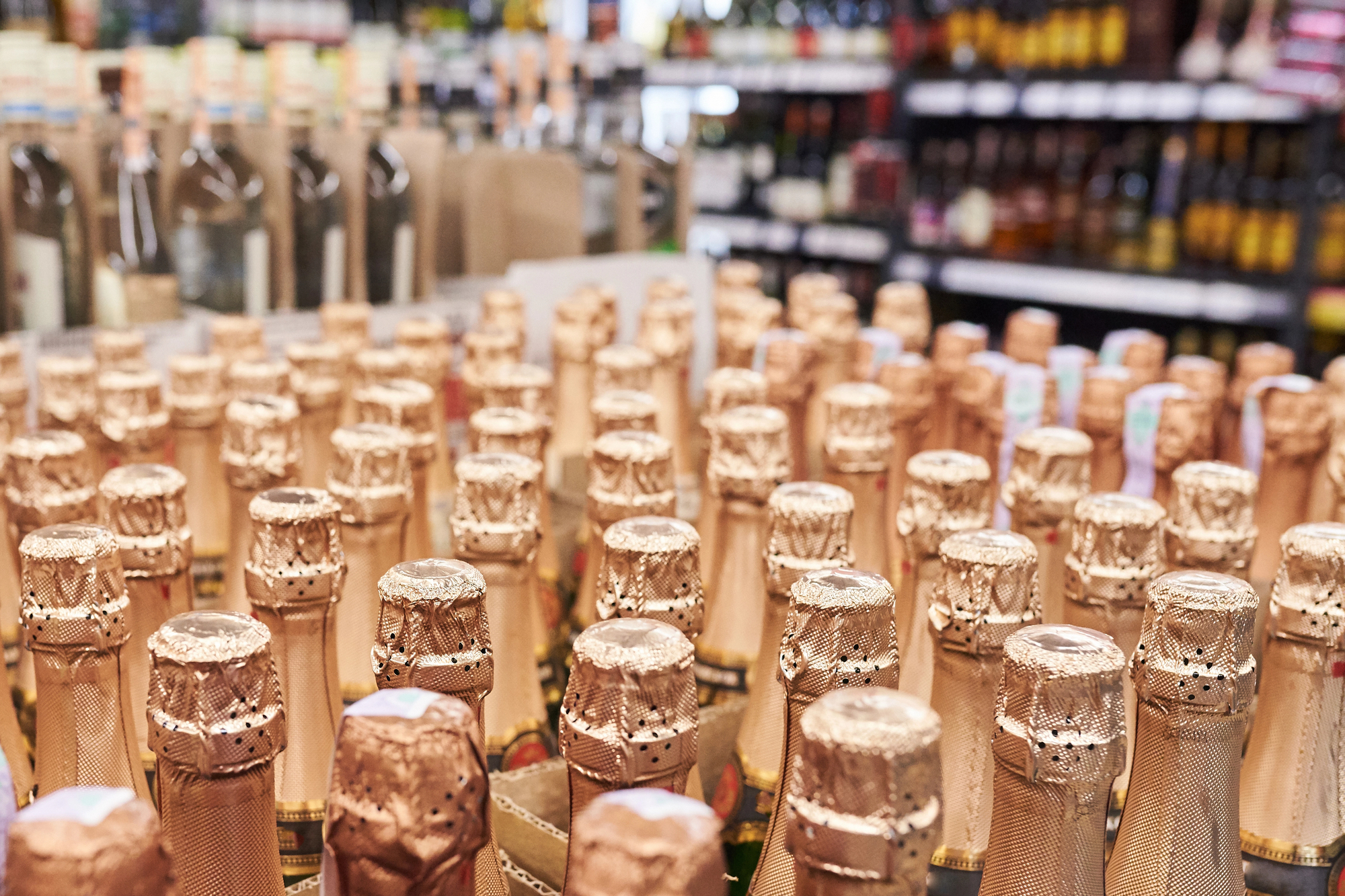
Just as Italian wine exports in 2025 fell slightly compared to the record year of 2024, without collapsing (7.7 billion euros in value, -3.7% year-on-year, and 2.1 billion liters in volume, -1.8%), there was also a decline, noticeable but not dramatic, in domestic consumption through gdo. Wine sales in 2025 decreased by -3.4% in volume compared to 2024, dropping to 737 million liters of wine and sparkling wine, with a decline in value as well, unlike in recent years, by 1.1%, for a total of 2.3 billion euros, of which 1.9 billion came from PDO and PGI wines. The average price for bottled wines (worth 1.7 billion, almost the entire category) reached 5.69 euros per liter, up 2.1% from 2024 (when it had grown by 2% over 2023). Once again, sparkling wines bucked the trend, reaching 750 million euros (+1.2%) and 109 million liters (+1.5%) with an average price higher than the category average at 6.88 euros per liter (-0.3%). Prosecco, across DOC and DOCG categories, dominated with 392 million euros in sales (+0.9% over 2024) and 53.7 million liters (+2.6%), and one of the highest average prices at 5.4 euros per liter, despite a slight -1.5% decline from the previous year. This category remains the top choice in many regions, not only Veneto and Friuli-Venezia Giulia, where it is produced, but also Valle d’Aosta, Piedmont, Lombardy, South Tyrol, Tuscany, Lazio, Puglia, and Campania. These insights come from preliminary findings of the Circana by Vinitaly Research Institute study (featured in the traditional roundtable “Il vino nella Grande Distribuzione: dinamiche di mercato e criticità emergenti” - “Wine in Gdo: market dynamics and emerging challenges” organized by Veronafiere on April 13th at Vinitaly), with executives from Crai, Conad, Coop Italia, Md Discount, NewPrinces Group, Federvini, and the Italian Wine Union (Uiv).
“If in 2024 sales of wine in gdo had improved, though still in negative territory, this year the market has moved backward, with a decline across all fronts - declared Virgilio Romano, Business Insight Director at Circana - and it must be noted that this trend is affecting all countries where alcohol is consumed, as they face the consequences of growing attention to alcoholic beverage consumption. Italy feels this particularly in wine, as it has traditionally been both a major producer and consumer of wine. One question we must ask is whether action is needed on the production side, given that consumption is declining slightly faster than annual output”.
“To increase awareness, and consequently sales of wine, there is only one path: promoting culture, storytelling, and responsible consumption across all commercial channels - underlined Gianni Bruno, dg of Veronafiere - this is why we dedicate a privileged space every year to analyzing the wine market in Italian gdo, which remains a central topic at Vinitaly 2026, with the valuable support of the Circana Research Institute, our long-standing partner”.
Data shows that among still wines, red wine remains the largest category, although declining both in value (1.07 billion euros, -1.7%) and volume (261 million liters, -4.2%), while white wine reached 897.9 million euros (+0.5%) and 243.6 million liters (-2.1%). Among the various types and denominations, as mentioned, Prosecco is the absolute leader. In terms of volume, the other top-selling wines are Lambrusco with over 28 million liters but -7.2% (82 million euros, -6.9%), and Trebbiano from various regions with over 23 million liters, essentially stable year-on-year (+0.3%, generating 42.4 million euros, +1.4%).
Rounding out the top five by volume, Montepulciano d’Abruzzo (21.8 million liters, -7%, 68.8 million euros, -4.9%) and Sangiovese follow in its varietal form from various regions (18.1 million liters, stable compared to 2025, at 44.5 million euros, -0.3%). Just outside the top five in volume, but second overall in value, there is Chianti with 15.9 million liters (-2.6%) for 93.7 million euros (-2.6%). Vermentino (from Sardinia, Tuscany, Liguria) continues to grow, though far less than in 2024 (+2.5% against +11.7%), with over 12.3 million liters sold for 90 million euros (+4.4%, third in absolute value), along with varietal Chardonnay (12.6 million liters, -0.6%, 56 million euros, -2.6%).
Among the warnings, there is the growth of Metodo Classico sparkling wines (especially Trentodoc and Franciacorta), with just over 8 million liters sold, up 6.3%, for a total of 48.2 million euros (+4.9%). The study further highlights that among the best-performing wines in 2025, those with the highest volume growth, Sicilian Grecanico increased by +13.7%, Nebbiolo (from Piedmont and Lombardy) by +9.7%, and the international Pinot Noir by +7.8%, followed by Metodo Classico sparkling wine at +6.7%. The wines with the highest value growth were the so-called “emerging wines”, led by the same varieties that grew most in volume: Grecanico (+9.4%), Nebbiolo (+9.1%), and Pinot Noir, followed by Lagrein from Trentino (+6%).
Copyright © 2000/2026
Contatti: info@winenews.it
Seguici anche su Twitter: @WineNewsIt
Seguici anche su Facebook: @winenewsit
Questo articolo è tratto dall'archivio di WineNews - Tutti i diritti riservati - Copyright © 2000/2026