


Sunday 20th of September 2026 - Last Update: 21:50






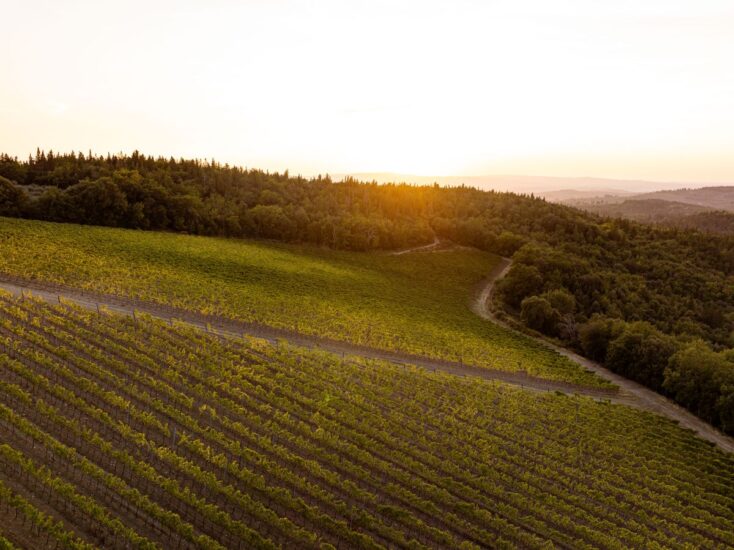
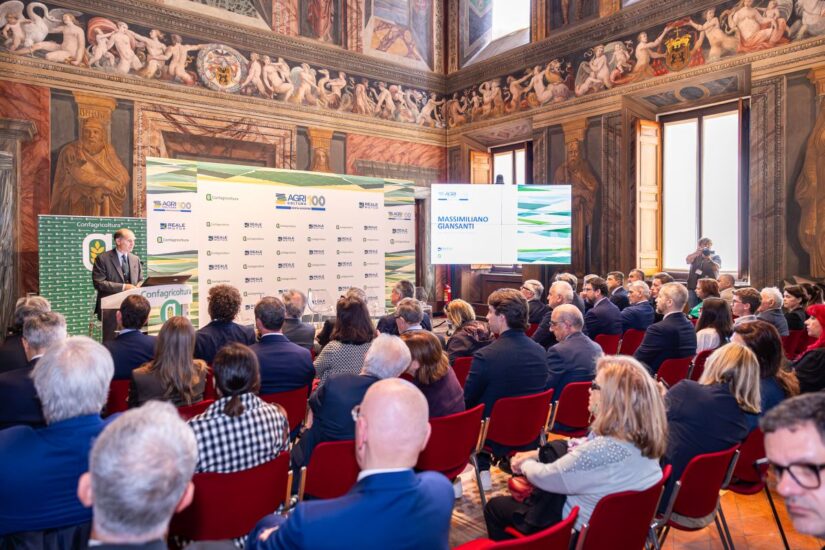
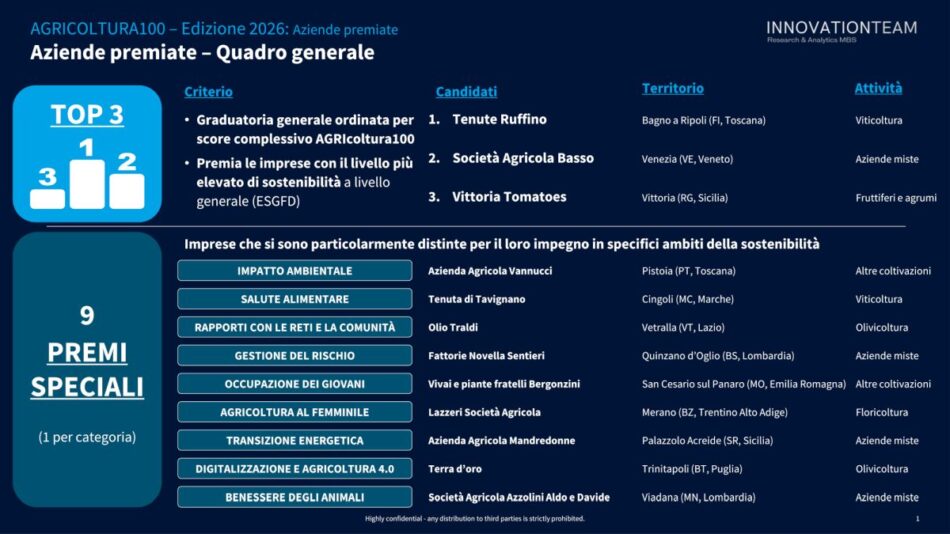
Environmental, social and economic sustainability for agricultural companies comes at a price. However, this is not a cost, but an investment, considering that in Italy an increasing number of businesses have decisively chosen this path. Those who achieve excellence in this field, whose figures are also growing, are twice as likely to increase their turnover compared to those who remain at basic levels (which, moreover, are becoming fewer), especially in an increasingly more complex context for Italian agriculture. This context is characterized by global and national challenges which make it essential to strengthen the competitive capacity of companies. This is highlighted by the edition No. 6 of “Agricoltura100” Reale Mutua multi-year initiative in collaboration with Confagricoltura, presented in the 2026 Report produced by Mbs Consulting (Cerved Group). Once again, the wine sector stands out as a pioneer: at the No. 1 position of the 2026 “rating”, there is Ruffino, the historic Tuscan company rooted in Chianti Classico, but now also present with estates and vineyards in other prestigious areas of the region, from Bolgheri to Montalcino, as well as in the Prosecco area (and owned by Constellation Brands). It is followed by Società Agricola Basso of Venice and the Sicilian tomato producer Vittoria Tomatoes, based in the province of Ragusa. In the wine category, Tenuta di Tavignano in Macerata was also recognized for its “commitment to food health” (see focus).
The survey, carried out on more than 3,800 companies in the sector, a number steadily increasing since 2020, shows that the share of businesses reaching a high level of sustainability continues to grow, rising to 57.9% from 49.3% in 2020, the first year of the study. Over the same period, the share of companies stuck at an initial level has halved, dropping from 21.6% to 11.9%. In the past year, 30.6% of companies with a high level of sustainability recorded revenue growth, compared with 14.6% among those at a basic level.
The survey, presented today at Palazzo Della Valle in Rome at Confagricoltura headquarters, also assessed the consequences of tensions in international trade and tariffs which have limited a strategic market such as the United States. 42% of farmers report concern about the impact of trade conflicts. Respondents highlighted, in particular, rising raw material costs, market difficulties, and a reduction in export volumes. In response, more than 70% of companies operating in foreign markets have implemented new policies: 45% sought new destination markets, 20% revised contracts and international trade conditions, and another 20% redirected their focus toward the domestic market. Trade tensions have also led to increased costs and difficulties in procurement, with 20% of agricultural businesses seeking alternative suppliers. More recently, the conflict in the Middle East has triggered a cycle of energy crisis and inflation to which Italian agriculture is particularly exposed. Already last year, 42% of agricultural businesses experienced rising costs, while only one in four (26.4%) reported having the ability to adjust their selling prices. The pressure of costs is squeezing profitability: 47.5% of the companies surveyed report profits below 5% of turnover.
Nevertheless, it is clear that sustainability is a cross-cutting trend, with fairly uniform levels across the country and no major differences between North and South. Larger, more structured companies achieve higher levels, but the share of small businesses with a high sustainability index is also significant. The area which has grown the most is environmental sustainability, where high level companies increased from 49% in 2020 to 63.8% in 2025. There has also been a notable improvement in the quality of development (including competitiveness, innovation, and employment quality) from 49% to 58.9%. Additionally, 47.9% of companies have reached a high level of sustainability in the social sphere and 43.9% in risk management and relationships.
Trade tensions, increased competition in the domestic market, and the risk of a new inflationary cycle are making it increasingly urgent to transform Italian agriculture by scaling up business activities and strengthening supply chain integration. The report identifies five sustainability factors that could guide this transformation in the near future. Quality, meant as a combination of origin, traceability, safety, sustainability, and the symbolic value of the product, is probably the key distinguishing factor of Italian agriculture and thus a strategic driver of competitiveness. Some 65.5% of companies have reached a high level of sustainability in this area, and 34.6% of these are at the highest level. Italian agriculture also confirms its strong orientation toward innovation, with 70.3% of companies having made investments over the past 2 years. Innovation is the factor that most generates positive impacts on the environment, production quality, and overall company economics, and its correlation with sustainability is very strong: 82.2% of companies with a high level of sustainability also show a high level of innovation. Another key issue is industrial integration. Excessive fragmentation, the report notes, is a structural weakness of Italian agriculture. About half of agricultural businesses (50.2%) have developed activities connected to primary production, such as product processing, energy production, hospitality and tourism services, and social and educational services. These activities significantly contribute to business growth and stability; for more than half of the companies that carry them out, they account for over 30% of revenues. Another fundamental aspect is mitigating hydrogeological vulnerability. Climate change also affects agriculture, which nonetheless plays a leading role in land protection through measures such as water channeling and rationalization, careful soil management, natural barriers against erosion, and the covering of uncultivated land. However, awareness of risk exposure differs greatly between those who have suffered damage and those who have not, highlighting the need for widespread information and engagement efforts to increase awareness of threats and to develop skills for more effective risk management. Investing in human capital is equally essential. Providing stable employment, attracting and empowering women and young people, and managing generational turnover are key factors for developing agricultural human capital. These represent another critical lever in a context of ongoing evolution and challenges.
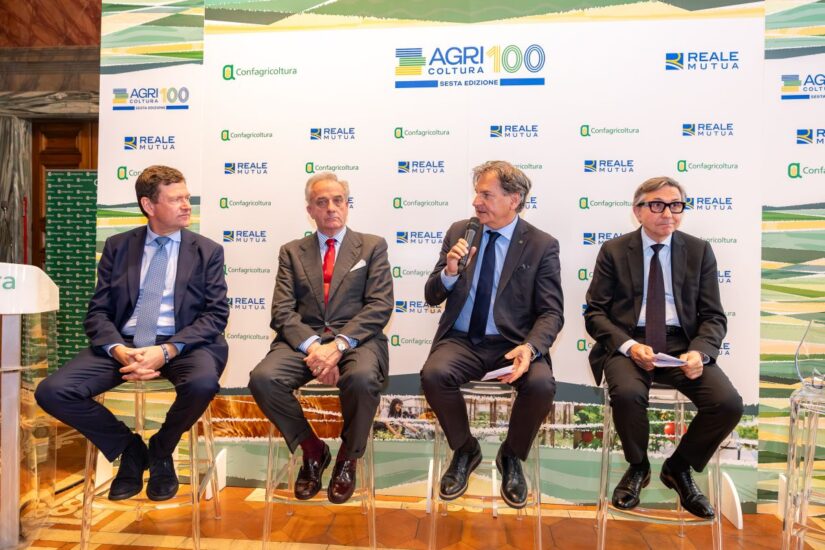
“The new edition of the “Agricoltura100” Report, realized with our long-standing partner Confagricoltura, confirms the central role of sustainability and innovation as transformative factors capable of supporting the growth of companies in the sector, enabling them to navigate even a complex scenario like the current one on a solid footing declares Luca Filippone, dg of Reale Group - in this journey, insurance coverage can also play a central role, helping to protect activities, strengthen risk prevention capacity, and enhance resilience in facing future challenges”.
“Today, we must ask ourselves how to approach the new path of sustainability - commented Confagricoltura president Massimiliano Giansanti - which remains an absolutely strategic issue, provided it is clearly defined and developed with realistic yet ambitious objectives. When properly implemented, it becomes a tangible added value. To continue investing in this direction, effective and streamlined supporting policies aligned with the international context are needed, but also a cultural approach, one that younger generations already possess. In this sense, generational turnover becomes a decisive factor in achieving even greater sustainability goals, with positive effects on local economies and communities”.
Copyright © 2000/2026
Contatti: info@winenews.it
Seguici anche su Twitter: @WineNewsIt
Seguici anche su Facebook: @winenewsit
Questo articolo è tratto dall'archivio di WineNews - Tutti i diritti riservati - Copyright © 2000/2026